
One name on a paper map was enough to make me abandon the Greek temples. For everything that followed, I had only myself to blame.
The morning in Marsala began wonderfully. For breakfast I had freshly squeezed orange juice from a nearby farm and a generous assortment of homemade Sicilian pastries — a gastronomic paradise, to put it mildly. My plan for the day was relatively simple, if ambitious. Before leaving, I intended to walk through the old town once more and then devote myself to one of the reasons I had come to the island in the first place: the Greek temples. First on the itinerary was Selinunte, one of the largest archaeological sites of Greek Sicily, followed by Heraclea Minoa. I was supposed to finish the day in Agrigento, arriving early enough to see at least part of the Valley of the Temples in daylight.
Then, for reasons I still cannot explain, I unfolded the paper map the rental-car company had given me. The car had navigation, I had already chosen my destinations, and I had absolutely no need for the map. But once someone gives you one, it somehow seems a shame to leave it folded in the glove compartment. I began examining the roads crossing the Sicilian interior and soon noticed one name printed in considerably larger letters than those of the surrounding towns — Corleone.
When The Godfather Ruins a Perfectly Good Plan
Of course I knew about Corleone. It is difficult to watch The Godfather without remembering the name of the family whose cinematic history has shaped an entire corner of popular culture. I also knew that Coppola had not filmed the Sicilian scenes in the actual town. He chose Savoca and Forza d’Agrò as locations because, by the early 1970s, the real Corleone had already become too modern for the Sicily he wanted to portray. So I could not expect to see Don Vito Corleone’s house or any recognisable film scene there. Yet the name was enough. It suddenly seemed a shame to be so close and not visit the place my generation associates with the very heart of the Mafia. Only later would I discover just how relative a concept ‘close’ was. At that moment I was simply looking at a map, where every road appeared perfectly respectable.
Selinunte, then, was out. Perhaps nothing illustrates the diversity of my interests better. An ancient city with two and a half thousand years of history, enormous temples and every cultural argument in its favour had lost to an artefact of modern popular culture. I cannot claim this was the most sensible decision I made in Sicily. But at that moment I was more interested in seeing what the real Corleone looked like than in counting the columns still standing at Selinunte.
When Navigation Decides to Take a Shortcut Through a Cornfield
I left Marsala on the SS188 through the Belice Valley. The road crossed a broad agricultural landscape, far from the tourist centres I had visited over the previous days. The first kilometres were pleasant enough, and I was already beginning to believe I had made a good choice. If nothing else, I would see a part of Sicily that does not appear on every postcard.
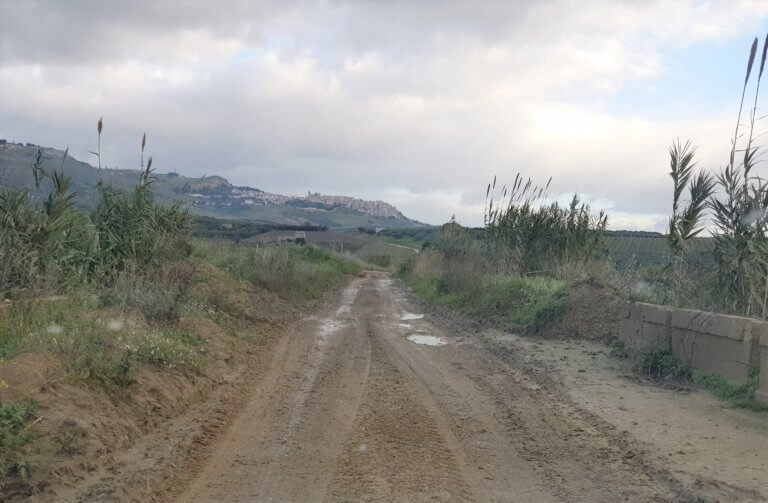
Then the navigation told me to leave the main road. At first that did not strike me as unusual. It was hardly the first time a navigation system had discovered a shortcut no normal person would ever find. The road grew progressively narrower until I eventually found myself in the middle of a cornfield. The stalks stood so close to the car that practically all I could see was a narrow passage ahead. The surrounding landscape disappeared. Instead of Sicilian hills, I had corn on the left, corn on the right and rapidly diminishing confidence in technology.
I tried to work out whether I was still driving along anything that could reasonably be called a road. There was nobody around, no signs, and the navigation showed no interest in returning me to the main route. Fortunately, the surface was, shall we say, passable. Eventually I did reach Salemi, proving that the navigation knew what it was doing after all. In the language of my profession, someone had mastered Dijkstra’s algorithm but had not done particularly well at assigning the weights. At that point I still found the experience entertaining. I took a few photographs, continued driving and thought my unplanned excursion had already given me one amusing anecdote. I had no idea what was coming.
Salemi and One Excellent Decision by the Rental-Car Company
Salemi is a classic old town gathered around a medieval castle. I had never planned to explore it and must admit that, before that day, I had never even heard of it. Only afterwards did I discover its intriguing role in Italian unification. After landing at Marsala in May 1860, Garibaldi made his way here and assumed authority over Sicily in the name of Victor Emmanuel II. Salemi therefore likes to describe itself as the first, if very brief and largely symbolic, capital of an Italy that was still coming into being.
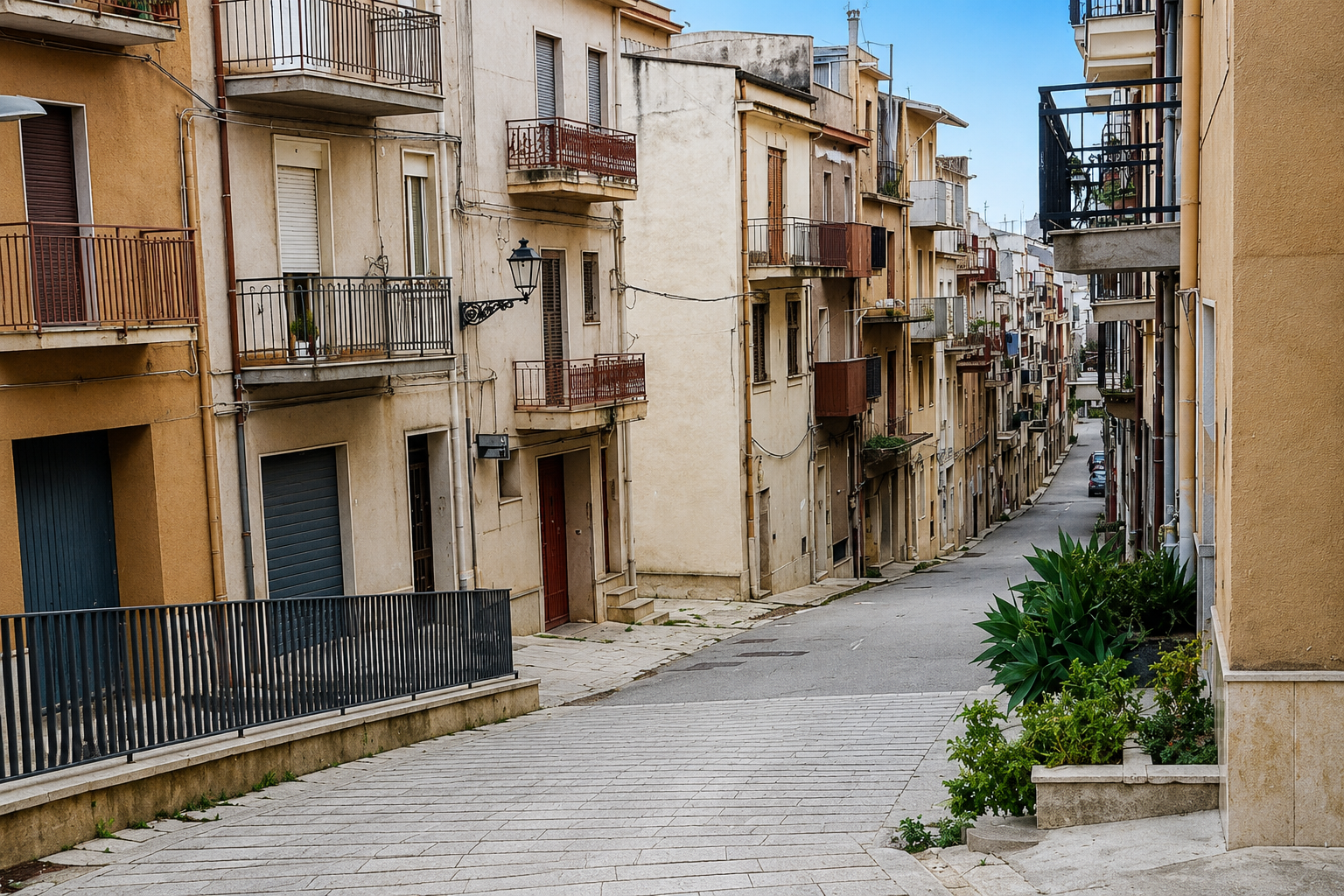
In my hands, a visit to this former capital took a considerably more modest form. I drove through it. The historic centre looked interesting, but the streets were steep, unbelievably narrow and full of bends, so most of my concentration went into controlling the car. Until then, the Fiat 500 I was driving had simply been a small car for a solo traveller. In Salemi, it suddenly became an almost perfect choice. With anything larger, I would probably still be trying to work out how to get between two stone walls — or paying off the insurance excess.
I nevertheless managed to catch glimpses of several churches, old façades and the surrounding valley. I liked Salemi, even more than I had expected. It was one of those towns where I would happily have stayed for a few hours, sat down for a coffee and wandered without the pressure of a timetable. It felt somehow typically Sicilian, although I am not entirely sure how I would explain that adjective.
A Bullet-Riddled Sign and Dwindling Optimism
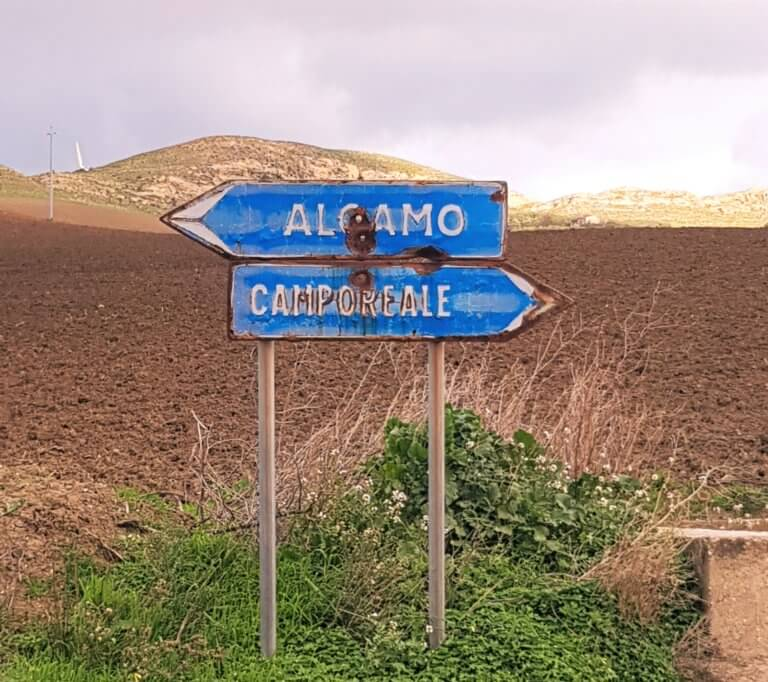
After Salemi, things took a rather different turn. At a rural junction I spotted a road sign that looked as though somebody had used it for target practice. It is entirely possible that this was ordinary vandalism or somebody’s peculiar idea of entertainment, with no connection to the Mafia whatsoever, but I was scared shitless. I suddenly remembered Hugo, a television-based computer game from my childhood, and his rhetorical cry: ‘Dear God, where have I ended up?’ A sign full of holes is, of course, no evidence of organised crime. But given where I was going, the explanations springing to mind were not especially reassuring.
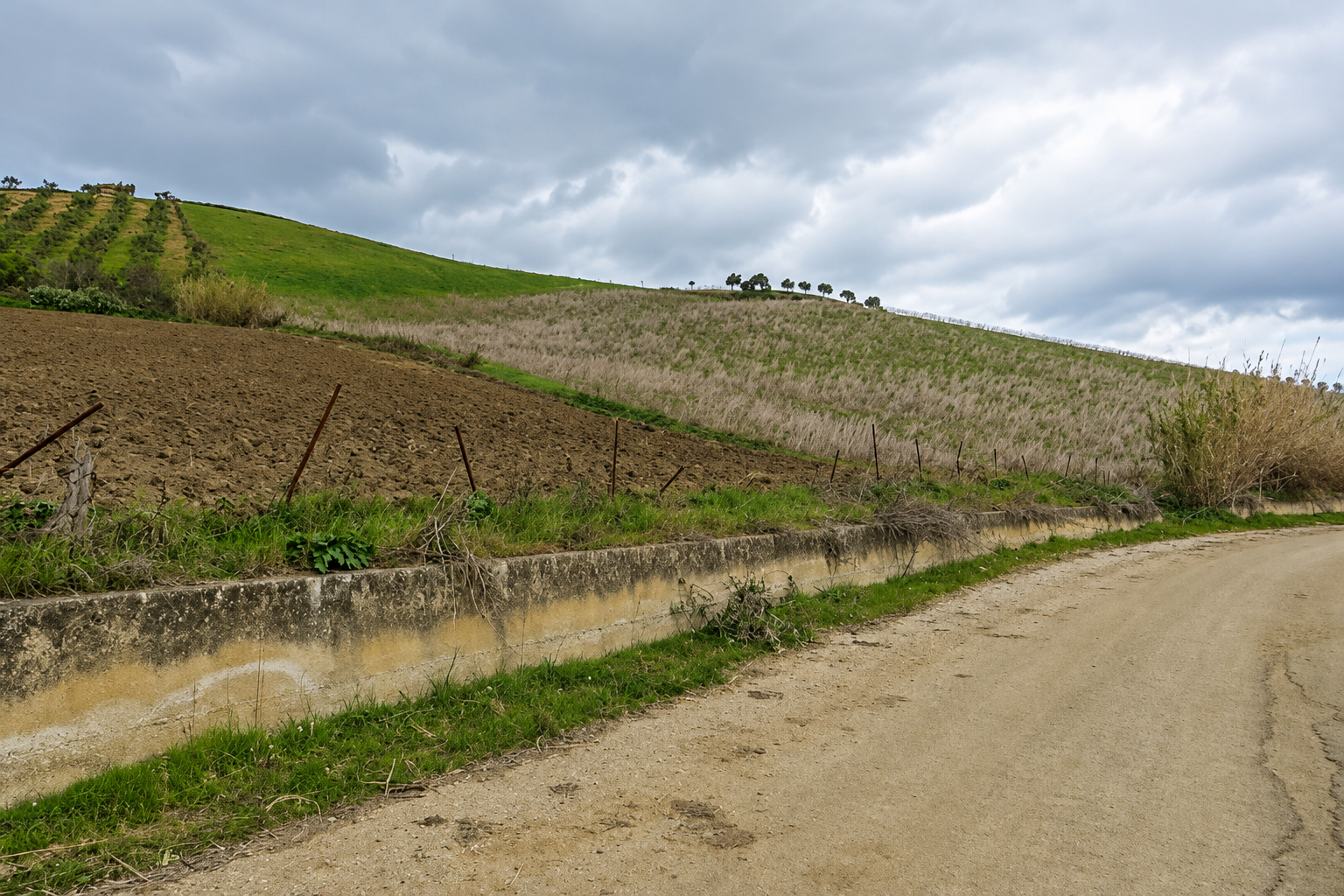
A few kilometres later, the problems were no longer confined to my imagination. They had become decidedly real. The road grew progressively worse, and in places there was barely any proper asphalt left. Deep cracks, enormous potholes and narrow strips of more or less level surface between them were all I had to work with. I drove ever more slowly, stopping in front of some holes to decide which side offered the better chance of getting past. I sincerely hoped that somebody in Turin had designed this Fiat 500 specifically for this kind of Sicilian motoring.
What particularly worried me was getting stuck or scraping the underside of the car against the road. It was a rental, the road was deserted, and my mobile-phone signal appeared only intermittently. I began listening to every sound beneath the wheels, an excellent way to ruin your own mood: after a few minutes, every stone sounds like a major mechanical failure. The full insurance cover, which had seemed outrageously expensive at the counter, suddenly became one of my best investments of the trip. I could already picture myself explaining to the rental company why their Fiat had ended up in a hole somewhere between Salemi and Corleone. I doubt they would have been impressed to hear that I had abandoned the Greek temples because of a name from The Godfather. Then again, perhaps they hear that more often than I imagine. After all, it is their own fault for printing Corleone so prominently on the map.
Several times I seriously considered turning back. The problem was that I would have to drive along exactly the same road again, and it looked no better in the opposite direction. So I decided to carry on, hoping that somewhere ahead there was still a part of Sicily where the asphalt had survived.
Enter the Cows and the Wild Dogs
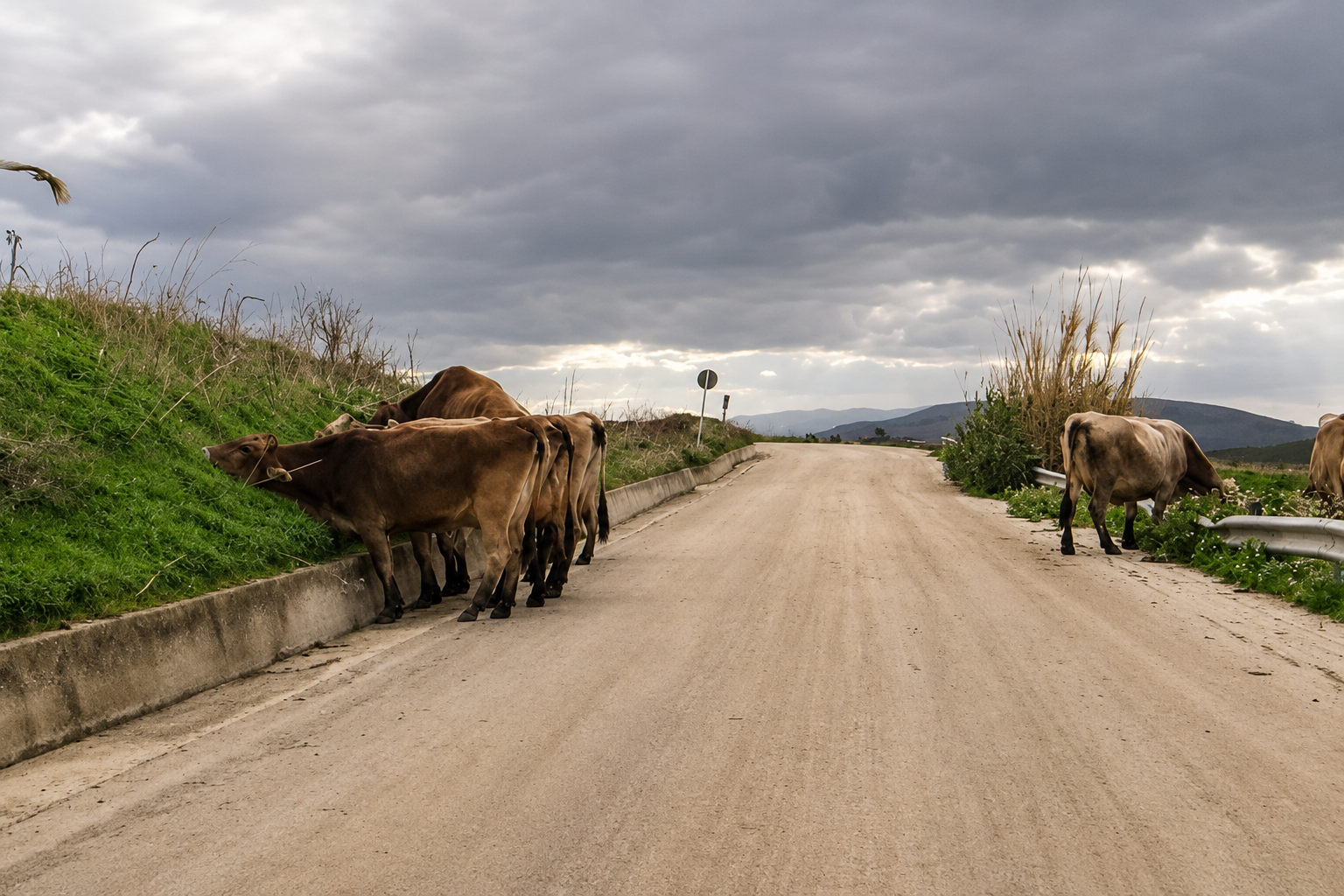
Just when I thought the road could hardly get any worse, animals began to appear. First came the cows, standing quite casually on the road or beside it. Some eventually moved after a little patient waiting; others clearly considered the road their property and expected me to make alternative arrangements. I had no intention of arguing. A cow has a sufficient advantage in kilograms to make yielding the right of way an easy decision. The situation was not entirely unfamiliar. I regularly encounter horses on the road to my holiday house, but those horses seem rather better educated and better behaved than the Sicilian cows.
I felt considerably less affection for the dogs. They were large, roaming freely, and I could not see anyone who could plausibly be described as their owner. A single dog beside a country road would not have bothered me, but several in the middle of an almost deserted Sicilian interior were rather too much. I locked the doors and drove on. Stopping to take photographs never even crossed my mind. There was none of the friendly neighbourhood-dog atmosphere of Žućo back home. This looked more like a well-organised pack from the Risnjak mountains. The dogs were also remarkably well fed, and I am not sure whether that observation reduced or increased my anxiety.
After a while, the desire to go sightseeing had almost entirely disappeared. I was no longer thinking about film locations or what I might see in the town. I simply wanted to arrive, preferably without damaging the car. Corleone had stopped being a tourist destination and become somewhere I had to reach at all costs, if only to prevent the whole drive from being completely pointless — or simply to bring it to an end.
To be clear, I did not expect an armed mafioso to emerge from a nearby field, as in some poor imitation of The Godfather. I was worried about much more mundane things. And what I liked least was knowing that I had nobody to blame but myself. The navigation had not forced me to go to Corleone. I had made that decision after opening that wretched map.
Corleone! At Last.
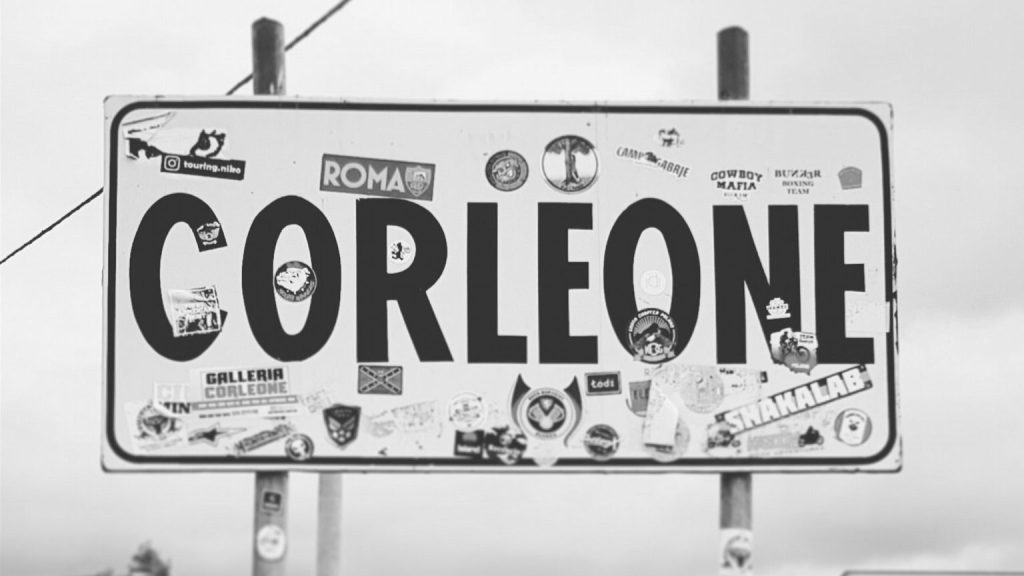
And then, after all those holes, cows, dogs and road signs, the sign reading CORLEONE finally appeared. It was black and white, rather battered and covered in stickers. At any other moment, I probably would hardly have noticed it. Now, however, I looked at it as though one of Sicily’s greatest monuments had materialised in front of me.
I stopped the car and photographed the sign. It was hardly photogenic, the light was nothing spectacular, and I had absolutely no desire to stand next to it and pose. I wanted only a photograph of the name, proof to myself that I had arrived. I must admit that I felt almost childishly pleased at that moment. I had made it! You might have thought I had just completed a serious mountain expedition rather than driven from Marsala to a town in inland Sicily.
I did not care that such excitement might make little sense. I had already taken many more beautiful photographs on this journey, and I would take more afterwards. But rarely have I been so delighted by an ordinary road sign. For a moment, it had become more important than anything I had actually come to see.
A Town Whose Name Is Its Greatest Attraction
And Corleone itself? Frankly, it did not particularly impress me.
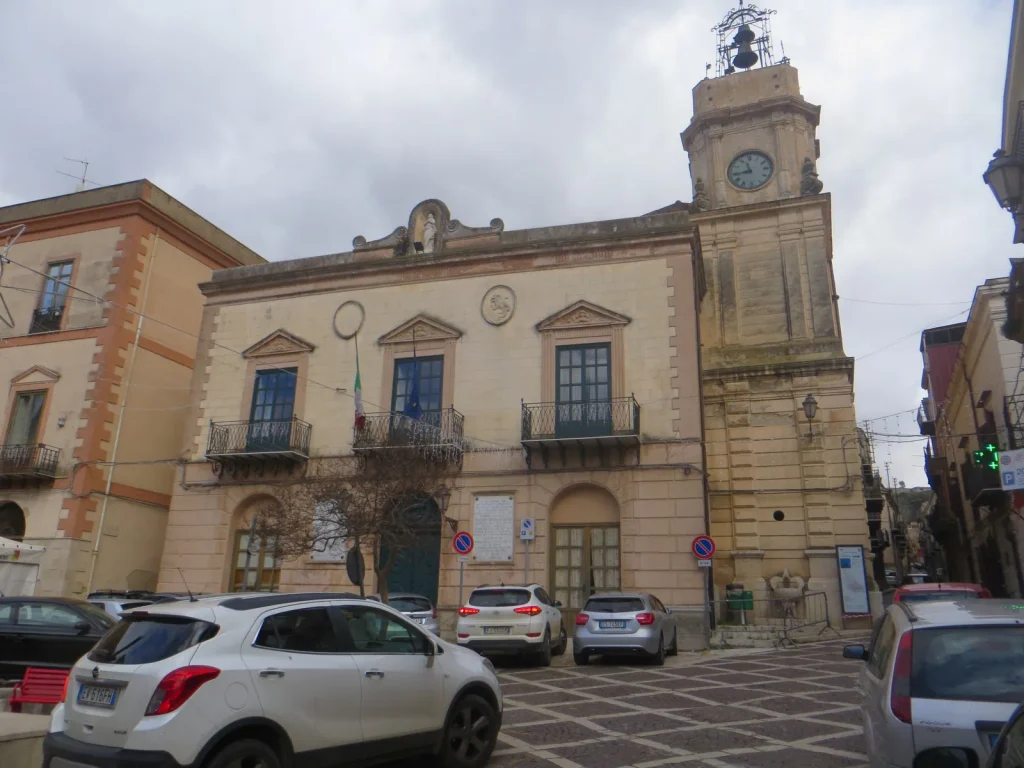
The town is not ugly, of course. It has its history, churches, squares, steep streets and striking limestone rocks rising above it. I went through the centre, saw Piazza Garibaldi and the main church of San Martino, but after all the Sicilian towns I had already visited, I found nothing that especially made me want to stay. In that respect, Sicily is rather unfair to its own towns. Once you have become accustomed to Palermo and the splendour of the Baroque southeast, an ordinary small town has a difficult time making a spectacular impression.
In fact, I found Salemi, which I had merely driven through, more interesting. I had come to Corleone for its name, and the name turned out to be its greatest attraction.
Yet Corleone did not give its name only to a fictional family. Luciano Liggio, Totò Riina and Bernardo Provenzano all came from this town. Through bloody struggles, their Corleonesi clan gained supremacy within Cosa Nostra. Provenzano was not arrested until 2006, after 43 years on the run, in a farmhouse not far from the town. Perhaps that is the greatest irony of the whole story: I had come in search of a fictional Mafia family and had almost missed the opportunity to discover the town’s real history.
The Godfather turned a Mafia family into an almost operatic tale of power, honour and loyalty. The real Sicilian Mafia was something considerably less attractive. Its roots lie partly in a society where the state was weak, property protection uncertain, and disputes were often settled by those with actual power rather than necessarily any legal authority. In such conditions, systems of parallel government developed, complete with their own rules and their own ways of charging for services.
I have always found that mechanism fascinating. When institutions cannot provide security, somebody else appears to offer it. The problem begins when that same somebody can also take your security away. Protection then very quickly becomes extortion. The real history of Cosa Nostra, with its violence, murders and assassinations, cannot be reduced to elegant suits and family dinners. The films are extraordinary, but unlike Coppola’s characters, the victims of the actual Mafia were not part of a film set.
The Museum I Managed to Miss
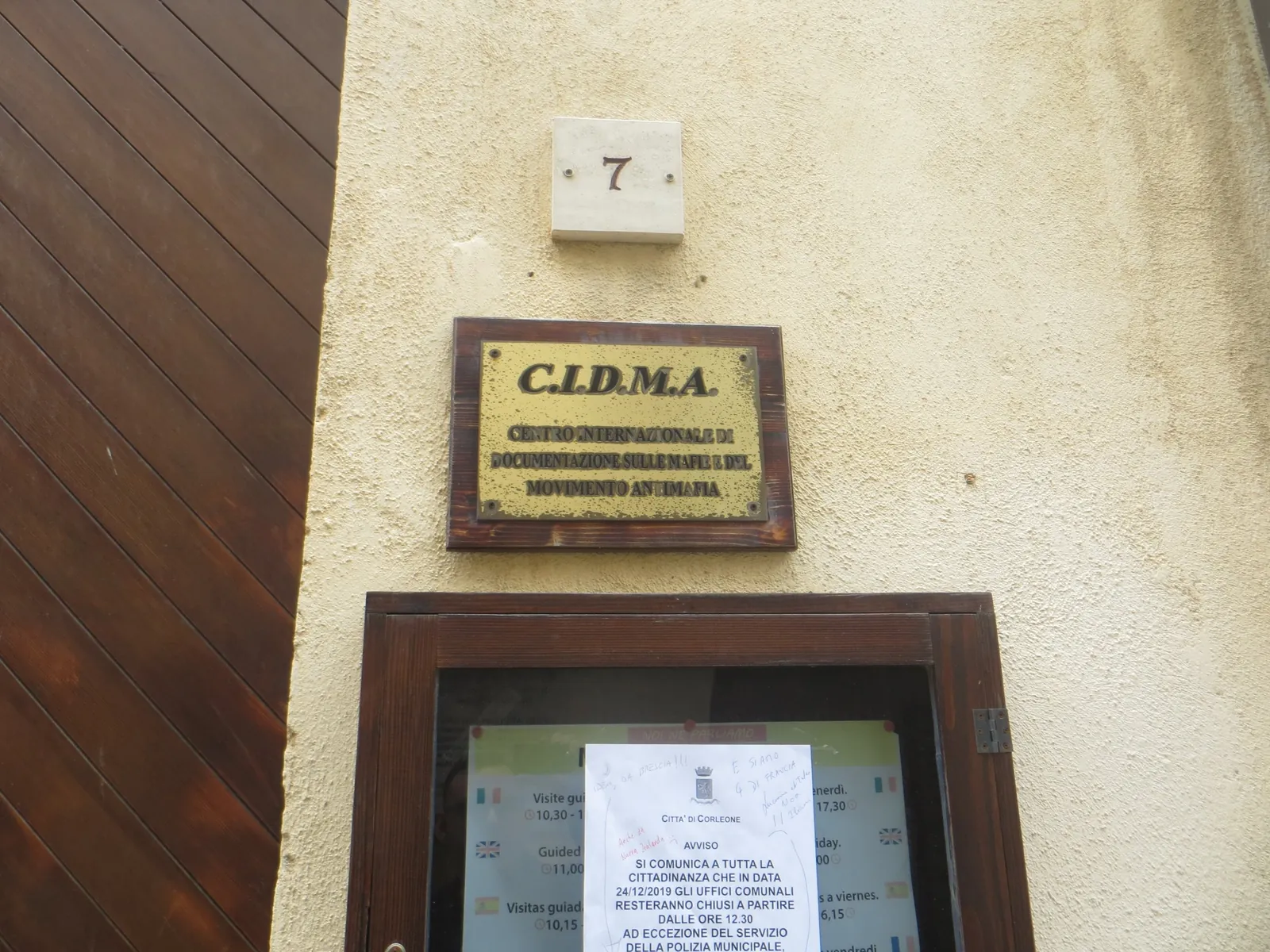
That is why I had wanted to visit CIDMA, the documentation centre devoted to the Mafia and the fight against it. I wanted to see precisely the side of the story that fits so poorly with the image of Don Vito Corleone. But the museum was closed. Guided visits require advance booking anyway, which my improvised plan had never stood a chance of accommodating. I could now claim that I was unlucky, but the truth is much simpler: I had decided to visit only a few hours earlier and had not even checked the opening hours. It would be difficult to blame the museum.
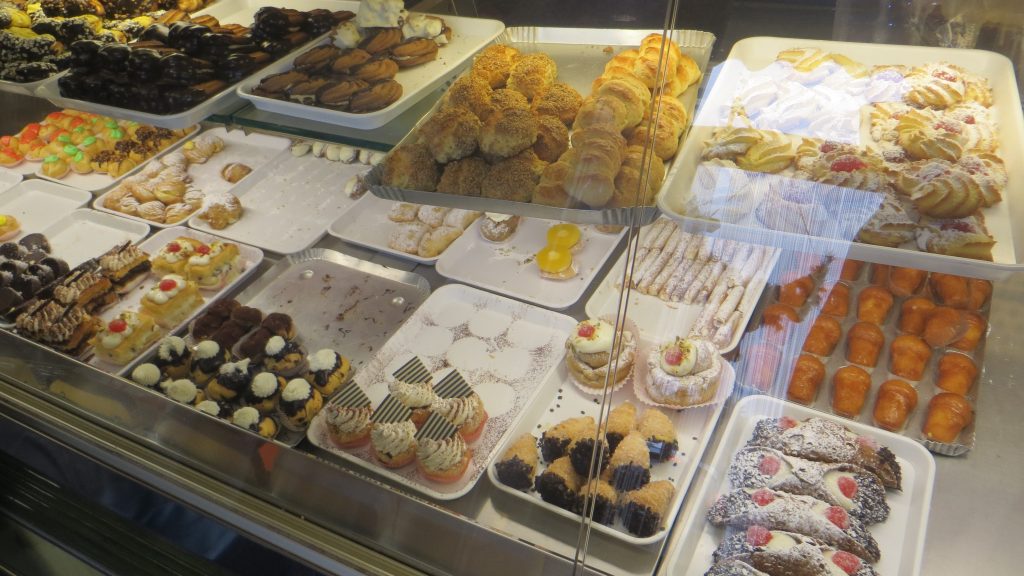
I photographed the entrance and wandered around the area for a while. Some kind of local fair was taking place in town, making traffic awkward, and then a pastry shop called Sweet Temptation caught my eye. It looked extremely promising. Unfortunately, it was so crowded that, after looking at my watch, I decided to give up. So I left Corleone without seeing the museum — and hungry as well.
At least the museum gave me another reason to learn more about the real history of a place whose name I had heard so often in films. It was harder to find consolation for the missed pastries. In Sicily, where there are so many excellent sweets, walking away from a pastry shop always feels like a rather serious failure of organisation.
What I Actually Took Away from Corleone
Today I remember Corleone itself far less vividly than the road leading to it. I can recall the central square, a few streets, the rocks above the town and the closed museum. But I could hardly describe the town with the level of detail with which I remember the drive through the corn, the climb through Salemi or my attempts to manoeuvre the Fiat between the holes in the asphalt. Of all the photographs I took that day, I have a particular affection for the utterly ordinary, battered sign at the entrance to the town.
Had I followed my original plan, I would probably have spent a wonderful day among the temples of Selinunte, continued to Heraclea Minoa and reached Agrigento without too much difficulty. It would have been more culturally rewarding, perhaps more productive photographically, and certainly kinder to both my nerves and the rental car. But it would also have been a day I had already planned almost down to the last detail.
Instead, I discovered an unexpectedly interesting town that I had unfairly rushed through, acquired a completely new opinion of the Fiat 500, confirmed once again that my navigation system and I do not always share the same definition of a good road, and eventually reached Corleone. When I add it all up, I am not sure I would recommend the same excursion to anyone else. But I do not regret making it.
For Those Who Want to Know More: Corleone Beyond the Cinema
Whenever you decide to abandon a carefully prepared itinerary while travelling, you have to accept that you will miss something. In my case, that ‘something’ turned out to be rather extensive. Only afterwards, while looking through photographs and researching the places I had passed, did I realise just how much I had overlooked. And since I am not inclined to give up completely on towns that leave me indifferent at first sight, I decided to offer them a second chance, at least retrospectively, to show themselves in a better light.
Salemi, for example, has a history stretching back long before Italian unification. The ancient Elymian town of Halyciae stood in this area and became known as Alicia after the Roman conquest in 272 BC. The Romans were followed by Vandals, Goths and Byzantines, and in 827 the Arabs conquered the town. One possible explanation of the name Salemi traces it to Arabic words associated with peace or safety. Other interpretations exist, however, so I would not insist too strongly on the etymology. What is much more certain is that Arab rule had a profound influence on agriculture and urban development in this part of Sicily, introducing new crops and irrigation systems. The Normans took control in the late eleventh century, and over the following centuries a castle was built on the hilltop, where it still dominates the historic centre.
Alongside its castle and numerous churches, Salemi has several interesting museums. The Museo del Risorgimento is dedicated to the period of Italian unification, while the Museo della Mafia examines organised crime through artistic interpretation and social criticism. The latter is associated with Leonardo Sciascia, one of the most important Sicilian writers to explore the relationship between the Mafia, politics and society. That fact alone would have given me a good reason to spend more time in Salemi. If I planned the same journey again, I would seriously consider moving my overnight stay from Marsala to Salemi. Perhaps I would then get to know the town that ultimately became one of the day’s pleasantest surprises.
Not far beyond Salemi lies Nuova Gibellina, another place whose significance I managed to miss entirely. It exists because of the devastating earthquake that struck the Belice Valley in 1968 and almost completely destroyed the old town of Gibellina. Instead of rebuilding on the same site, the decision was made to construct a new town several kilometres away. What makes the story remarkable, however, is not simply the relocation of its inhabitants but the attempt to create an identity for the new town through art. Well-known Italian artists and architects were involved, and Nuova Gibellina gradually became something of an open-air museum of contemporary art.
Pietro Consagra’s monumental star at the entrance to the town is particularly famous, but the fate of old Gibellina is perhaps even more fascinating. Alberto Burri transformed its ruins into the Grande Cretto, a vast expanse of white concrete crossed by fissures tracing the former streets. Today you can therefore walk through the streets of a town that no longer exists, although in a completely different way from before the earthquake. I must admit that I find the idea extraordinarily compelling. Yet as I drove through, Nuova Gibellina did not make a particularly strong impression on me. From the car it looked rather tired, which was evidently not a very reliable assessment of a place representing one of the most interesting experiments in modern Italian art. Then again, expecting a car to provide the ideal platform for serious art criticism may be asking rather a lot.
Camporeale met much the same fate. This small hill town has medieval roots and developed more substantially during the eighteenth century. Its notable sights include the neoclassical Church of Saint Anthony of Padua and the sanctuary of Madonna dei Peccatori, on a hill overlooking the town. A local tradition links the sanctuary’s origin to the discovery of an image of the Virgin Mary in the mid-nineteenth century, after which it became a place of pilgrimage. I did not explore Camporeale particularly seriously either, by which point this was beginning to resemble an actual method for touring the Sicilian interior. From the surrounding countryside, I remember the flocks of sheep, the occasional dead fox by the roadside and some remarkably impressive quantities of animal droppings. All perfectly legitimate features of a rural landscape, I suppose, although tourist guides rarely put them on their covers.
I continued towards Corleone on the SP27 and SP4, where tractors made an additional contribution to the traffic experience. Their speed was entirely appropriate for agricultural work, though not necessarily for my ambition at that moment to reach my destination as quickly as possible. On this stretch, I relied more on road signs than on navigation, which seemed sensible under the circumstances. After all, one occasionally has to demonstrate the ability to learn something from one’s own experiences, even if the lesson lasts only until the next time the navigation system is switched on.
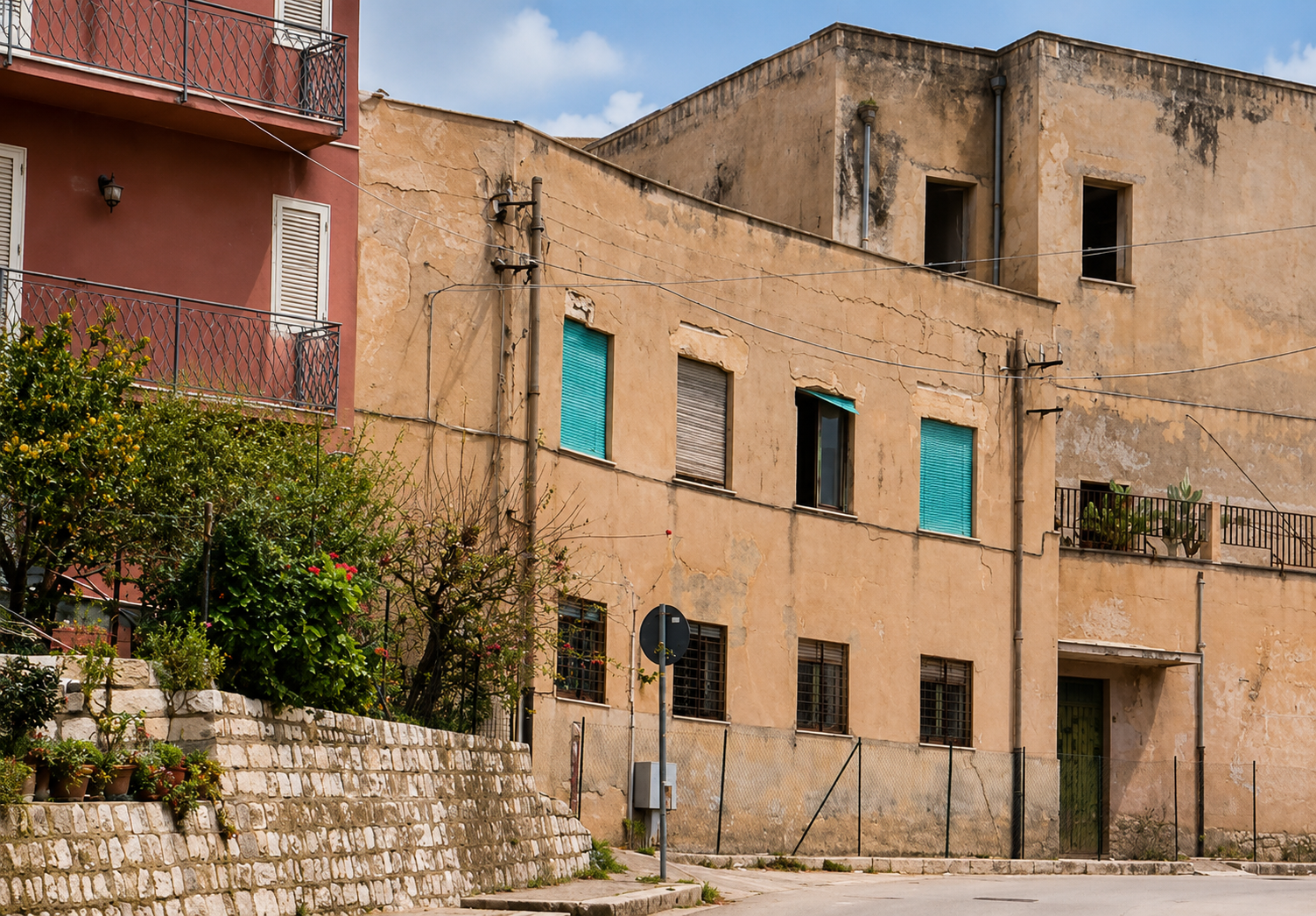
And Corleone, the town towards which I had been driving so determinedly, has a history that began long before popular culture. The area was settled in prehistoric and ancient times, but the present-day town took shape particularly during Arab rule in the ninth century. Its Islamic layers did not immediately disappear with the arrival of the Normans in the eleventh century. Sicily was then a meeting place for different cultures, languages and faiths, and their relationships were not always straightforward. Over the following centuries, Corleone changed hands repeatedly, while feudal rights to the town passed from one noble family to another. There is something strange about imagining an entire town treated almost like a piece of property at somebody else’s disposal. Arab influence remained visible in elements of the old urban fabric, especially the narrow streets and inner courtyards. Some remind me of medinas I have encountered on other journeys, although Corleone is, of course, much more modest in scale.
Among the more interesting remnants of its medieval history are two fortifications, Castello Soprano and Castello Sottano — the Upper and Lower Castles. Castello Soprano stands on an isolated rock high above the town, in a position that served defensive purposes for centuries. Its history is linked to the medieval period, while only fragments of the former fortified complex survive today, most notably the tower known as Torre Saracena. Castello Sottano is closer to the centre. It too belongs to Corleone’s earlier defensive history and has served several different purposes over the centuries, including as a prison. It later became associated with a Franciscan monastery, giving the building a role entirely different from the one for which it had originally been constructed. It is not a bad example of how both the uses of buildings and the values society assigns to them change over time.
Corleone was once known as the town of a hundred churches. I do not know whether there were ever exactly that many, but the nickname alone reveals how important religious heritage is to its history. The best known is the Chiesa Madre, the principal church dedicated to Saint Martin. Its origins date back to the fourteenth century, while its present appearance reflects later rebuilding and decoration. Over the centuries, it acquired artworks from different periods, including objects transferred from other religious buildings. Among those mentioned are a seventeenth-century wooden sculpture of Saint Sebastian and a gilded sixteenth-century depiction of the Madonna of Itria. I did actually manage to see this church, making it one of the few parts of my visit that could reasonably count as conventional sightseeing.
There is a great historical and social distance between medieval churches and fortifications on the one hand and the Mafia on the other. Yet organised crime has most profoundly shaped the world’s perception of Corleone in modern times. Even the origin of the word ‘mafioso’ is not entirely clear. Some older interpretations associated it with pride, self-confidence or a particular Sicilian character. That should not, however, be taken to mean that there was once some noble Mafia that only later became corrupt. The rise of organised Mafia groups is particularly associated with the social and economic conditions of nineteenth-century Sicily, when large estates, tenancy arrangements and weak central government made it possible for local intermediaries to gain power. Among these, the gabelloti, who leased large estates, and the campieri, armed guards who enforced their will, played important roles. Their economic and social influence rested not only on property but also on their ability to shape relations between landowners, workers and local authorities.
Italian unification did not automatically solve these problems. The new state inherited complicated relationships and already established networks of local power in Sicily, and replacing them with effective institutions was far from simple. Mafia intermediaries gradually became entangled with politics, business and administration, while the dividing line between legitimate influence and criminal coercion was often blurred. Over time, initiation rituals and rules of mutual loyalty developed, most famously omertà, the code of silence. It demanded refusal to cooperate with the authorities or reveal the internal affairs of the criminal organisation. The eventual breaking of that rule, especially through the testimony of Mafia informants who turned state witnesses, was one of the principal reasons Italian investigators and courts were able to understand Cosa Nostra’s workings much more clearly.
Nor did the twentieth century provide a straightforward resolution. During the 1920s, Mussolini’s regime launched a major campaign against the Mafia, particularly through the prefect Cesare Mori, known as the ‘Iron Prefect’. Many members of criminal groups were arrested and convicted, but the real achievements fell short of Fascist propaganda’s claims. After the Second World War, the Mafia regained strength by exploiting political and economic changes. The construction boom, especially in Palermo, opened opportunities to control land, building contracts, permits and public funds. Criminal operations later expanded into the international drug trade, turning Cosa Nostra into something far larger than an organisation rooted in the traditional rural relationships of Sicily.
The persistence of these consequences is illustrated by the Italian government’s decision in August 2016 to dissolve Corleone’s municipal council over Mafia infiltration and the risk of organised crime influencing local government. Problems linked to the Mafia plainly did not disappear with the arrest of its best-known bosses. Their effects persisted decades later, across society, politics and the economy. The area surrounding the town also contains locations associated with the lives or hiding places of individual mafiosi, but I would rather treat such sites as part of history than as tourist attractions. And the mere fact that someone is related to a notorious Mafia member says nothing about that person’s individual responsibility.
Another interesting question is how afraid of the Mafia an ordinary tourist should be. While preparing my trips to Sicily, I came across a range of claims, from the suggestion that tourists are generally of little interest to Mafia organisations to assurances that Palermo is statistically safer than other large Italian cities. I even encountered the rather exotic assertion that terrorists are afraid of the Mafia. I would be cautious about all this. Without a clear source, date and methodology, statistical comparisons between cities tell us little, while the claim about terrorists sounds like something that would require substantial evidence before being offered as travel advice. What can be said is that modern organised crime has complex economic and political interests, from control of businesses and markets to public contracts and major flows of money. Tourists visiting churches and ordering coffee are not at the centre of those operations, although that naturally does not mean Sicily is free from the ordinary safety issues found in other tourist regions.
That is precisely why CIDMA, the International Documentation Centre on the Mafia and the Anti-Mafia Movement, is so important to understanding Corleone. It opened on 12 December 2000, not to glorify the Mafia but to document its activities and the struggle against it. One of its most important sections contains documents from the great trial against Cosa Nostra, the Maxiprocesso, which began in 1986. The museum holds extensive material linked to the work of investigators and prosecutors Giovanni Falcone, Paolo Borsellino and their colleagues. Particularly significant is the testimony of Tommaso Buscetta, one of the most prominent Mafia figures to cooperate with the judiciary, whose evidence offered a much clearer understanding of Cosa Nostra’s internal structure.
The museum, however, is not interesting only for its court records. One of its most important elements is the photography of Letizia Battaglia, the renowned Sicilian photographer who spent decades documenting Mafia violence and its consequences. Her photographs from the 1970s and 1980s are not merely records of crimes but testimony to a society forced to live with that violence. The collection also includes works by her daughter Shobha, focusing on the suffering of victims and their families. A special section is devoted to General Carlo Alberto Dalla Chiesa, who fought organised crime and was murdered by the Mafia in Palermo in 1982, together with his wife Emanuela Setti Carraro. Judicial documents, photographs and individual lives combine to create a much more serious picture of Sicilian history, one that cannot be reduced to a list of famous Mafia bosses.
That still does not exhaust what Corleone has to offer. Near the historic centre is the Cascata delle Due Rocche, a waterfall formed where the Corleone stream cuts through a rocky gorge. Here the water descends into a small pool surrounded by vegetation, a sight particularly impressive when the water level is high. The small church of Madonna delle Rocche is nearby. The photographs I found afterwards looked rather appealing, and I must admit that I regretted not knowing about the place during my visit. Even if I had known, whether I would have had time to see it is another question, and anyone planning to visit should check current access and conditions beforehand. Nevertheless, the very existence of such a spot shows how easily a town can be misjudged after a short, unprepared visit.
Putting all of that together, I must admit that I was rather annoyed with myself. Not because Corleone had failed to meet my expectations, but because I gradually realised how little I had done to get to know it properly. Blaming the town itself for that impression would have been unfair. Admittedly, my lack of preparation had another side. It allowed me to see a part of Sicily that would never have entered a carefully designed itinerary, discover several interesting places and develop a somewhat different opinion of what small cars can do. Even so, I think Corleone deserves another visit, this time with more time and at least some idea of what I actually want to see.
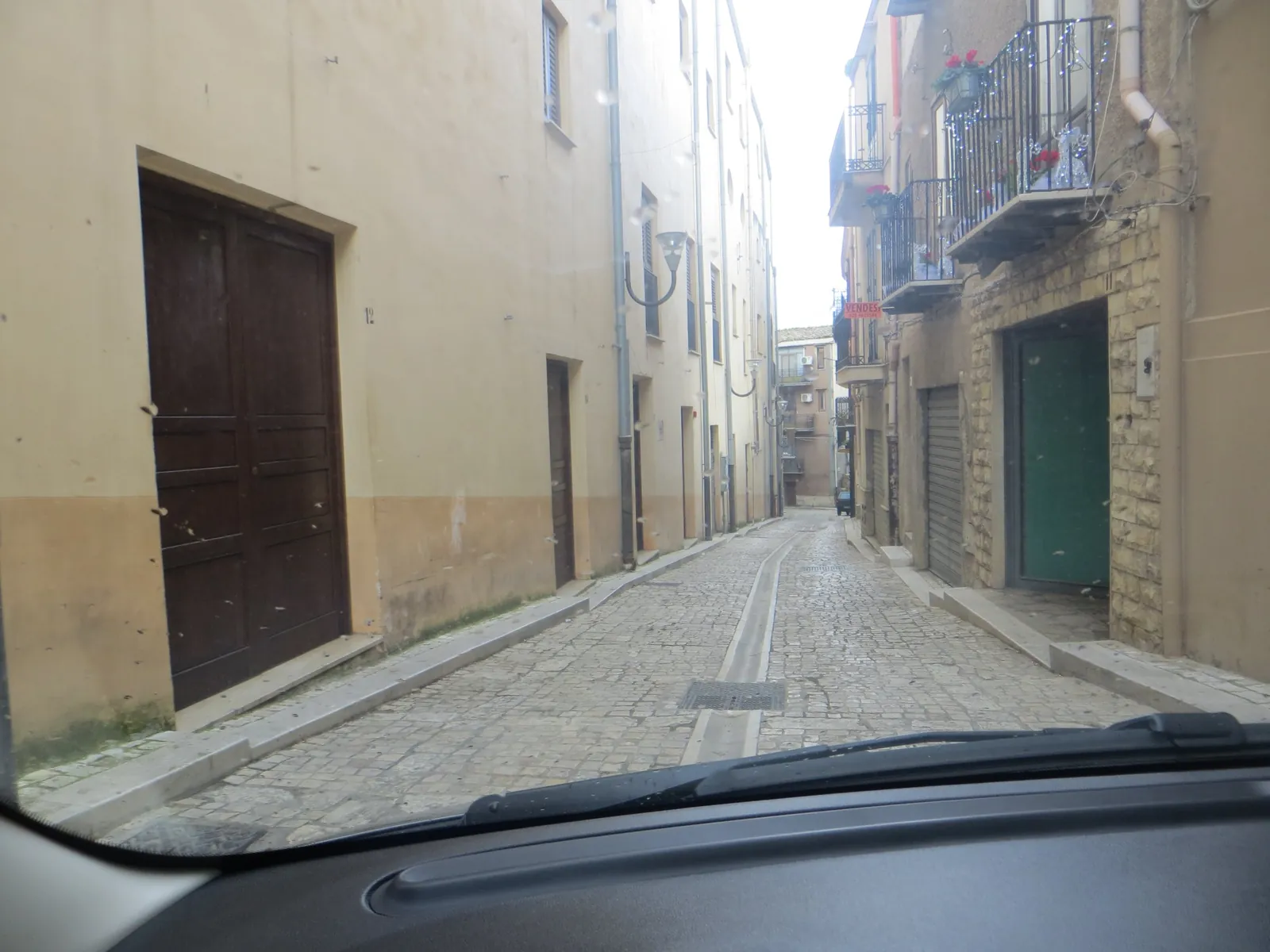
Leaving the town showed, however, that improvisation was not quite finished with me. I switched the navigation back on, even though everything I had experienced so far suggested that trusting my own judgement might be wiser. The result was a drive down one of the narrowest and steepest streets I have ever negotiated. After all the problems on the way to Corleone, I had somehow found a way to make leaving the town interesting too. When I finally extricated myself, I reached a spot with a lovely view of the rock crowned by Castello Soprano. It was one of the last images I took away from Corleone and, unlike most of the preceding ones, I could enjoy it without the immediate fear of getting the car wedged between two walls.
Looking back now, I feel that my visit to Corleone was really made up of two different stories. One I experienced on the road; the other I discovered only afterwards, reading about towns, castles, churches, earthquakes, the Mafia and the people who stood up to it. That second story does not change what happened to me, but it certainly completes the picture. Perhaps Corleone deserves a second visit, this time with a little more preparation. Then again, if I had planned it properly the first time, I might have missed out on the best story I brought home from Sicily that day.