At night, the white cathedral emerged from the darkness. By morning, it had almost disappeared into the snow. Those two views framed my first encounter with Helsinki.
Visiting Finland without seeing Helsinki was unthinkable to me. The problem was time. My trip had begun with an interesting day in Lapland and continued with a five-day Erasmus visit to Tampere University, while Tallinn and Kraków were still waiting on my way home. That left less than 24 hours for the Finnish capital.
The plan was therefore simple: walk through the city centre that evening and find somewhere for dinner, then see a few of the main sights the following morning. Main, that is, not according to the guidebooks, but according to my camera. Trying to get to know a metropolis in that time sounds like an impossible mission. For a first impression, it was more than enough.
A Train, Two Languages and One Inexhaustible Priest
We arrived in Helsinki by train from Tampere. The journey itself was short, about ninety minutes, but one remarkable fellow passenger made sure those ninety minutes felt at least twice as long.
In our carriage was a retired Finnish priest who, as it turned out, could fill every single minute of the journey with conversation. She spoke impeccable English, had travelled extensively and spent much of her life on religious assignments around the world. She told us about distant countries, religious customs, the Finnish attitude towards faith and anything else she could connect to the conversation. And she could connect practically anything. She was intelligent, cosmopolitan and genuinely interesting at first. What she seemed to lack was that internal mechanism that tells most people when a conversation has reached its natural end.
Somewhere between a story about a religious mission in Canada and the childhood that had shaped our companion’s life, my thoughts wandered to something entirely different. I began paying closer attention to the train. It seemed more substantial and spacious than other European trains and reminded me uncannily of the carriages on the Lisbon–Cascais line. A little research revealed that Finland, like Portugal, uses a wider railway gauge than the European standard. To be precise, Finland’s is 1,524 millimetres, almost nine centimetres wider than the standard 1,435 millimetres, a legacy of the period when Finland was part of the Russian Empire. Portugal’s is wider still, at 1,668 millimetres. I cannot responsibly claim that track gauge determines how spacious a carriage feels, but my own experience certainly points towards that hypothesis.
And while I’m listing surprises, an even bigger one was waiting on the signs: Swedish. Before this trip I hadn’t even known Swedish was spoken in Finland, let alone that it was one of its two national languages alongside Finnish. Stations and public signs therefore displayed two names for the same places. Even Helsinki was also Helsingfors. It reminded me how little I knew about the Scandinavian countries. Just how little became clear later, when I learned that Finland is one of the Nordic countries, while Scandinavia in the narrower sense refers to Denmark, Norway and Sweden.
By the time we finally arrived in Helsinki, my colleague and I felt as though we had completed a crash course in international theology. Finland’s reputation as a land of silence had suddenly become much more appealing.
Hotel U14 was close enough to the station to reach on foot. At least on the map. With snow beginning to fall, suitcases in our hands and cold seeping through every layer of clothing, the distance suddenly looked much less attractive. I opened the Uber app without a second thought, and ten minutes later we were at the hotel.
The Hotel I Owed a Visit
Hotel U14, part of Marriott’s Autograph Collection, had been waiting for me longer than any hotel should have to wait for a guest. I first booked it back in 2020 for an earlier Erasmus visit to Finland, but COVID had other plans and the entire trip fell through. The hotel had opened barely ten days before my planned arrival, and our correspondence had become so personal that we were looking forward to its opening together. I was meant to be one of its first guests. With no idea what was coming, I had not only booked but paid in advance. The hotel cancelled my reservation without any fuss, refunded the money and treated me with exceptional warmth. That is a gesture you do not forget. It was hard for me, but I can only imagine how the owner felt, opening a hotel just as tourism fell into a deep coma. Booking it again six years later felt rather like repaying a small personal debt. I had promised myself back then that if the postponed trip ever happened, I would finally stay there.
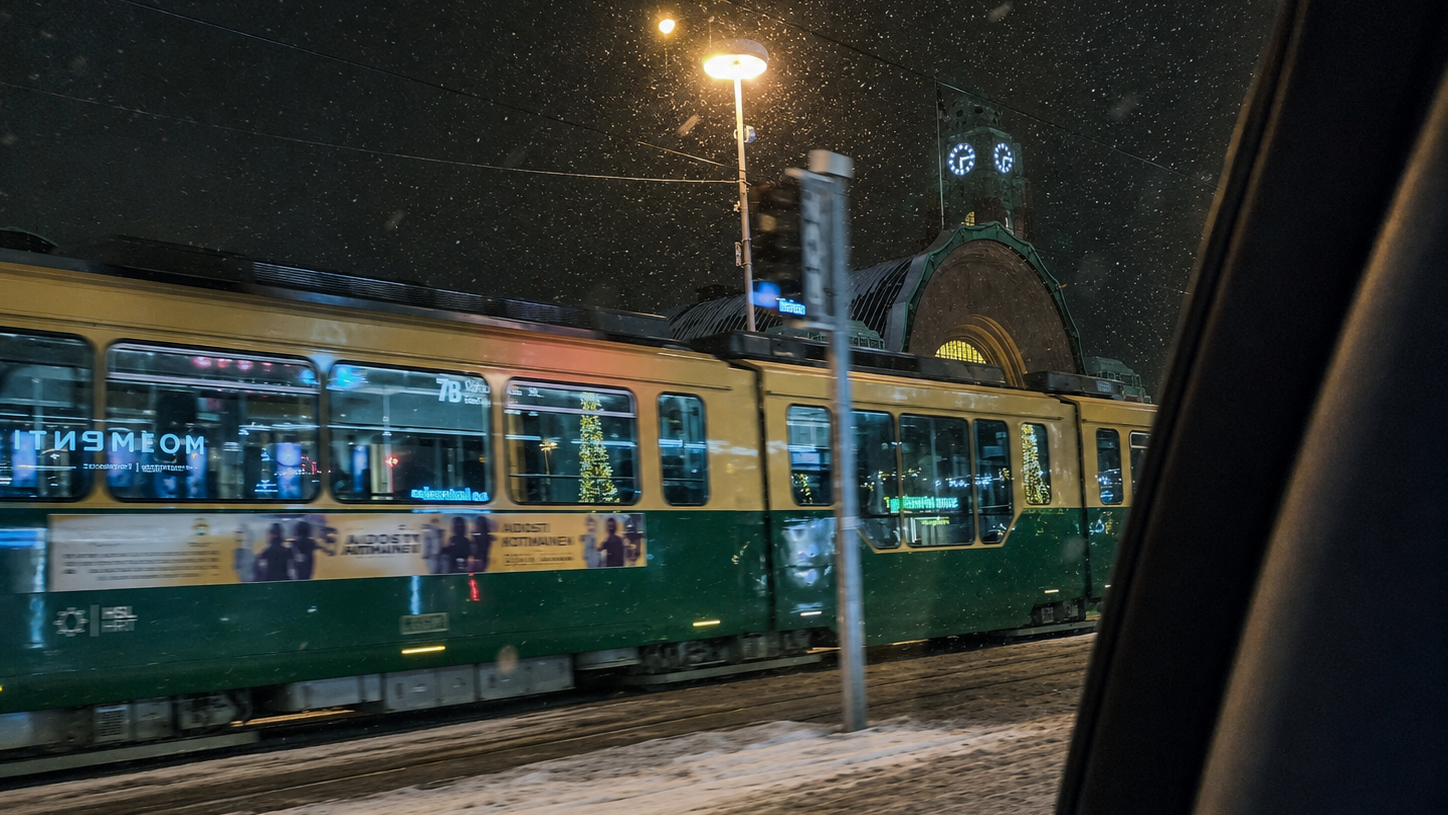
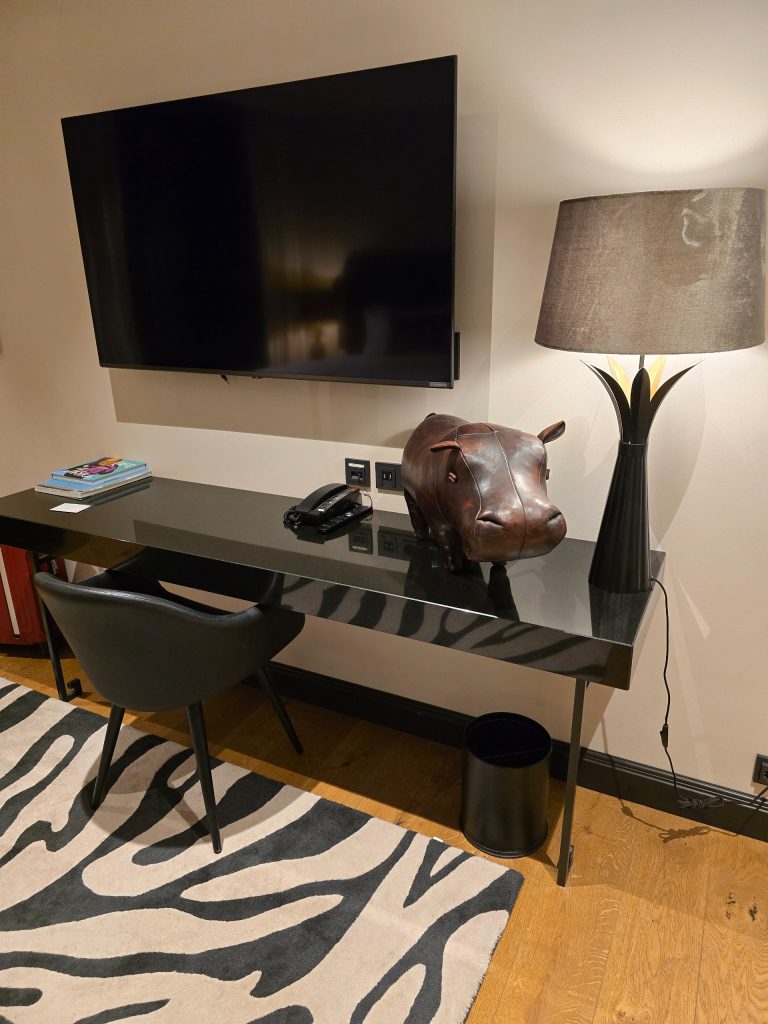
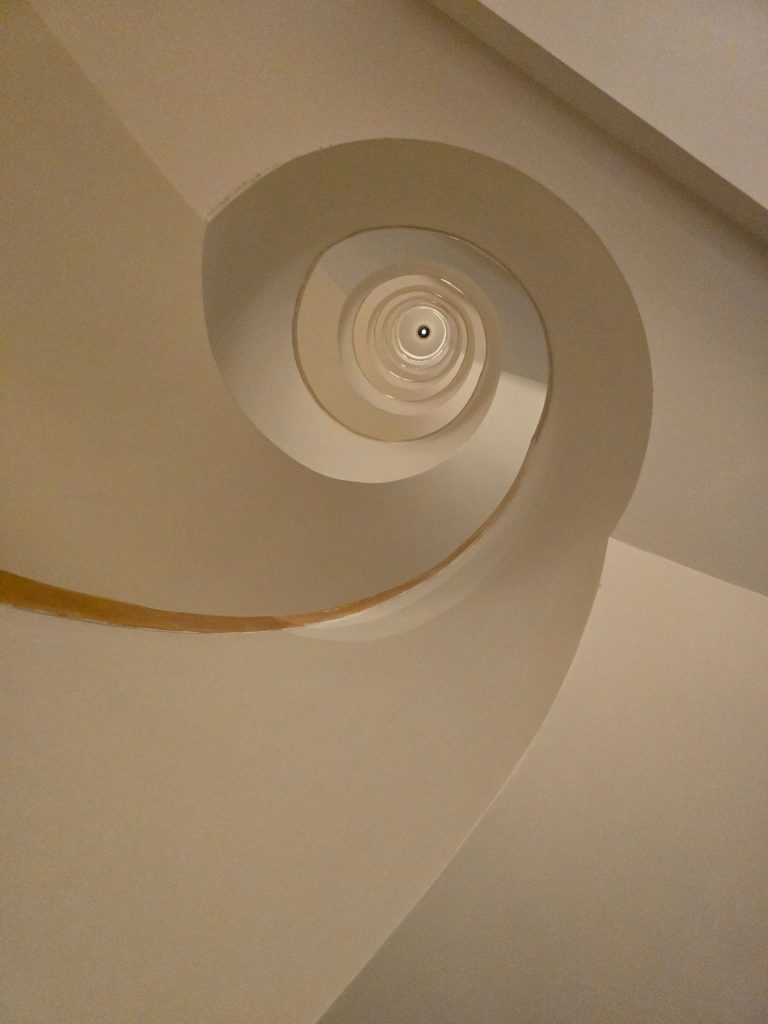
U14 is an upscale boutique hotel with a distinctive personality and a particular emphasis on design. It was in a noticeably higher category than the practical Courtyard where we had stayed in Tampere, and we were upgraded to a considerably better room than we had booked, which certainly helped. Pineapple-shaped lamps, a zebra-patterned carpet and a leather hippo standing guard on the desk made sure Nordic elegance lost some of its traditional seriousness. That suited me perfectly. But what fascinated me most was outside the room. The hotel’s spiral staircase wound through the building like an architectural sculpture, changing appearance with every floor and viewing angle. I photographed it that evening, then again the next morning, when different light transformed the same geometry. I photographed it once more on my way out. Every picture is different, and I am still looking for a spot in my apartment worthy of displaying one of them.
But enough about the hotel. Helsinki was waiting. And so was dinner.
Helsinki Began with Two Kinds of White and Absolute Silence
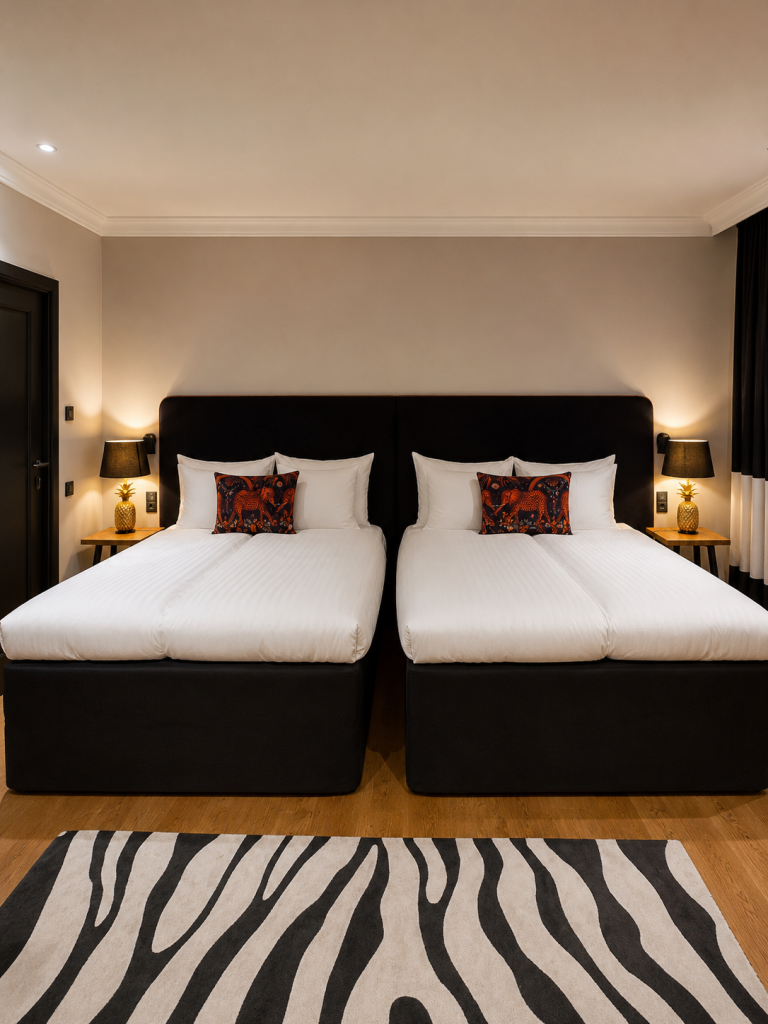
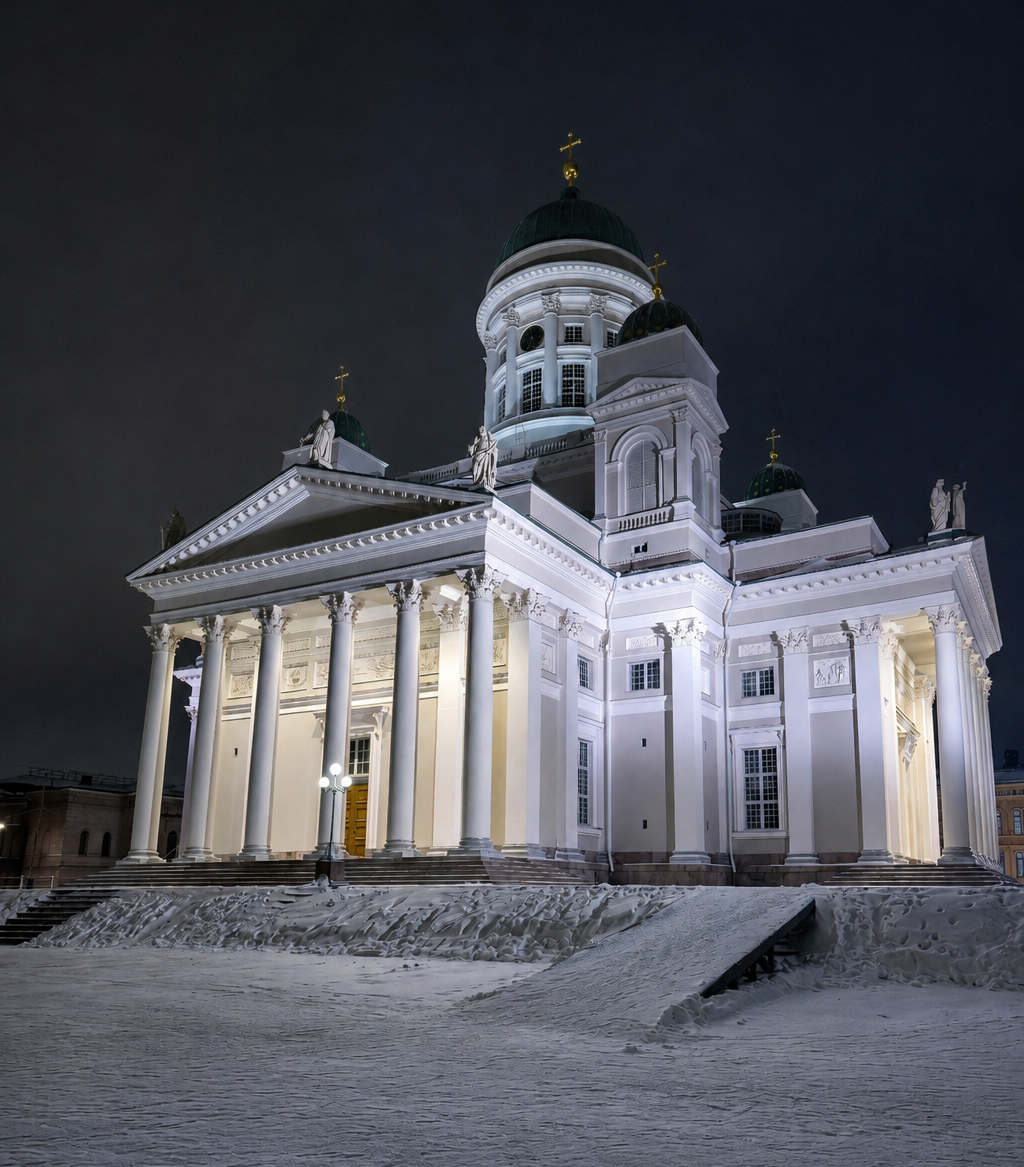
Dinner could wait a little longer. Senate Square was only a few minutes’ walk from the hotel, and there stood something I had absolutely no intention of missing in Helsinki. Helsinki Cathedral, one of the Finnish capital’s most recognisable buildings, dominated the almost deserted square. Its white façade emerged from the darkness, while the snow covering the square added another shade of the same colour.
The theological lecture we had received free of charge on the train seemed, in a way, to have inspired our visit to the cathedral. But a higher power had seen to it that balance was restored. There was hardly anyone in the square. And hardly a sound. The cathedral told its story in complete silence.
Looking at that monumental building, it was difficult to imagine that it had been built when Finland belonged to the Russian Empire. Carl Ludvig Engel designed it, but did not live to see its completion. The church was consecrated in 1852 to St Nicholas, while its name also honoured the Russian emperor Nicholas I. Thus a building that once celebrated a Russian ruler eventually became one of the most recognisable symbols of independent Finland. History evidently has a sense of irony.
The cathedral rises above Senate Square, the neoclassical centre Engel designed for the new capital. Government, university and church were arranged around a monumental space intended to represent political, intellectual and religious authority. The square can therefore feel like a theatrical set, and not merely figuratively. During the Cold War, when Western film crews could not easily film in the Soviet Union, Helsinki often doubled as Soviet cities. In the 1981 film Reds, it portrayed what was then Petrograd. Not a bad film career for a square we had almost entirely to ourselves that evening.
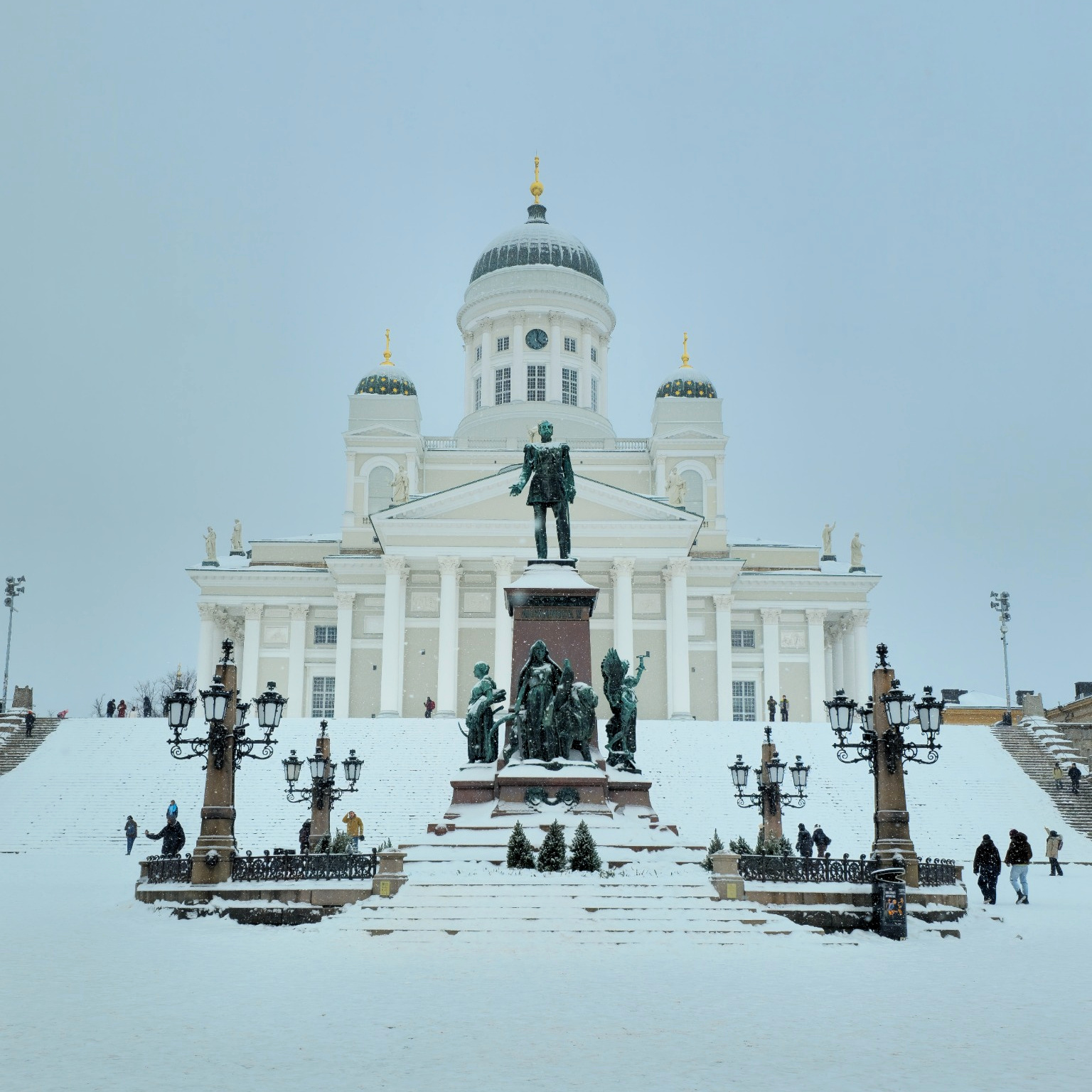
Trams passed almost unnoticed through the centre, traffic made little noise, and the wide square seemed even emptier beneath the dark sky. The white cathedral rose above it all, almost floating over its steps. The stillness made the darkness deeper, the snow brighter and the cathedral more like an apparition than a church where services actually take place.
Anything, Just Not Reindeer Again
My exploration of Finnish cuisine had revolved almost entirely around reindeer meat. There had been sandwiches and sausages, and then something considerably more brutal: smoked reindeer heart, the climax of our Viking dinner in Tampere. Before coming to Finland I hadn’t the faintest idea that reindeer was even edible. I’m slightly ashamed to admit that I hadn’t even realised reindeer existed outside Santa Claus’s world, let alone that the meat was one of the most recognisable ingredients in Lapland’s cuisine. All in all, reindeer had done its duty, and I think eating a reindeer’s heart was quite enough of a tribute to local cuisine. It was time to find something rather less distinctly Finnish.
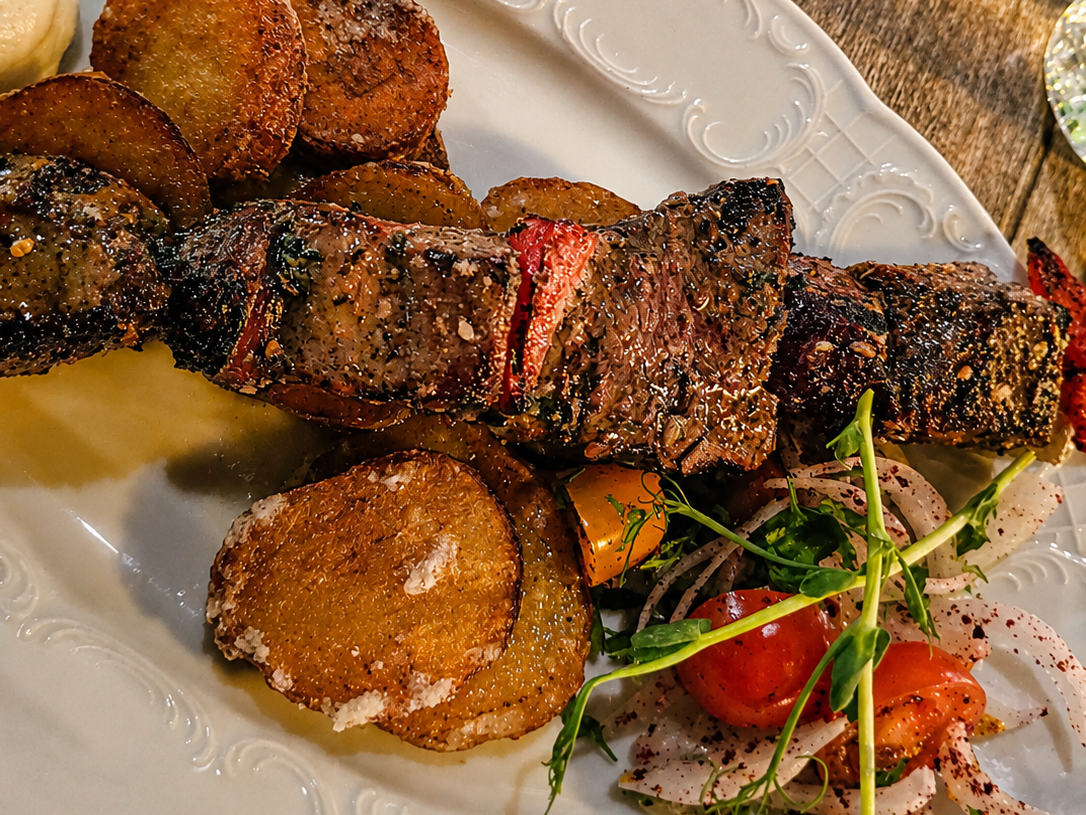
For restaurants, the hotel was in a fantastic location. Literally across the street were Georgian and Lebanese restaurants. Behind the hotel were Chinese and Italian restaurants, with Scandinavian, Greek and French options nearby. All this alongside several Finnish restaurants serving local and international cuisine. We chose Farouge, a traditional Lebanese restaurant. Until then I had tried Lebanese food only once, in Morocco about eight years earlier, and enjoyed it. Here I ordered baba ghanoush, warak inab—vine leaves stuffed with rice—and a lamb skewer whose exact name on the menu I can no longer remember. Not that it matters. The important thing was that it wasn’t reindeer on a skewer.
The food was excellent, the Lebanese waitresses exceptionally kind and the warm dining room especially appealing after the cold outside. Herbs, spices, grilled meat and smoky aubergine were a complete change from the flavours of the previous days. Everything was different: the smells, the tastes, the atmosphere—as if we’d been teleported to the Mediterranean. Exactly what we needed.
At one point, the restaurant manager decided that food alone was not enough for the full experience. He dimmed the lights, turned up traditional Lebanese music and suddenly, out of nowhere, an actual belly dancer materialised. I almost forgot I was in Finland.
Stepping outside into temperatures around ten degrees below zero was quite enough to remind me where I was. Fortunately, the hotel was only one pedestrian crossing away, and the bed was not only beautifully designed but exceptionally comfortable.
And that concluded the first stage of my Helsinki sightseeing: the evening one.
A Morning in Search of Photographs
There are hotels in my travel history that I will remember for their breakfasts. U14 is not one of them. I can’t say breakfast was bad or that anything in particular was missing; it simply wasn’t spectacular. But even that had its advantages. I finished quickly and could set off with the first rays of Finnish sunshine—or rather the first signs of daylight, because there wasn’t a hint of sunshine. Planning began with one simple question to ChatGPT: ‘What is worth photographing in Helsinki?’
My colleague stayed at the hotel and I went out alone, which suited this kind of sightseeing perfectly. When I’m taking photographs, I can spend twenty minutes circling a single building and then, without a second thought, walk straight past a landmark that would have its own chapter in any guidebook. So I built my morning route around the pictures I wanted: an unusual memorial, Sibelius’s steel pipes, a red cottage, a street of colourful façades, the railway station and a contemporary wooden chapel. Conventional tourist priorities had slipped completely out of focus.
Then it turned out that the morning itself was one of Helsinki’s attractions. The sky was uniformly grey, light snow fell from time to time, and there were hardly any people in the streets. Nothing dramatic. Just an ordinary Finnish winter morning, really. Yet I found precisely that atmosphere strangely appealing. The city was quiet and peaceful, almost as it had been the night before. The silence of Senate Square clearly hadn’t been a coincidence.
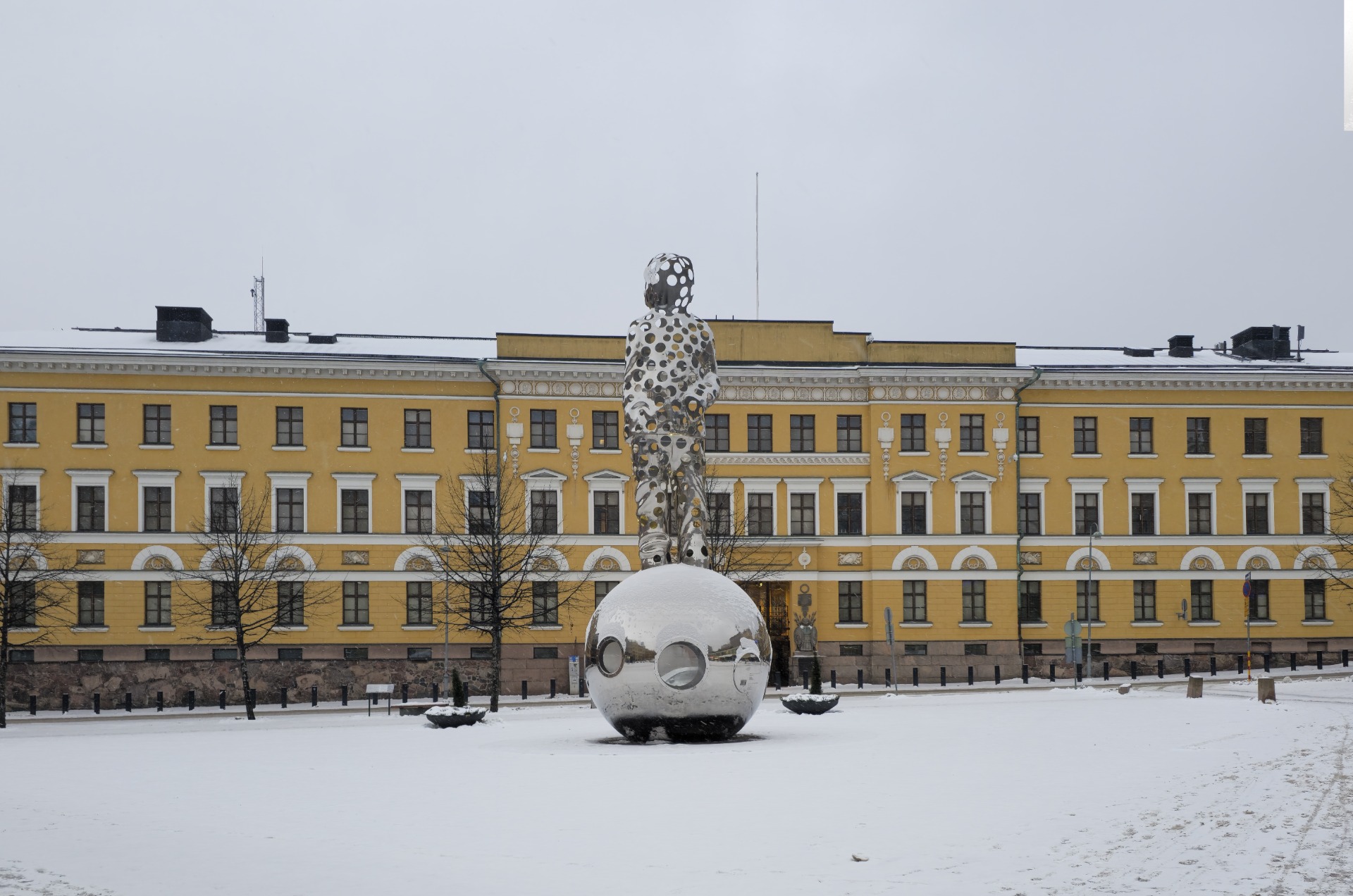
My first photograph was waiting just a few minutes’ easy walk from the hotel. It was on Kasarmitori, or Barracks Square, named after the former Guards’ Barracks beside it. In the middle of the snow-covered square stood a strange silvery figure, pierced with openings yet still upright. This was Finland’s National Memorial to the Winter War of 1939–1940, a work by Pekka Kauhanen unveiled in 2017. I knew none of that as I stood in front of it. What attracted me was the relationship between the unusual, seemingly vulnerable figure and the almost empty white space around it. I only researched what I had actually photographed afterwards. That was when I discovered that the monument’s base contains 105 photographs from the Winter War. I had been photographing an unusual sculpture without realising that photographs were already part of it.
The Monument I Brought Home
The next shot was too far away to reach on foot. Well, technically I could have walked there—but not in the few hours I had available. So it was time for another of Helsinki’s moving attractions: the old green-and-yellow trams. Against the snow-faded streets, their green looked almost indecently vivid. And somehow they suited a city I was only just getting to know: a touch of old-fashioned elegance, plenty of practicality and absolutely no need to show off.
After about ten minutes on the tram and a short walk through a park, I reached my next photographic target: the Sibelius Monument. It was on my list because of pictures I had seen, not because of any particular interest in the life of Finland’s most famous composer. To be frank, that was the first time I had even heard of him. I was drawn to a structure that looked like a sculpture from one angle and almost like a machine from another. Above all, I wanted to see what would happen when I stood underneath it with my camera.
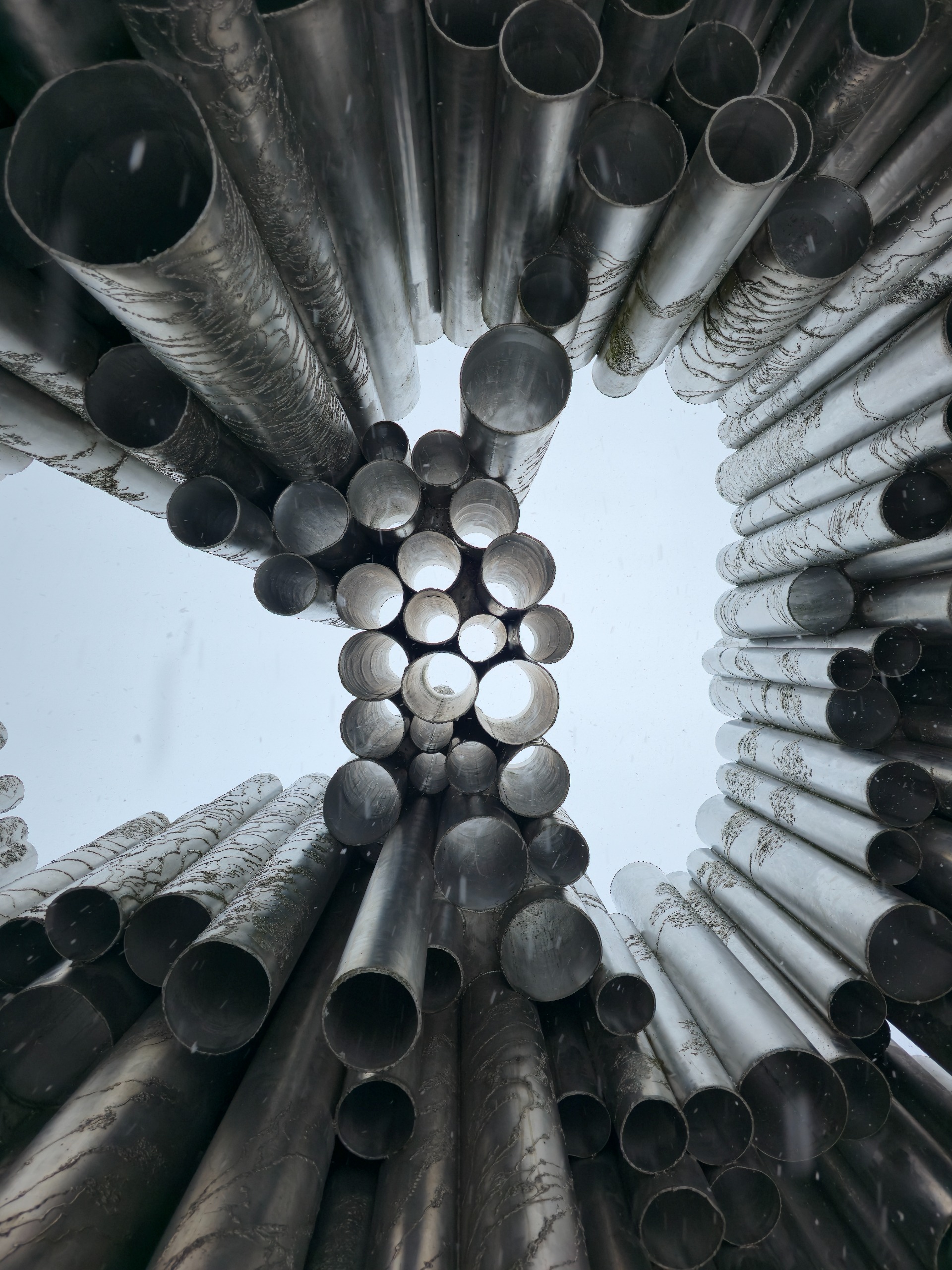
Eila Hiltunen made it from more than six hundred welded steel pipes, and the monument was unveiled in 1967. People often compare it to an organ, understandably, although I find that comparison a little too simple. You cannot take in all the pipes at once: as you move, new passages, rhythms and views of the sky open up. If the idea was to turn music into something you can walk around, the result is remarkably convincing.
I circled it again and again, photographing the pipes from below, from the side and through the surrounding trees. Their surfaces shifted from silver to grey to almost black, while small, ever-changing fragments of the winter sky appeared through the openings. Snow covered the rocks and the park, erased much of the surrounding detail and allowed the metal structure to take centre stage. For a photographer, it’s hard to imagine a better arrangement with the weather.
It was magnificent. I must have taken at least fifty photographs from every possible angle, and each one was different. I was also extraordinarily lucky: for a few minutes I had the place entirely to myself and could photograph it exactly as I wanted. Then a group of Japanese tourists occupied the monument. And when I say occupied, I mean it quite literally. They formed an impeccably orderly Japanese queue for photographs, and I realised the whole operation might take hours. Fortunately, I had just finished.
I knew immediately that one of those photographs would end up on a wall in my apartment. And a few months later, it did. I chose a direct print on brushed aluminium, which turned out to be the perfect medium for a subject made up of hundreds of metal pipes. The photograph acquired an almost sculptural quality; today it looks more like a striking piece of interior design than an ordinary travel photograph.
Café Regatta
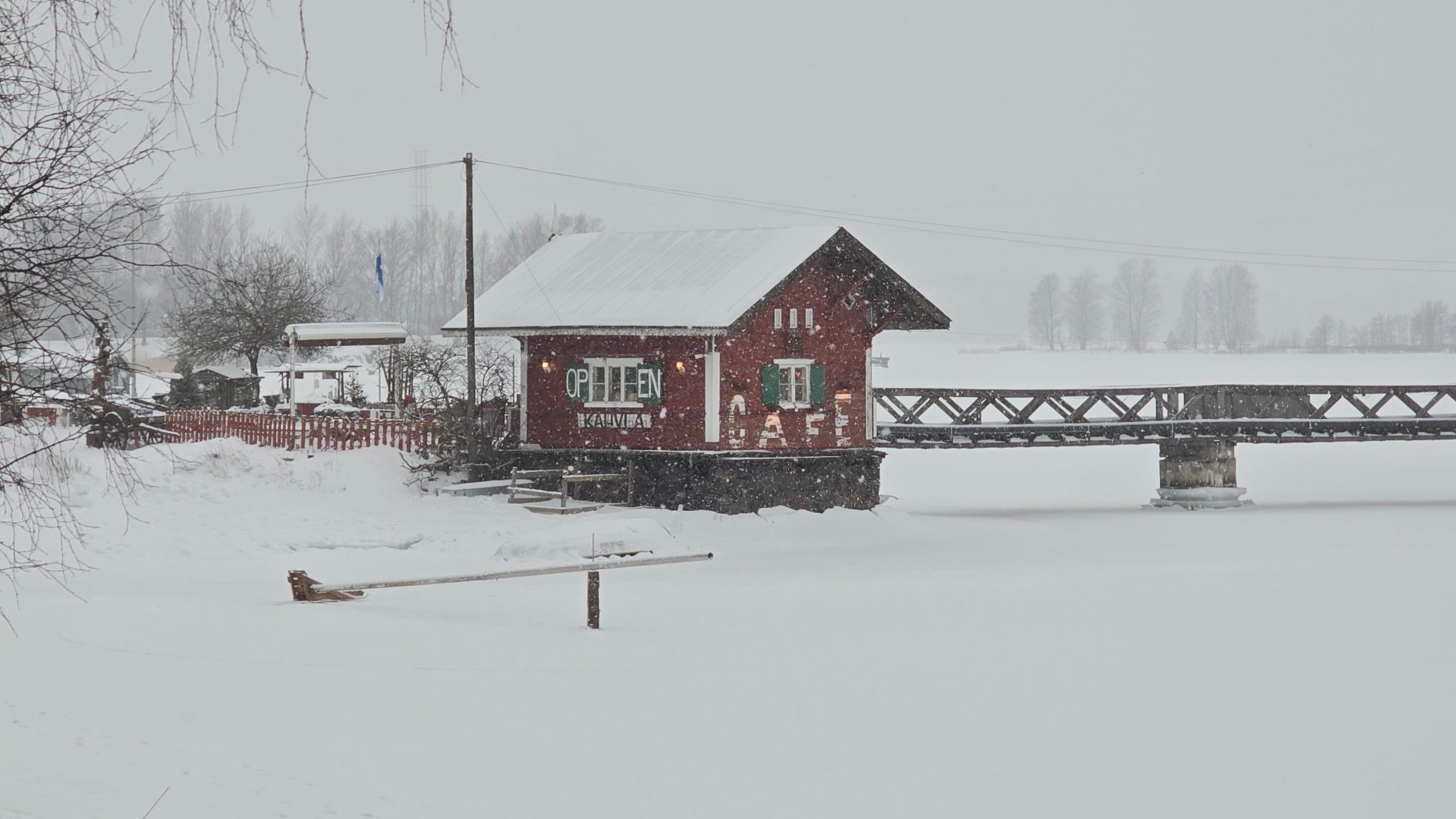
Literally a minute’s walk from the monument was Café Regatta, another place I had added to my plan thanks to ChatGPT. On the tram I had googled a couple of pictures, and the scene looked almost unreal: a tiny red cottage beside the water, surrounded by snow, as though someone had dropped a postcard from rural Finland into the middle of Helsinki. It was a photograph that positively screamed Finland.
I’m not ashamed to admit that I had never heard of this place either. Only later did I discover that the cottage was built back in 1887 as a storage shed for fishing nets beside the Paulig family’s villa; the family was known for its coffee business. Coffee had occasionally been served there since the 1950s, and in 2002 someone had the bright idea of opening today’s Café Regatta. Whether this is cosmic balance, poetic justice or an excellent marketing trick is hard to say, but it is difficult to overlook the fact that a former storehouse belonging to a family in the coffee trade is now a café. Regular readers know that I tend to prefer slightly different—let’s be snobbish about it—rather more refined places, so going in for coffee didn’t particularly interest me. Café Regatta was, first and foremost, a perfect photographic subject.
Further research revealed that my snobbery had done my battle with obesity a favour, though not my hedonism. Apparently they bake fantastic cinnamon buns there. Suddenly, I was desperate to taste them. They are one reason I have to return to Helsinki. At least having a reason to revisit a city is no bad thing. Mounjaro is taking care of the obesity, while the hedonist in me is already worrying that by my next visit they might have replaced those buns with some healthy alternative.
Secession? Art Nouveau? Liberty? Jugend!!
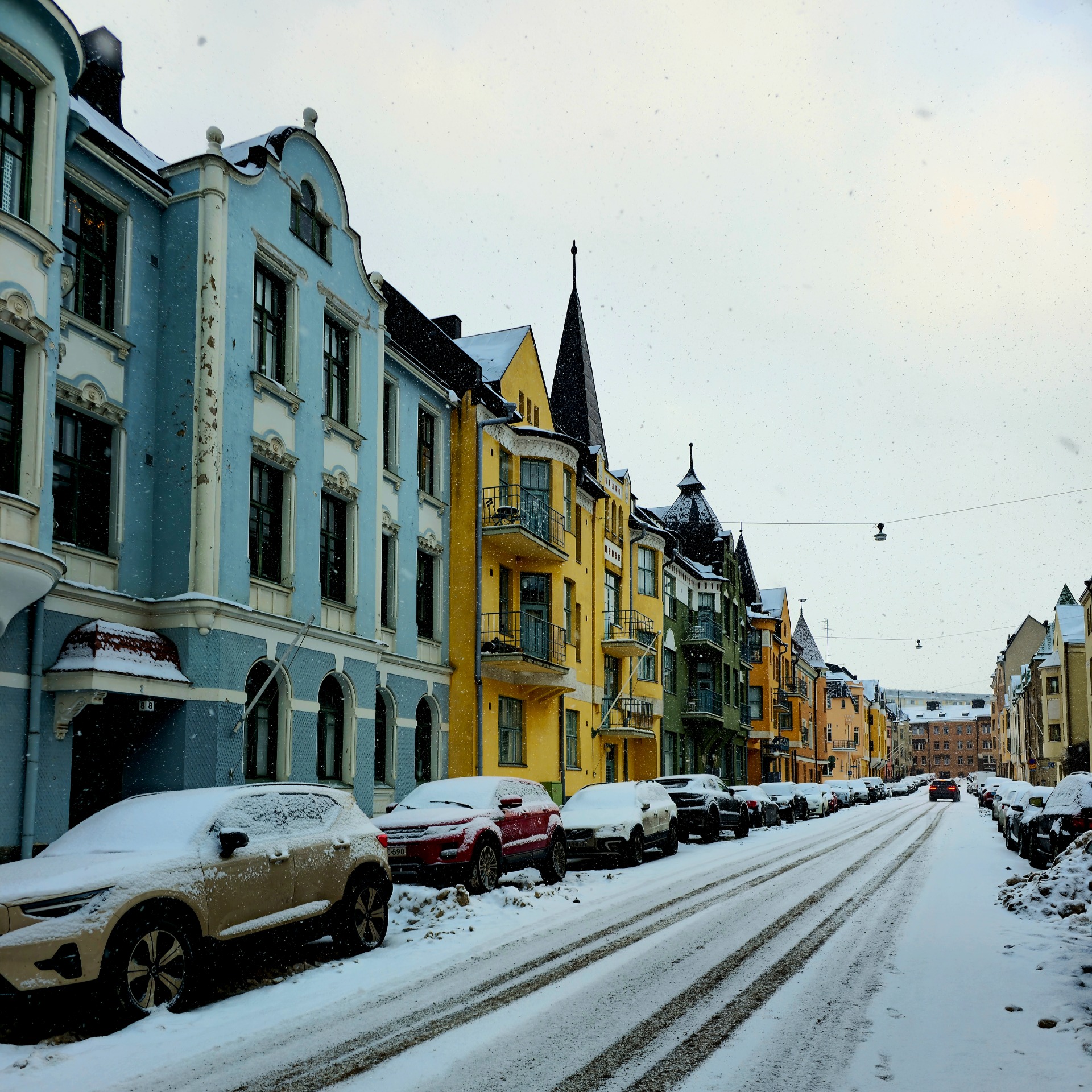
ChatGPT’s next suggestion was Huvilakatu. It hadn’t concerned itself much with architectural history; colour was what interested it. It described a row of residential buildings with strikingly colourful façades, and after all those white scenes the idea seemed especially attractive. So, after my photographic session at Café Regatta, I summoned another Uber and headed for Huvilakatu. From a purely Instagram perspective, it was a direct hit. I took another series of photographs. I don’t know whether any will end up on the wall of my apartment, but they certainly have a place in my photographic portfolio. And they have already improved my Instagram feed.
A short walk down the street soon activated my analytical and artistic sides. I started wondering what all those houses reminded me of. Images came unbidden: Vienna, Naples, a little Paris and Prague. I recognised Art Nouveau almost immediately. But which kind? The colours drew me towards Italian Liberty, certain details towards the Vienna Secession, and in some lines I tried to find French Art Nouveau. Yet something kept upsetting the picture. The façades were unusually playful, the proportions a little unexpected, and what puzzled me most was the asymmetry. That was the key. I wasn’t looking at the kind of Art Nouveau I was used to recognising at first glance.
The asymmetry reminded me of German Jugendstil, and suddenly the other details began to fall into place. Before me was Finnish Jugend, one of the local expressions of the great European Art Nouveau family. What had initially confused me suddenly made sense.
Then another comparison occurred to me. The previous evening I had stood in Senate Square, surrounded by Engel’s neoclassicism: monumental buildings, regularity and architecture that clearly considered it important to project order and authority. Huvilakatu seemed almost its opposite. The contrast was not merely between two attractive groups of buildings; it was a key to understanding Art Nouveau. Huvilakatu was a living example of a departure from neoclassical regularity, monumentality and authority. Instead of rigid grandeur, playfulness. Instead of orderly compositions, asymmetry. Instead of restrained colours, a whole little spectrum of façades. In less than a day I had encountered two very different architectural faces of Helsinki. And I liked them both.
I later learned that most of Huvilakatu’s houses were built in the early twentieth century and that not all their contemporaries had been delighted by their unconventional, asymmetrical architecture. Today tourists from all over the world photograph them, including one mathematics professor who arrived thanks to ChatGPT and then started giving himself a lecture in art history.
I have probably tired the reader a little by now with my private architectural analysis, but these are exactly the things I love doing when I travel. The search for a good photograph led me to a textbook example of Finnish Jugend and, along the way, reminded me that I can fall for a city long before I have learned to name everything I like about it.
On the Threshold of Modernism
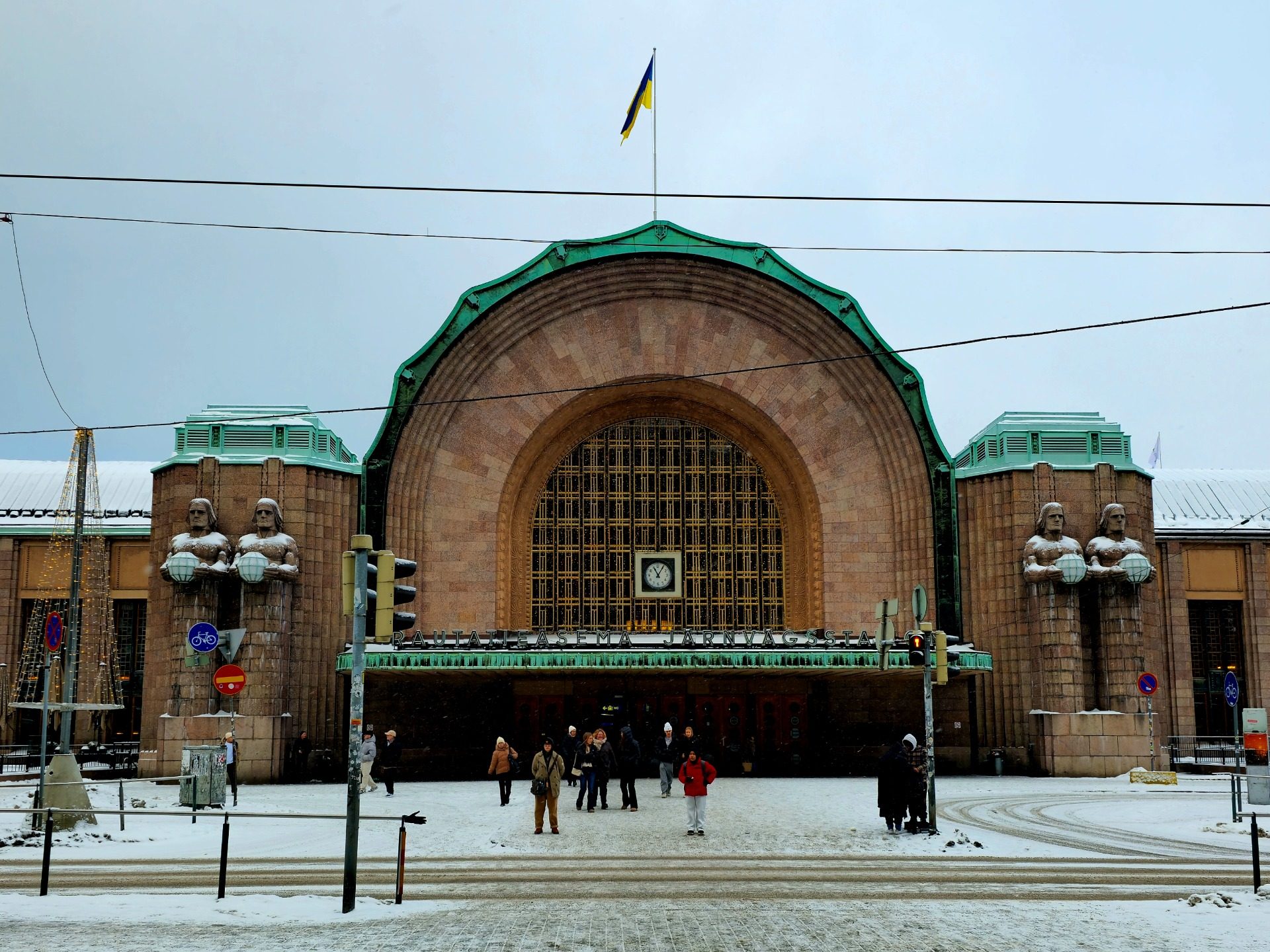
From Huvilakatu, the next photograph was about fifteen minutes away by tram. Curiously, I already knew the building quite well. Or so I thought. It was Helsinki Central Station, where our train journey from Tampere had ended the previous evening. At the time I had been far less interested in architecture. Finding the exit, calling an Uber and avoiding any more time in the freezing cold with a suitcase had seemed much more important. Now I was back without a suitcase, with my phone, and evidently with a much greater appreciation for the artistic qualities of railway infrastructure.
After Huvilakatu, where asymmetry had almost started an argument with my own knowledge of Art Nouveau, the station felt like a return to mathematical order. I stood in front of the façade and began to study it. Monumental granite, almost perfect symmetry, a geometrically precise arch over the entrance and four enormous stone figures holding spherical lamps. Above it all, a green copper roof that stood out particularly well against the snow. There was relatively little ornament, and even that seemed determined to behave itself. After Huvilakatu’s playful façades, it was as if someone had decided to tell architecture that the party was over and it was time to get down to serious business. Simplicity, geometry and monumentality had taken charge. The building seemed to shout: a new, modern age is beginning!
It turned out that my impression was not far from the truth. The station was designed by Eliel Saarinen and opened in 1919. Interestingly, his original design was much closer to National Romanticism, but after criticism from fellow architects he reshaped it into a simpler, more modern building. What I was looking at was, in fact, an important step in Finnish architecture towards modernism. So my little architectural diagnosis hadn’t been entirely wrong after all.
Real Silence in the City of Silence
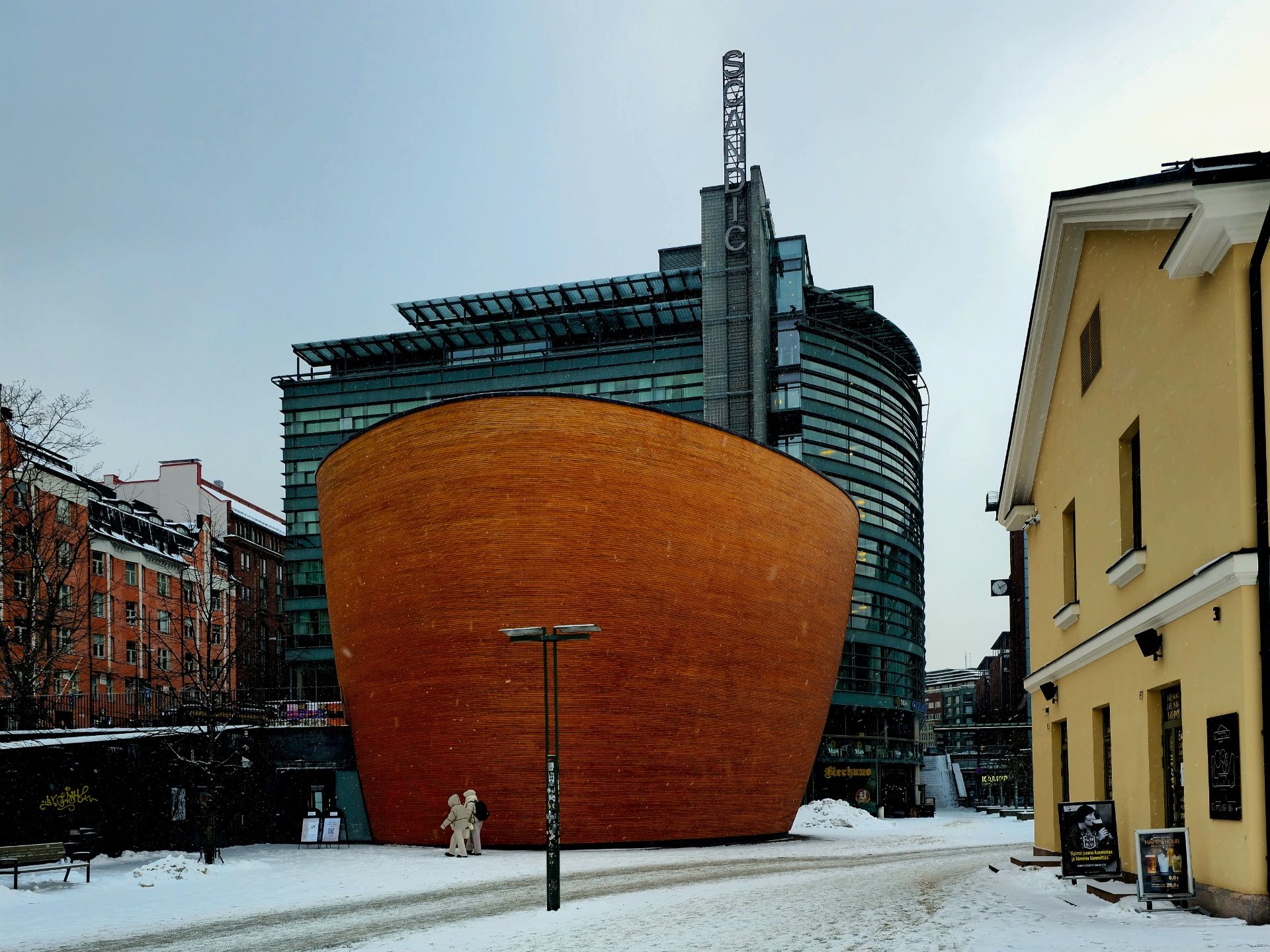
If anything defined my visit to Helsinki, it was silence. True, the train journey from Tampere had been anything but quiet, thanks to the priest I have already described. Then ChatGPT proposed, of all things, the Kamppi Chapel of Silence as my next photographic subject, just a few minutes from the main station. After a priest who couldn’t stop talking, I ended up in front of a chapel where silence itself is the main attraction. I don’t know whether that was a coincidence or whether the algorithm had developed a sense of humour.
The idea behind the name is interesting. The chapel in Kamppi belongs to the Evangelical Lutheran Church, but it is open to everyone regardless of religious beliefs. There are no regular Sunday services, and the space is intended above all for people who want to step away from everyday city life for a moment and enjoy some peace. I found the whole idea rather charming—until I discovered that admission cost five euros. For silence! I’m not particularly stingy when I travel, but Helsinki had been so quiet that paying for extra silence struck me as rather absurd. So I skipped the interior. The city had already provided me with a perfectly respectable amount of silence free of charge.
Only later did I learn that the chapel’s own future had become uncertain in 2026. With running costs mounting, its owners had considered selling it and then the possibility of leasing it out. Apparently, even silence cannot pay its own bills.
But enough about silence. What had brought me here was the photograph. Completed in 2012, the chapel resembles a gigantic, smooth wooden bowl that seemed blissfully unaware it had landed in one of Helsinki’s busiest shopping districts. After the monumental granite of the railway station, this was a completely different architectural story. Almost no decoration, no sharp corners, just wood and rounded lines that turn the entire building into a sculpture.
One Extra Star and Two Average Cakes
My next stop was Hotel St. George. Regular readers know I have a weakness for Marriott hotels. I was staying at U14, but I wasn’t about to miss the chance to see St. George, a Design Hotels property in Marriott’s portfolio. I had no booking and no plans to spend the night. I simply wanted to know where it was, what it looked like and what impression it made. Everyone has their weaknesses.
St. George occupies a historic building, and at first glance it clearly belongs to a higher category. Compared with U14, everything felt a little more serious, refined and exclusive. I could sense that extra star, but I must admit I had expected more, especially as a night here cost almost twice what I had paid at U14. Of course, I hadn’t stayed in a room, tried breakfast or used the facilities, so I can’t draw any definitive conclusions. Will I stay at St. George someday? Very probably. I know myself well enough to know these things rarely stop nagging at me.
The hotel is known for the art integrated into its design. Among the works is Tianwu, a giant bamboo-and-silk dragon by the Chinese artist Ai Weiwei. I must admit I can barely remember it now. Evidently I was more interested in the hotel than in the art collection I could have explored for free. But I certainly noticed St. George Bakery. My curiosity about the hotel soon took a culinary turn.
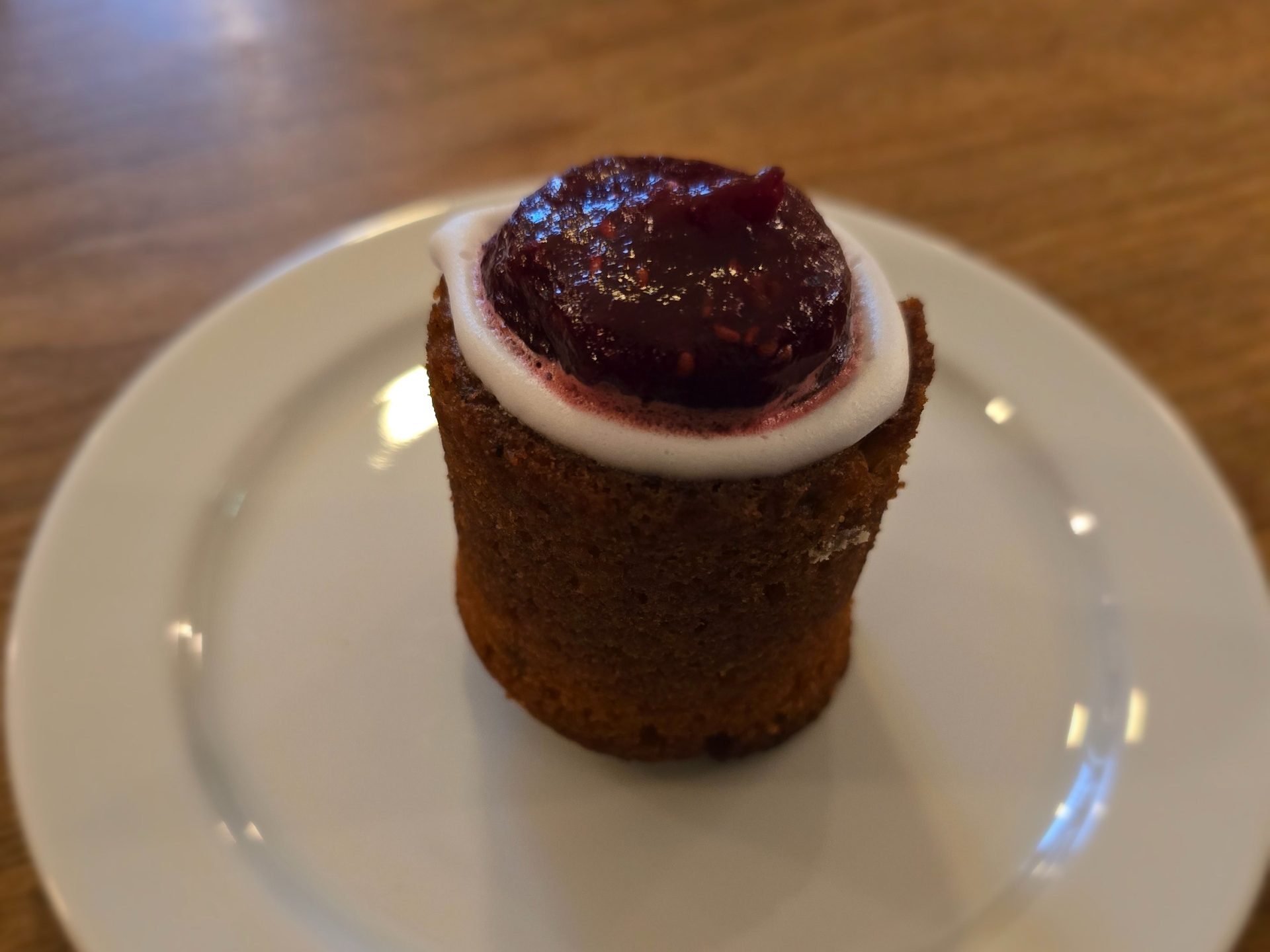
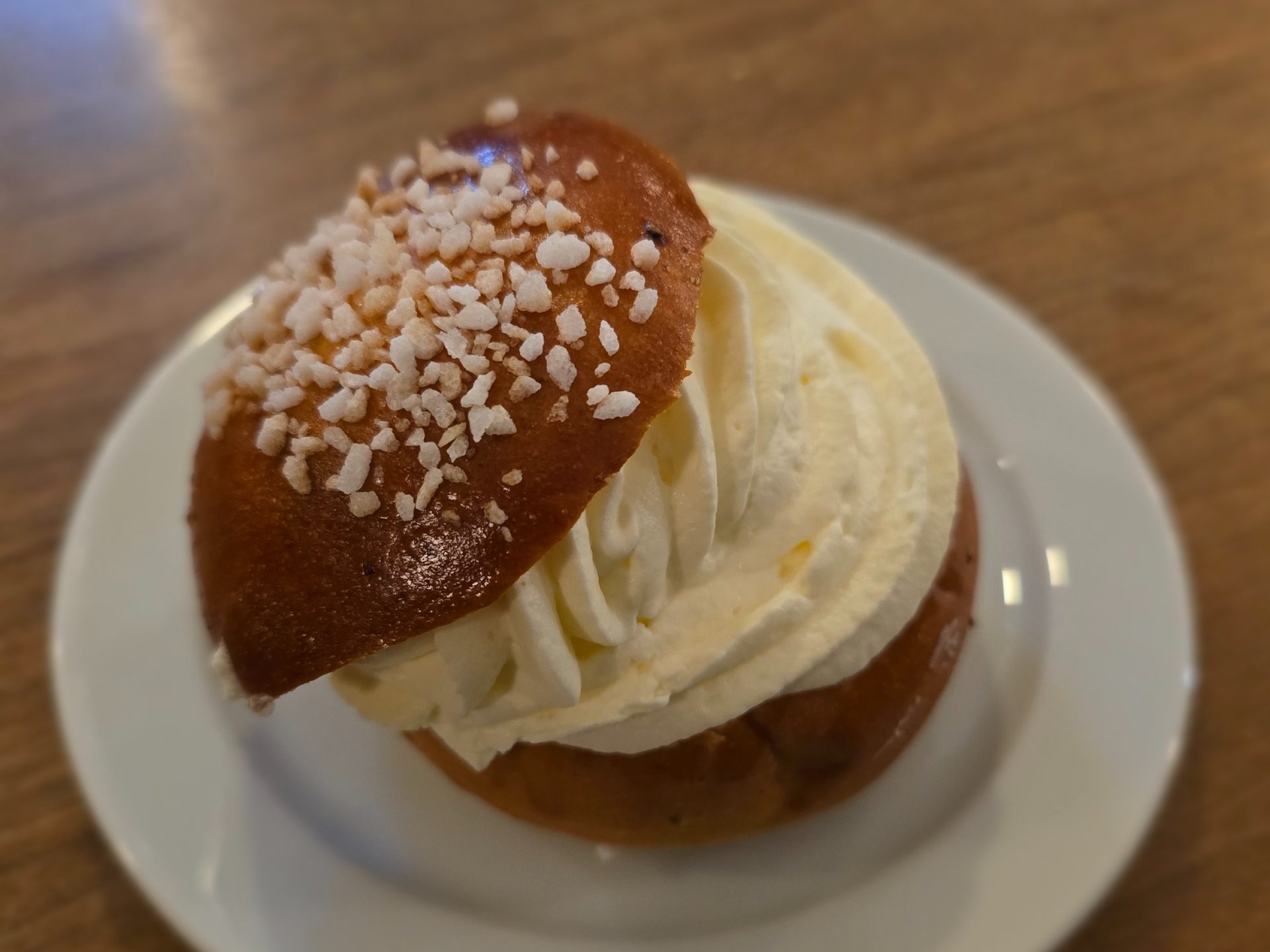
In Tampere I had kept seeing Runeberg torte in pastry-shop windows. For days I had wondered what was so special about those little cakes. Since I was already at St. George, it seemed time to explore another aspect of Finnish culture: its pastries. Alongside the Runeberg torte I ordered a laskiaispulla, a cardamom bun with whipped cream and raspberry jam. Unlike the first cake, that choice had nothing to do with cultural curiosity. It simply looked good.
Only later did I research what I had actually eaten. The Runeberg torte is named after Johan Ludvig Runeberg, Finland’s national poet, and is traditionally eaten around his birthday on 5 February. It usually contains almonds, biscuit or bread crumbs, sometimes rum or punch, and raspberry jam surrounded by white icing on top. I found the cake’s history more interesting than its taste. The laskiaispulla didn’t live up to its looks either. After days of Runeberg torte practically haunting me from Finnish pastry-shop windows, I had expected rather more.
White on White
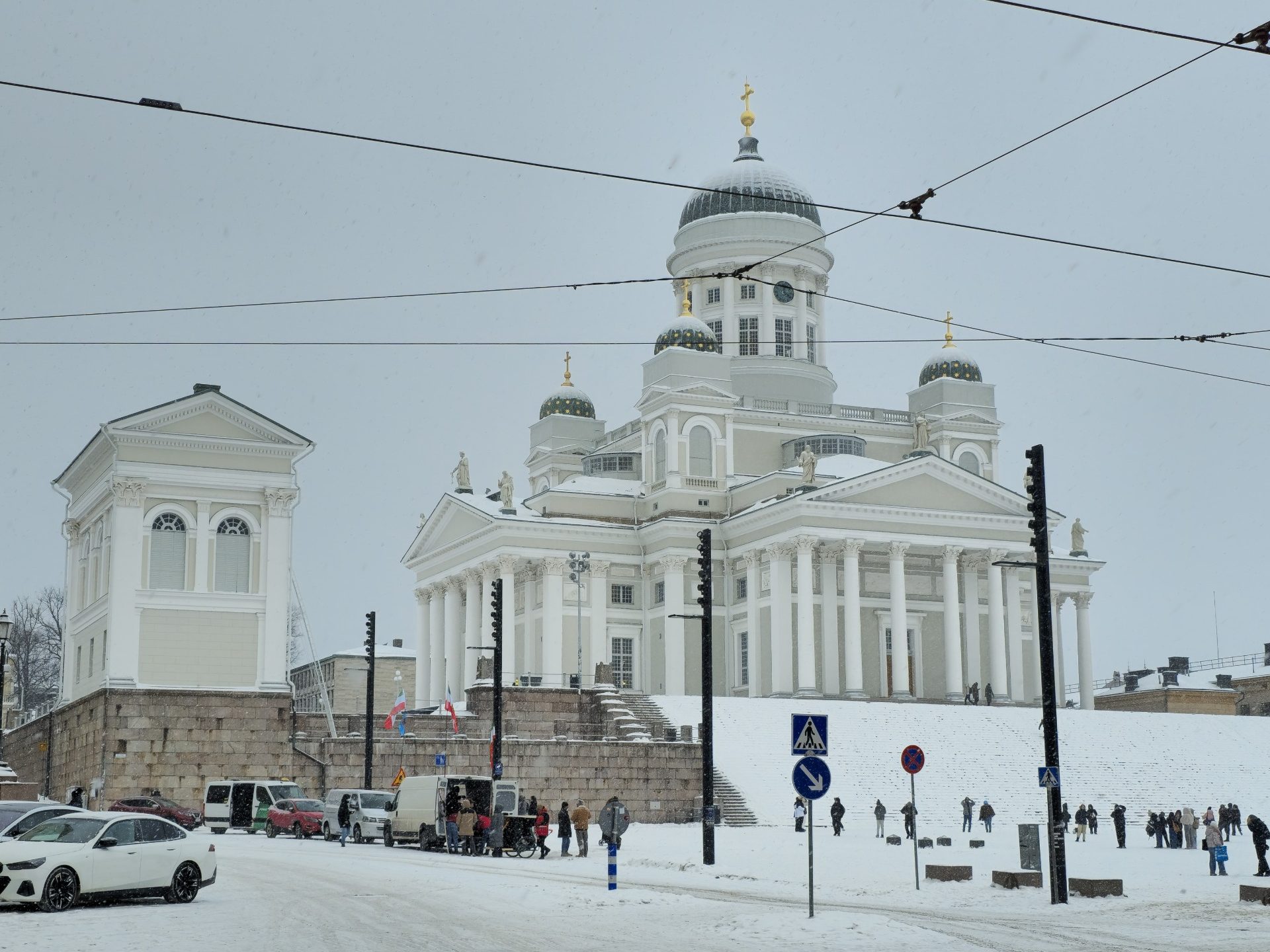
After two rather unspectacular cakes, I headed back to Senate Square. It was the only place in Helsinki I had deliberately decided to revisit. The previous evening the cathedral had enchanted me, its almost unreal whiteness in the night among the loveliest sights of the entire trip. Yet something kept nagging at me. How would the same building look in daylight, with snow covering almost the whole city?
The answer was rather unusual. At night the white cathedral had dominated a dark square. Now there was a white building, white steps, a white square and a sky barely distinguishable from the snow below. As though someone had decided to see how many shades of white could fit into one photograph. Only shadows, an occasional darker line and details emerging from the almost uniform whiteness marked the boundaries. It looked entirely different from what I had photographed the previous evening. And yet it was the same cathedral, in the same place, only a few hours later.
I photographed it again and was pleased. In fact, when I think of Helsinki now, that morning cathedral is one of the first images that comes to mind. Curiously, it was a photograph of the Sibelius Monument, not this one, that ended up on my apartment wall. Sibelius’s steel pipes were more suited to interior design, but the cathedral remained one of the strongest Helsinki images in my memory.
Then I remembered the previous evening. Senate Square, which Engel conceived as a monumental space for government, university and church authority, now looked almost unreal. All that neoclassical seriousness, regularity and symbolism of power somehow lost their importance beneath snow that showed very little respect for architectural hierarchies. The cathedral remained, almost lost in its own whiteness. And the same silence that had made me so fond of Helsinki.
The Ferry at the End of the Story
Before returning to the hotel I stopped at a supermarket to buy Finnish sweets as gifts. U14 had granted me a late checkout, a welcome benefit after a whole morning spent in the snow. I went back to my room, rested a little and prepared for the next leg of the journey. My time in Helsinki was drawing to a close, and somehow I felt I had only just begun.
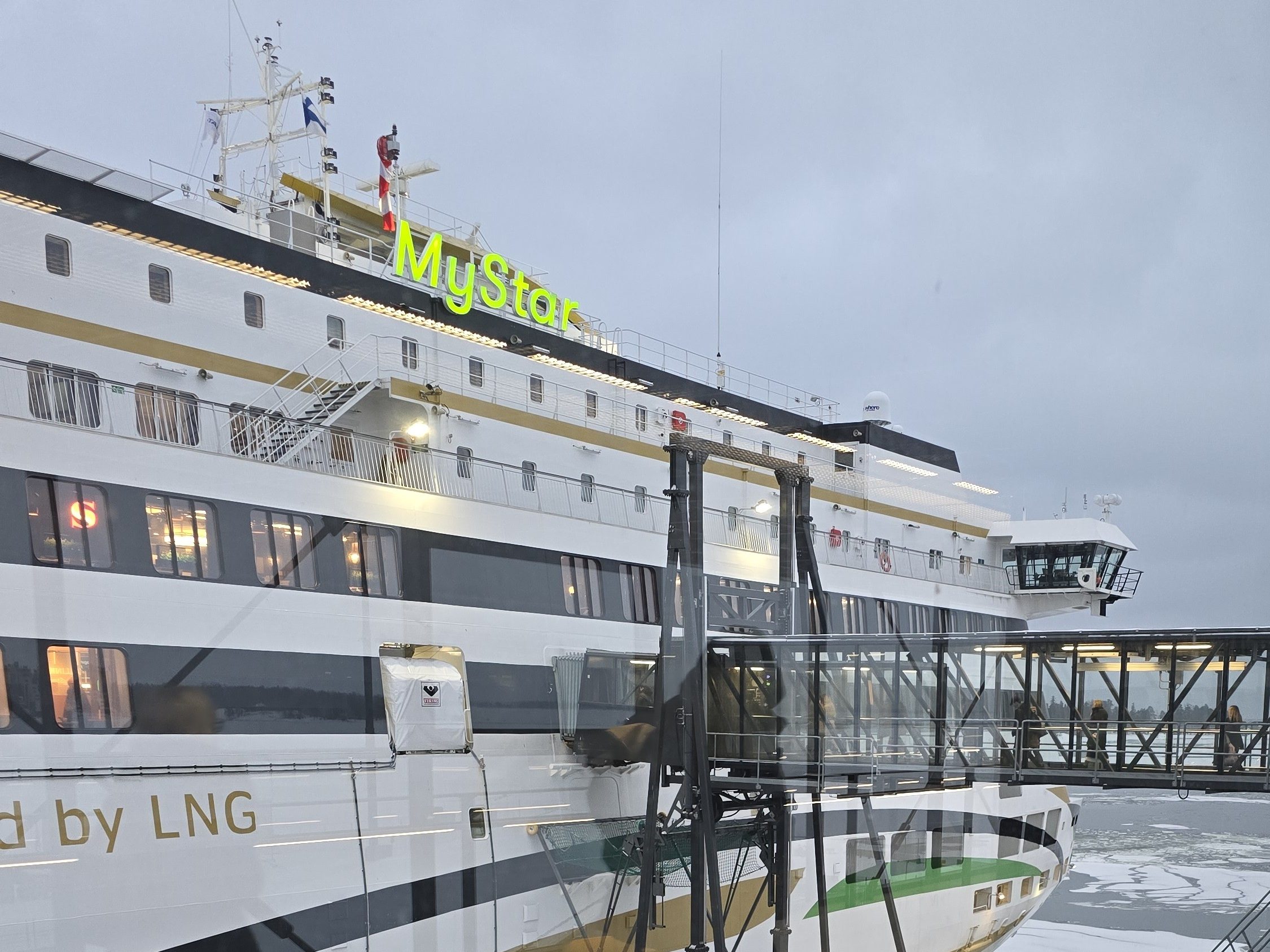
That afternoon my colleague and I called another Uber, this time to the ferry terminal. Tallink’s MyStar was waiting there, with Tallinn on the other side of the Gulf of Finland. Less than twenty-four hours had passed since our arrival by train from Tampere. Written down like that, I’m almost embarrassed by how little time I devoted to a European capital. But the schedule was what it was. And considering everything I managed to see, photograph and learn in those few hours, I can hardly complain.
I had set out looking for a few good photographs and ended up giving myself lessons in art history. You might think I had come on a study trip. Yet before that morning I hadn’t even heard of Sibelius, and now his sculpture adorns my apartment wall. Evidently my travels don’t always unfold the way I imagine.
Still, when I think of Helsinki, the cathedral comes to mind first. Once white against the darkness of night, then almost lost in the snow. Somehow those two photographs became my Helsinki.
And what remains for next time? Almost everything, I would say. One morning and one evening can hardly be enough for a city that intrigued me this much. I haven’t yet stayed at St. George, I photographed Café Regatta but rather foolishly passed up its cinnamon buns, and I’m certain there are plenty of other interesting places I never had time to discover.
I will definitely return to Helsinki.