
Exploring Catania on foot through its palaces, churches and fish market, with Bellini along the way, pasta alla Norma at dinner and rather too many reasons to miss my train.
This is how I like to imagine Catania: when Venus and Mars make love, Vulcan rages in the depths of Etna, spewing his pain into the sky. Fire rains down on Catania, but Liotru, the mighty black elephant, takes the god’s fury upon himself, his magic saving the city again and again. And so Catania stands, dark and defiant.
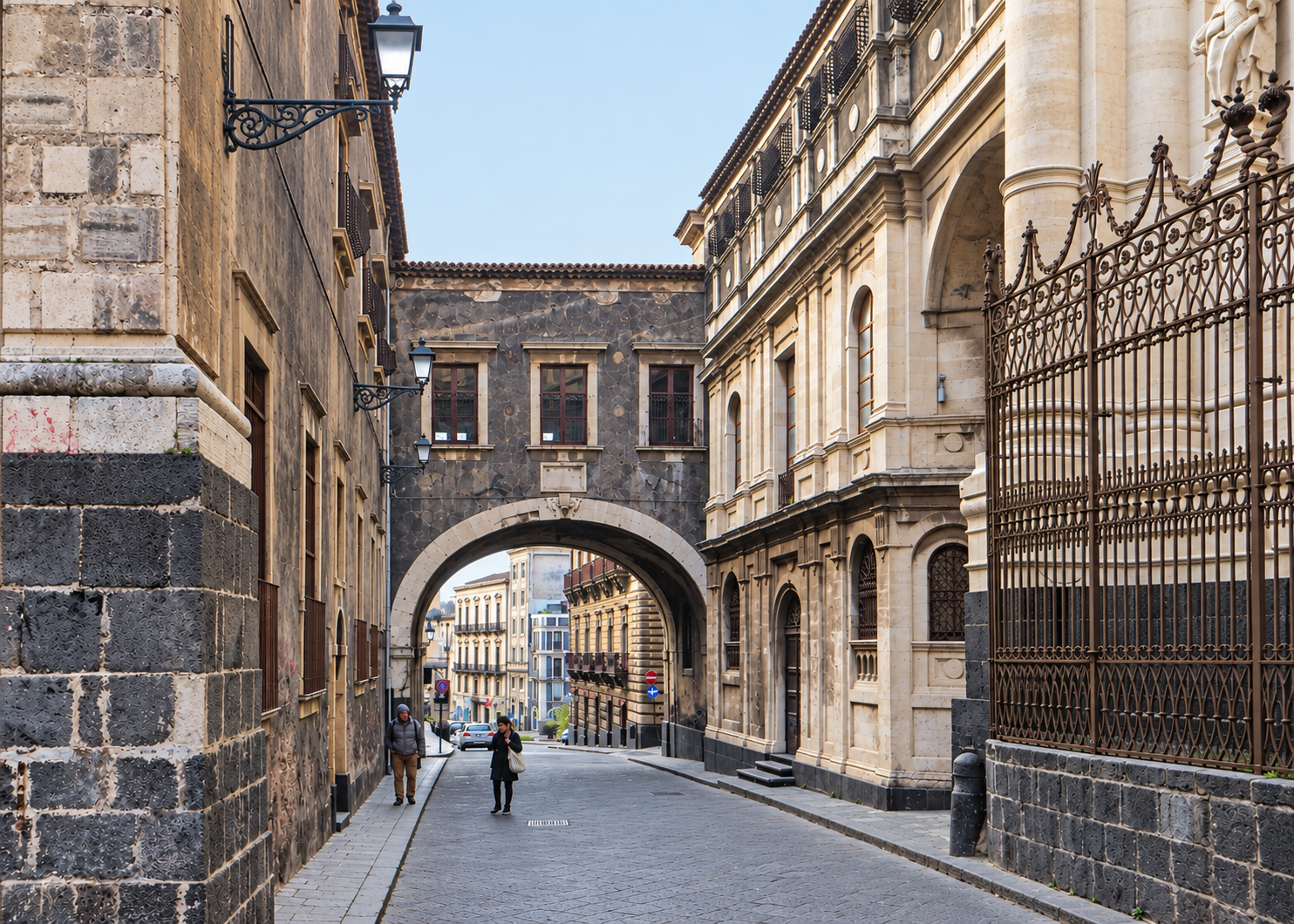
Catania needed a second look. At first, I saw a large city under a grey-black veil, with little of the immediate charm that makes some Italian towns so obligingly attractive. Then I began noticing the pale stone around the windows, the curves of a church façade, the confidence of a balcony projecting over the pavement. The darkness acquired texture, and somewhere between one square and the next, I started wishing I had allowed myself more time.
Much of that distinctive colour comes from Etna. Lava stone appears in buildings, steps and paving, while volcanic material mixed into plaster gives other surfaces their smoky tone. Against it, white limestone and marble become unusually vivid. Catania’s dark façades can look austere from a distance, but up close they reveal surprisingly elegant details, especially if you let your gaze wander above the shopfronts.
Architecture was what I had mainly come to see, and there was plenty to occupy me. But the city also had Bellini, whose name kept turning up on monuments and eventually on my dinner plate, and a fish market capable of holding the attention of someone who does not even like eating fish. I felt comfortable here. There was an ease to the everyday life around me that the grandest façade could only partly explain.
I explored Catania over two mornings, between trips elsewhere in Sicily. I saw many of the buildings described below only from the outside: some were closed, while others will have to wait for another visit. If you want to follow the same route and explore the interiors too, allow at least a full day.
Before the walk: how Catania became Catania
Sicily’s second-largest city began as the Greek colony of Katane in the eighth century BC, on a site already associated with the island’s Sicel population. The name is often connected with the rough character of the surrounding ground, which seems appropriate for a city built beside Etna. Its coastal position encouraged trade, but prosperity also attracted neighbours with ambitions of their own.
In 476 BC, Hieron I of Syracuse expelled the inhabitants and installed a new population, even renaming the city Aitna. The original inhabitants later returned, but independence remained precarious: Catania was drawn into the struggles involving Syracuse, Athens and Carthage before coming under Roman rule in 263 BC, during the First Punic War. Under Rome it developed into an important urban centre; Cicero’s references to the city belong to that long period of prosperity. The remains encountered on this walk give some idea of its scale.
After the Roman period came the upheavals of Vandal and Ostrogothic power, Byzantine rule, Arab conquest and, in the eleventh century, the Normans. Later, the conflict between the Angevins and the Aragonese brought Catania into the dynastic struggles of medieval Sicily. It became an important royal residence under the Aragonese kings, before Sicily’s incorporation into the Crown of Aragon in the early fifteenth century drew it more firmly into the political world of the Iberian monarchies.
Two seventeenth-century disasters explain much of the city visible today. In 1669, Etna’s lava reached Catania and flowed into the sea; in 1693, a devastating earthquake struck southeastern Sicily and destroyed much of the city. The rebuilding produced the broad streets, theatrical squares and Baroque churches through which I would be walking. The date keeps recurring in the histories of churches and palaces, a reminder of how thoroughly the earthquake divided Catania’s story into before and after.
Via Etnea and Villa Bellini
My own part in that story began on New Year’s Day, considerably earlier than a holiday morning normally requires. I had already booked a morning train to Syracuse. Catania had to fit in before it. My loyalty to Marriott had placed me at the Four Points by Sheraton, a few kilometres up the coast, so getting into town meant taking the hotel’s minibus. After a quick breakfast, I was ready for it at 8.30. Public transport offered limited practical alternatives that morning, while the shuttle was direct, reliable and, at the time, priced much like an ordinary city bus. There seemed little reason to make the journey more complicated.
By about nine I was on Via Etnea, the long street that provides the simplest introduction to central Catania. It runs north from Piazza del Duomo towards the slopes of the city and the direction of Etna, stretching roughly three kilometres to the area of Parco Gioeni. Much of its central section is pedestrianised, with shops and commercial premises occupying the ground floors of buildings whose upper storeys often deserve rather more attention. The street took shape during the rebuilding after 1693 and gradually extended northwards.
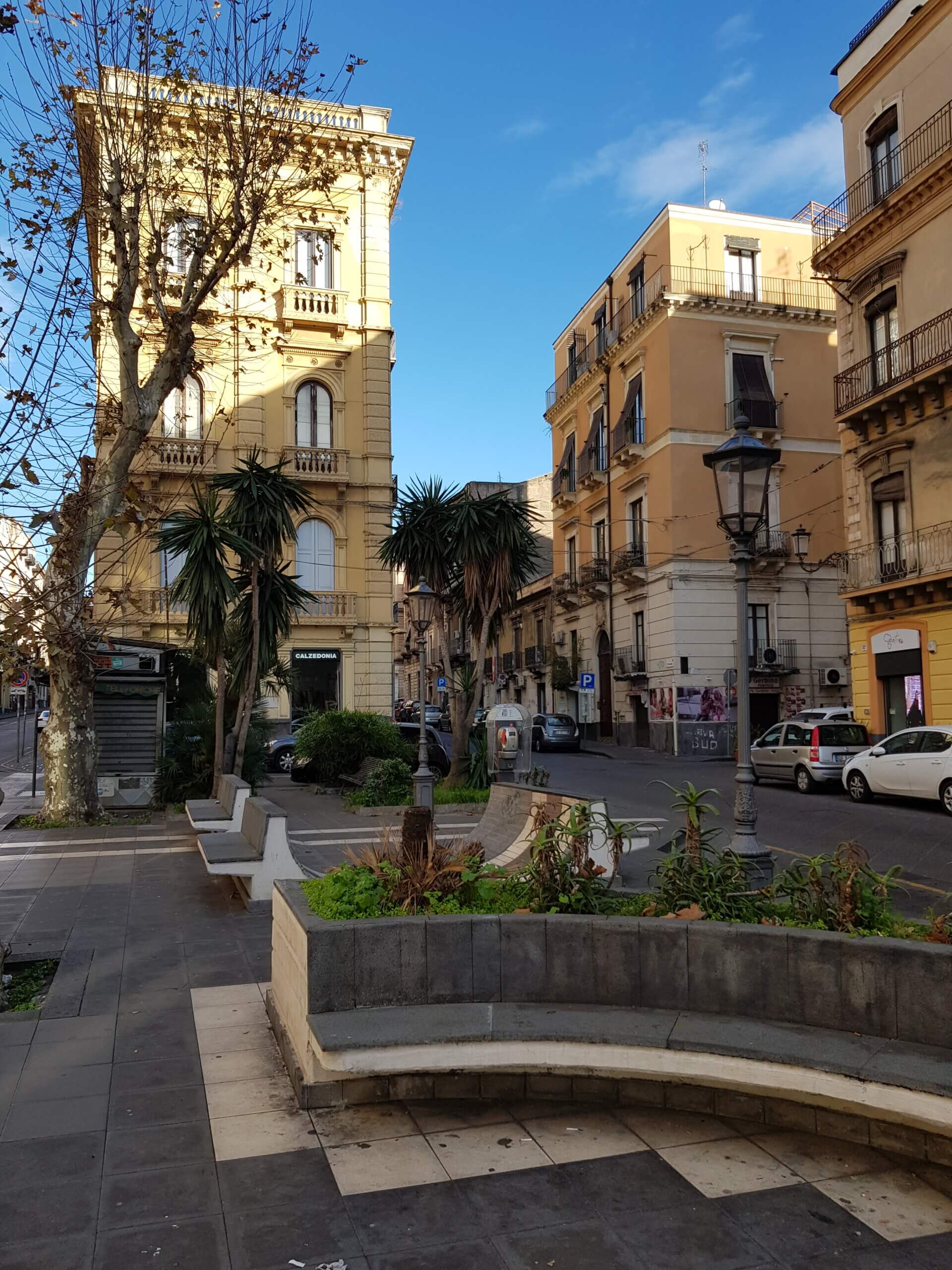
The minibus left me at Largo del Rinazzo, near the statue of Giuseppe Garibaldi and the entrance to Villa Bellini. Despite its name, the villa is a public garden, laid out on a site that once belonged to Ignazio Paternò Castello, Prince of Biscari. His eighteenth-century grounds had a labyrinth, statues and fountains: the sort of private garden in which getting lost was presumably part of the entertainment.
After the prince’s death, the garden declined. The municipality acquired its original core in 1854, expanded it through further purchases and eventually inaugurated the unified public garden in 1883. The monumental entrance from Via Etnea was added in 1932. Inside, changes of level, stairways, small bridges and winding paths make the grounds more varied than they first appear, while the hilltop bandstand and the avenue of illustrious figures give the greenery a distinctly civic character.
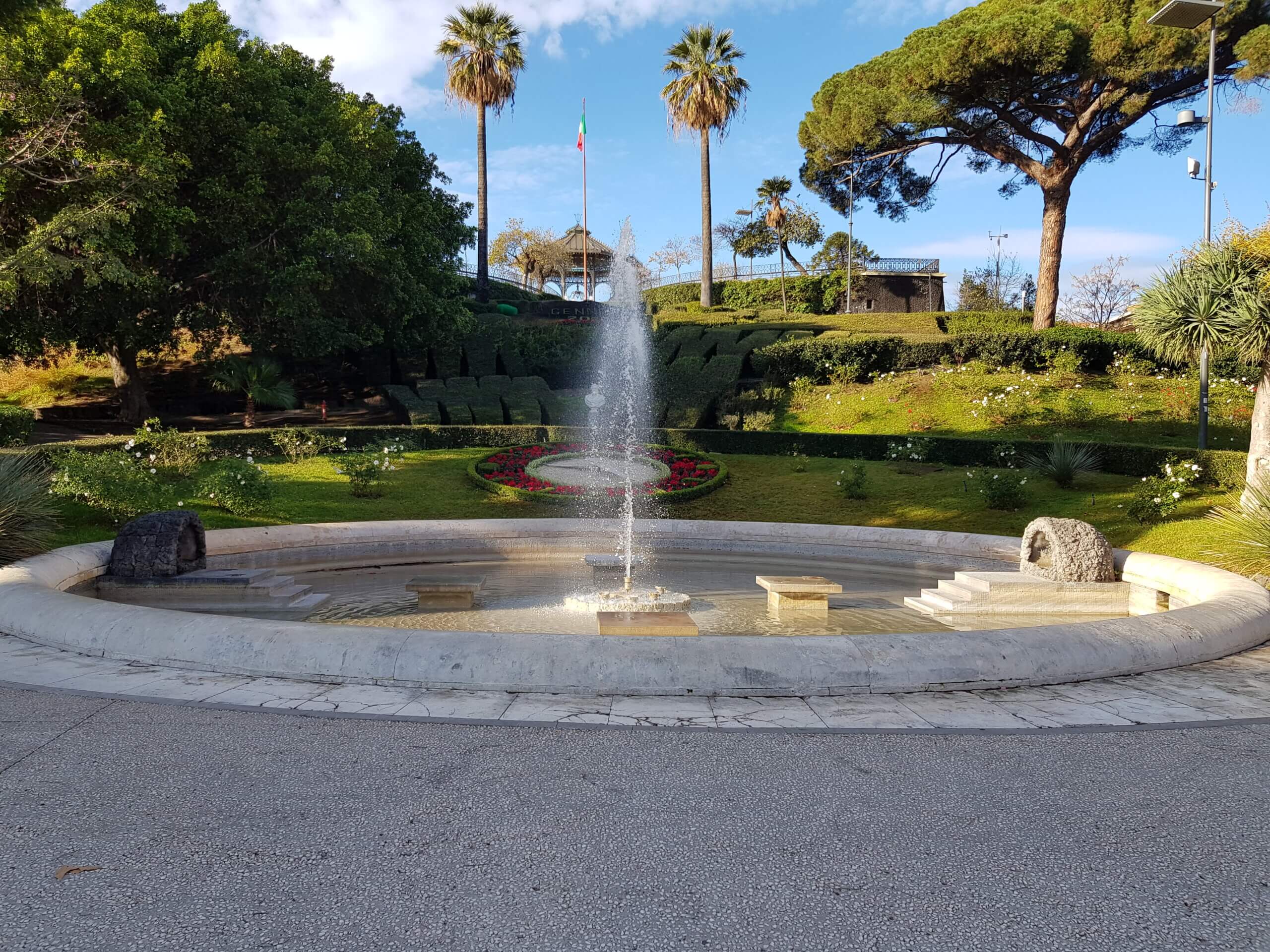
I gave the park far less time than it deserved. It was easy to see how a quick look could become a much longer wander, and I had a morning train to Syracuse to catch. Villa Bellini became the first entry on a list of things to do properly on a return visit, a list that was about to grow with embarrassing speed.
Piazza Stesicoro: Bellini above, Rome below
Walking south along Via Etnea brought me to Piazza Stesicoro, only a few hundred metres away. Its name commemorates Stesichorus, the ancient Greek lyric poet traditionally associated with Catania, where he is said to have spent the final part of his life. His reputation rests on bringing the great stories of myth and heroic poetry into choral song. Tradition also places his tomb in this area, although the square’s most conspicuous tribute to an artist belongs to a much more recent resident.
On the eastern side, Vincenzo Bellini sits high above four of his operas. Giulio Monteverde’s monument, unveiled in 1882, rises about fifteen metres, its white marble making the composer conspicuous even among Catania’s substantial buildings. Around the base, allegorical figures represent Norma, I puritani, La sonnambula and Il pirata. It is a useful monument for an opera enthusiast: the programme is already included.
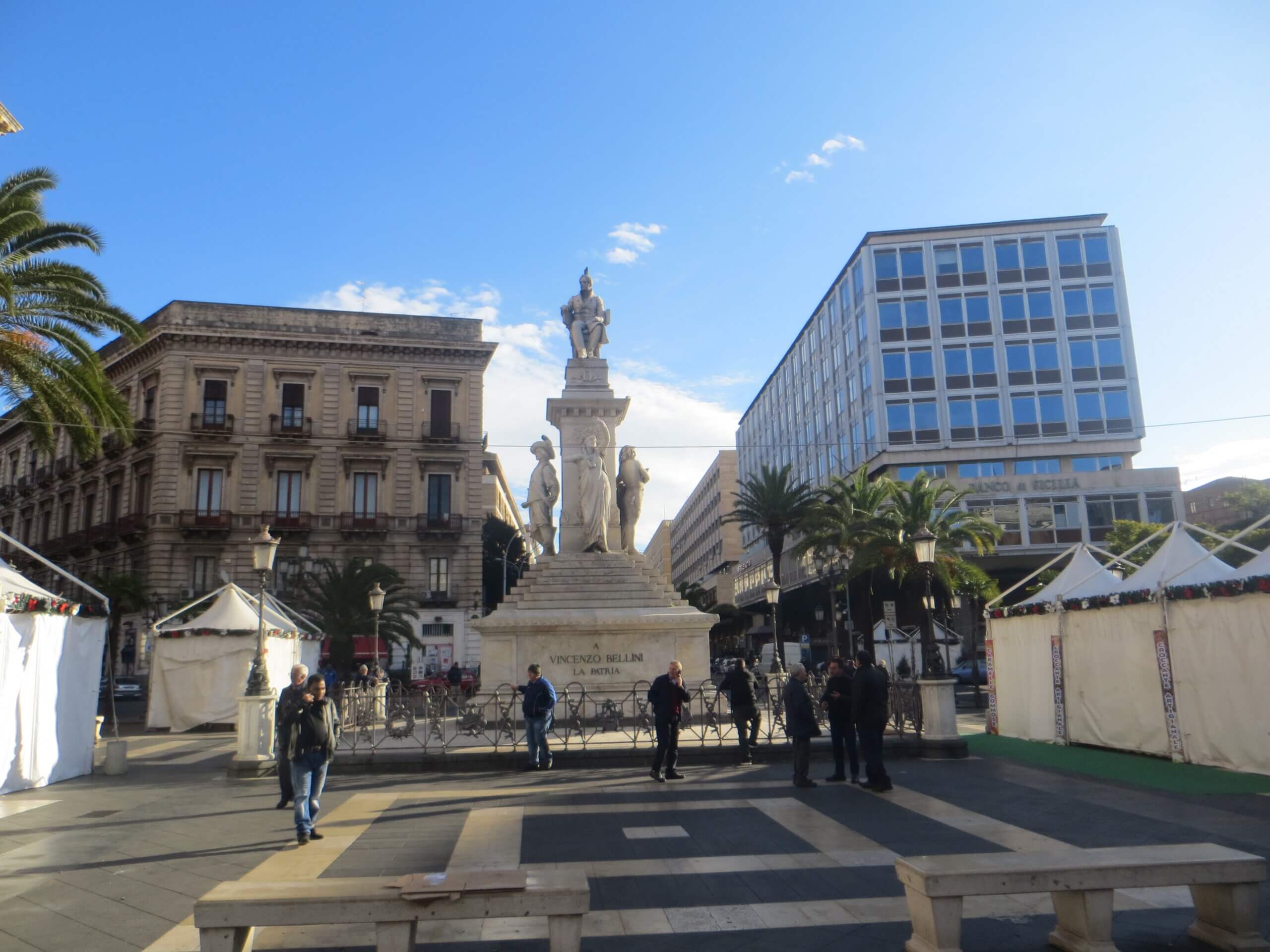
Bellini was only thirty-three when he died, having written ten operas and secured a place among the defining composers of nineteenth-century bel canto. The phrase means “beautiful singing”, but the beauty comes with considerable demands: long melodic lines, control, agility and expression all have to sound effortless. Norma, with its famous prayer “Casta diva”, remains a particularly unforgiving demonstration of how much work can be concealed beneath a floating melody. Catania’s affection for its composer extends well beyond the theatre; I would renew my acquaintance with Norma in edible form that evening.
East of the monument, Corso Sicilia opens a much more modern view. The broad street was cut through part of the historic San Berillo district during the redevelopment of the 1950s, making room for banks, offices and a different idea of urban prestige. After the compact spaces and decorated façades of Via Etnea, that change in scale is noticeable. It also provides a reminder that Catania continued remaking itself long after the Baroque rebuilding was complete.
Across Via Etnea, on the western half of the square, the city suddenly drops into its Roman past. A section of the amphitheatre lies below the surrounding streets, a fragment of a structure large enough to accommodate around 15,000 seated spectators. Dating principally to the second century AD, it was the largest amphitheatre in Sicily, built with extensive use of dark volcanic stone alongside brick and lighter materials. The surviving opening is only a small part of what once occupied this area.
The arena itself measured roughly seventy by fifty metres. Its surroundings would once have been enriched with marble, columns, statues and reliefs, but centuries of dismantling and reuse dispersed much of that material into later buildings. Eventually, the expanding city covered most of the monument. Excavations, including those of the early twentieth century, exposed the section visible in the square, leaving an intriguing mismatch between the modest patch of ruins in front of you and the scale of the building you have to imagine.
Above the ruins stands San Biagio, also known as Sant’Agata alla Fornace. The alternative name connects the church with the tradition of the furnace in which Saint Agatha suffered during her martyrdom. Rebuilt after the earthquake, it has a restrained Neoclassical façade with paired columns and a triangular pediment. Its place in the devotion to Catania’s patron saint gives it an importance that is not immediately obvious from a quick look at the exterior.
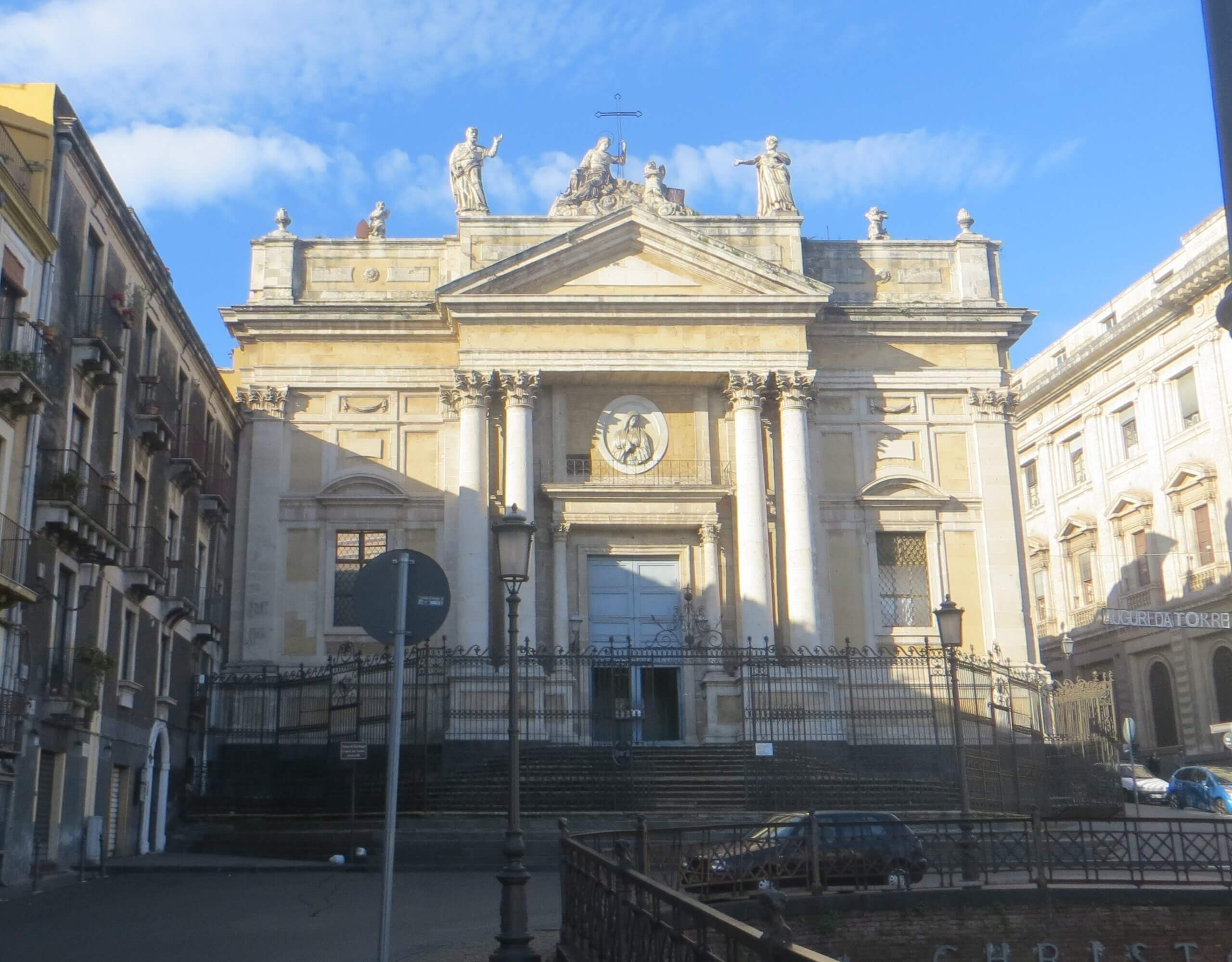
The buildings around the square also deserve a little attention, and their differences make them easier to remember than a list of names suggests. Towards the western side, Palazzo della Borsa belongs to the 1930s and the architecture of commerce. Designed by Vincenzo Patanè on the site of a former Capuchin complex, it later became associated with the Chamber of Commerce. Pale stone, a formal entrance and dark steps give it a solidity quite distinct from the more decorative palaces nearby.
Palazzo Tezzano, recognisable by its central balcony and clock, has had a particularly useful existence. Begun in 1709 at the expense of the physician and count Niccolò Tezzano, it was donated to the city for the San Marco hospital. Financial pressures eventually brought archives and judicial offices into the building, and after the hospital moved out, the courts remained until 1953. From 1915, the building also housed the Grande Birraria Svizzera, later the Gran Caffè Lorenti: a more sociable counterpart to the courtrooms. Another occupant was the university archive documenting ancient Greek vase painting. Pale pilasters divide the grey façade into a regular rhythm, giving several centuries of changing occupants a reassuringly orderly exterior.
Palazzo del Toscano expresses a more private kind of ambition. Its earlier eighteenth-century fabric was transformed in the nineteenth century, with Enrico Alvino giving the palace much of its present character around 1870. Its patron, Antonino Paternò del Toscano, was politically loyal to the Bourbons and, after Italian unification, became mayor of Catania. The broad entrance, formal Renaissance references and grand staircase inside belonged to the world of an aristocratic city residence; later subdivision created separate apartments without entirely erasing the ceremonial spaces. Nearby, Palazzo Beneventano della Corte followed a related architectural language in the later nineteenth century. The palace survived the 1950s clearance of much of San Berillo, passing to Banco di Sicilia before later returning to private hands.
From the Minoriti to Piazza Università
Continuing south along Via Etnea, I reached Palazzo Minoriti and the adjoining church of San Michele Arcangelo ai Minoriti. The former religious complex took its eighteenth-century shape during Catania’s rebuilding, with Francesco Battaglia involved in the architectural work. After the suppression of the religious house in 1866, the palace entered the administrative life of the city, housing provincial and prefectural functions. Offices, archives, cultural activities and exhibitions have since occupied the palace.
The church makes a bright interruption in the street’s darker surfaces. Its pale façade rises in ordered levels, while the interior contains three aisles, a dome, devotional paintings and an organ dating from 1858. It would make a rewarding stop beyond the shopfronts, particularly for anyone interested in the art and instruments of these working churches.
A little farther on, Via Etnea crosses Via Antonino di Sangiuliano at the Quattro Canti. The four palaces curve back at their corners, opening the intersection into an almost octagonal space. It is an architectural gesture that makes a crossroads worth stopping at: the buildings cooperate to produce a small square without giving up their individual fronts.
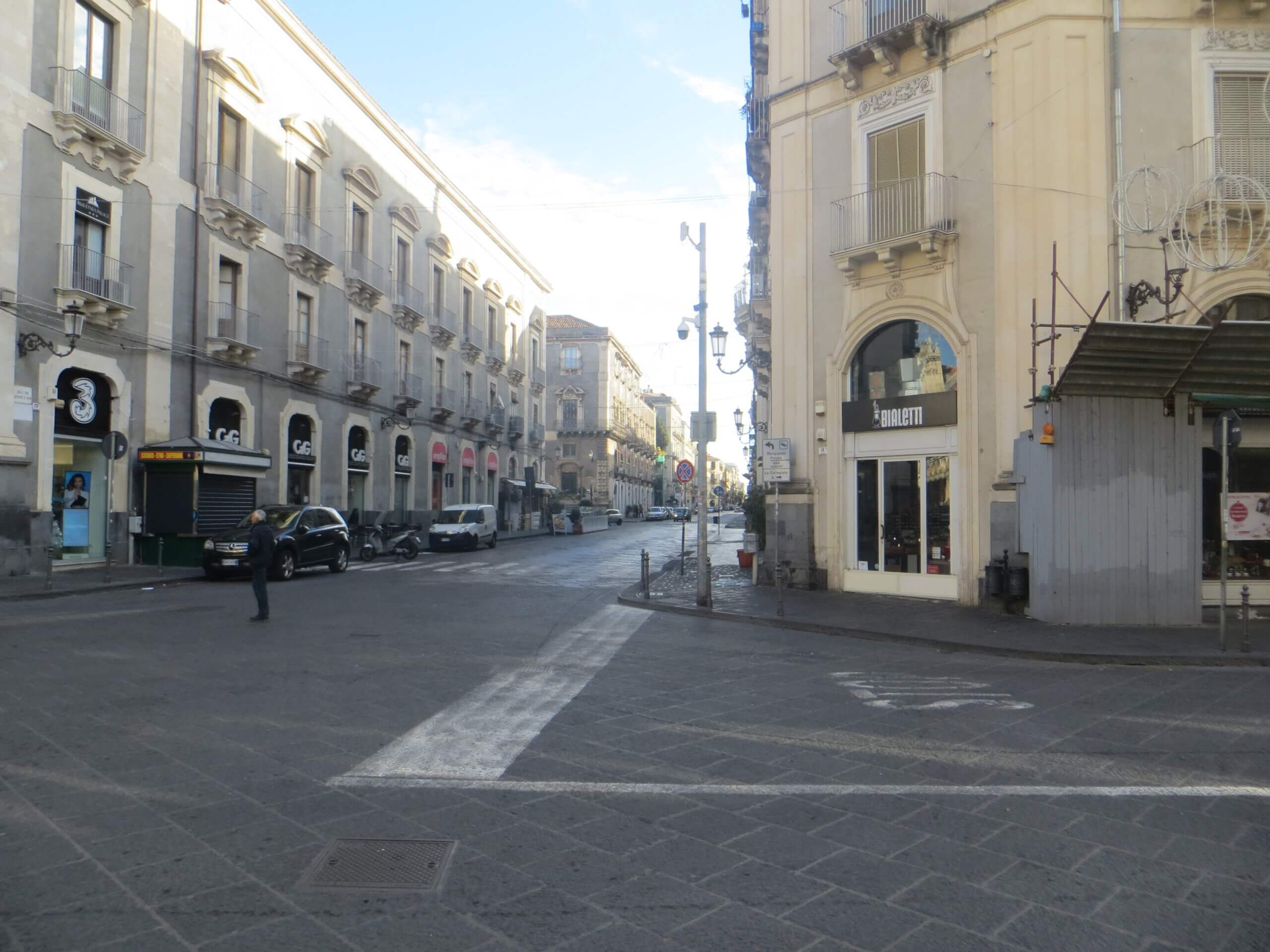
There is political theatre here too. In 1862, Garibaldi addressed the crowd from a balcony with the rallying cry “O Roma o morte!” — “Rome or death!” — during his campaign to bring Rome into the new Italian state. I had met him in statue form at the start of the walk, and now he was back on a balcony. Between Garibaldi and Bellini, Catania was already providing a fairly substantial cast.
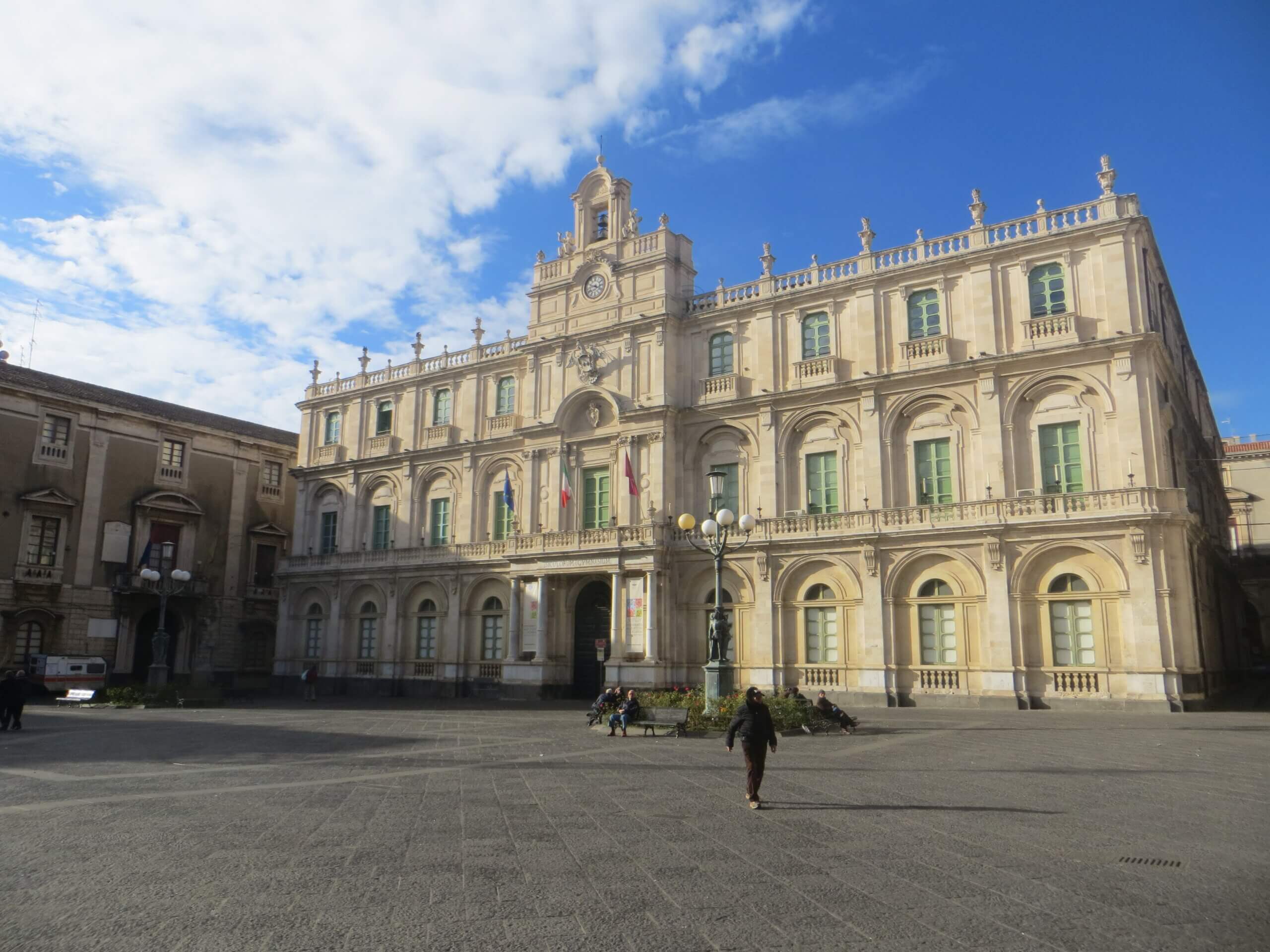
Piazza Università opens shortly afterwards. The university was founded in the fifteenth century, but its main palace belongs to the rebuilding that began after 1693: construction started in 1696, with work by several architects, including Vaccarini and the Battaglias. The building occupies an entire block around a courtyard and houses the rectorate, administrative offices and a historic library. Frescoes, ceremonial rooms and an Aragonese tapestry give the interior further layers of institutional memory.
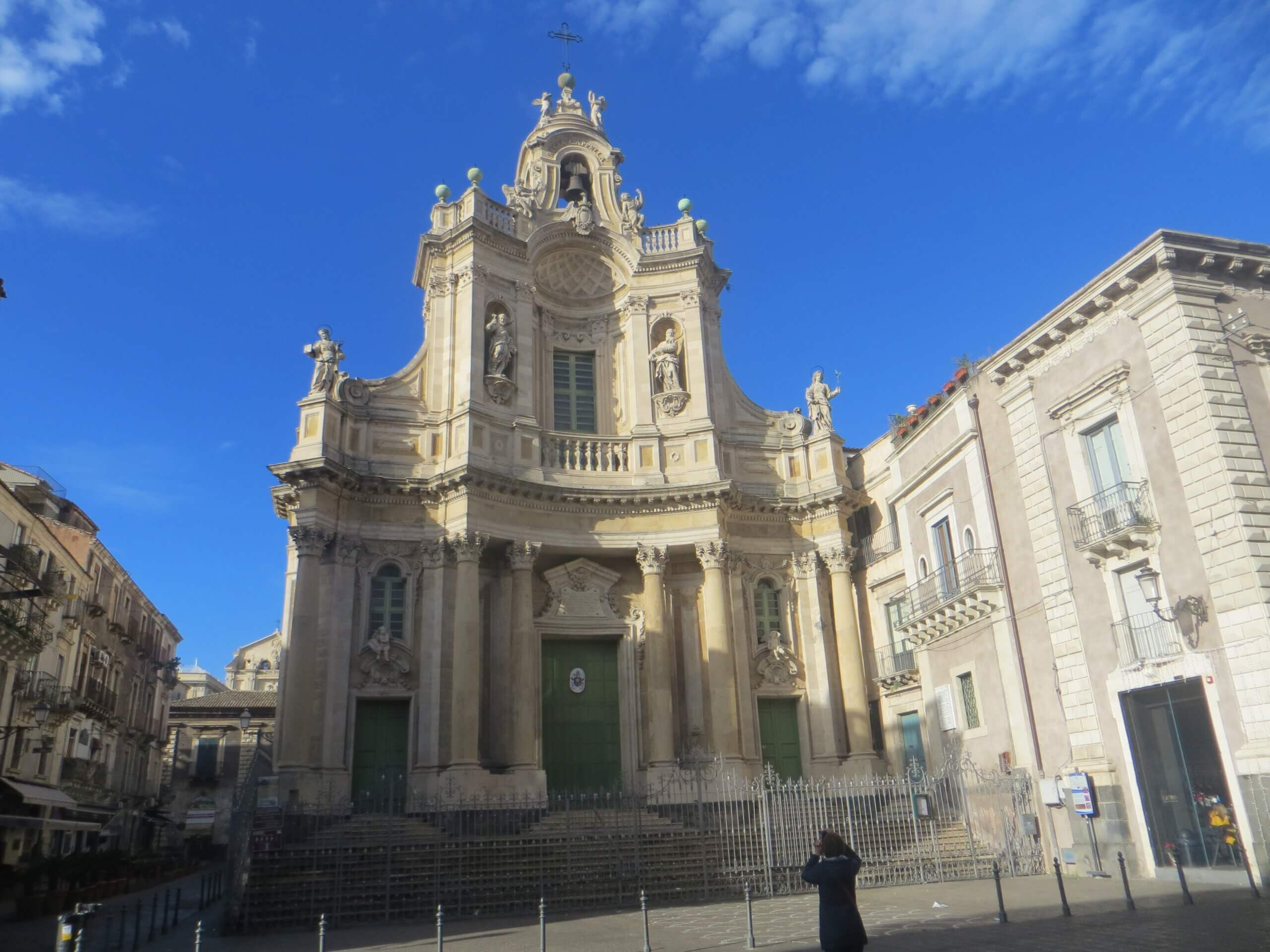
Near the northern approach to the square stands the Basilica della Collegiata, one of the most satisfying façades along this stretch. Its eighteenth-century front bends in and out, with six columns below and a central window and statues above. Steps raise the entrance from the pavement, and the upper section provides a setting for the bell. The whole composition seems designed to make you pause halfway past it and return for a better look.
The church’s history reaches behind the present building. Traditions connect the site with earlier pagan worship and a Byzantine church, while its later role as a royal chapel links it to the Aragonese court. Its present name refers to the college of canons established in the fifteenth century. After the earthquake, the church was rebuilt, and its interior acquired the frescoes, decorated chapels and funerary monuments that make it more than an attractive frontage.
Across Piazza Università, Palazzo San Giuliano has its own handsome entrance in coloured marble, with a balcony above and a courtyard beyond. Built for a branch of the Paternò Castello family, it gradually acquired uses that would have brought a rather different clientele through the door: the Bristol hotel, the Teatro Machiavelli and, eventually, university offices. The palace was altered over time, but the entrance and the staircase retain the ambition of Vaccarini’s design. University administration has inherited some remarkably good addresses.
Palazzo Gioeni, on the northern side of the square, contributes another eighteenth-century frontage and a richly worked pale-stone portal. There are smaller things to look for as well, particularly the four bronze lampposts illustrating figures from Catania’s popular legends. During my visit, a brightly coloured elephant from an installation by the Sicilian artist Ligama added a much more contemporary presence. Before meeting the city’s famous black elephant, I had encountered a decidedly less restrained relative.
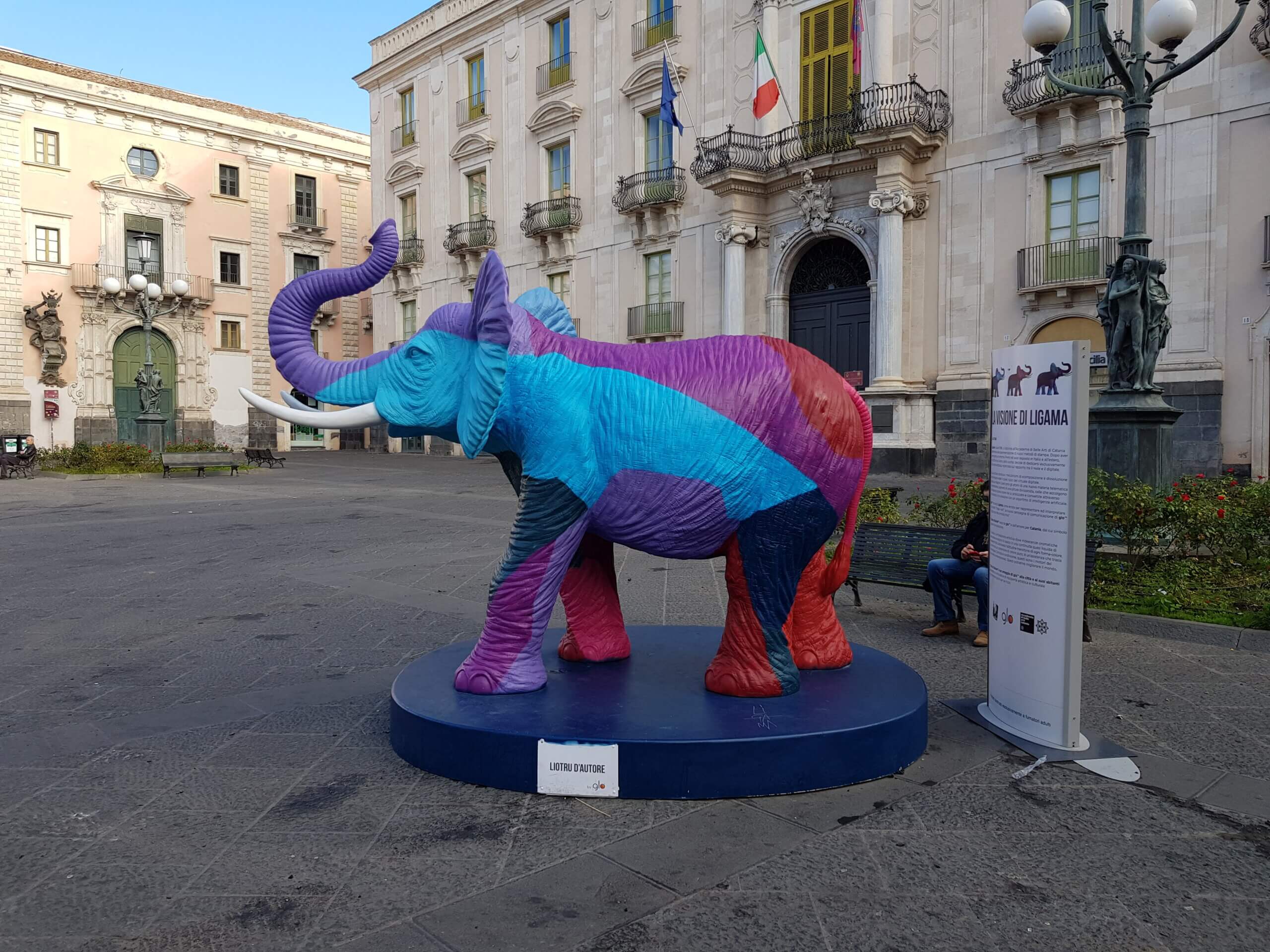
Piazza del Duomo: the elephant, the river and Saint Agatha
Via Etnea leads directly into Piazza del Duomo, where the principal buildings open out around the city’s most recognisable animal. Liotru stands in the middle of the Fontana dell’Elefante, carrying an obelisk on his back above a marble pedestal. He is a small elephant with a substantial civic responsibility, and the dark stone against the pale fountain makes him immediately recognisable.
The elephant’s origins are uncertain, which has left plenty of room for stories. It has been interpreted as an ancient protective figure and associated with memories of the dwarf elephants that once inhabited Sicily. Another tradition connects it with Eliodoro, a magician said to have used the animal for extraordinary journeys; Liotru’s name is commonly linked to his. For a traveller working around bus and railway timetables, the transport arrangements of a magician have an obvious appeal.
The sculpture’s old association with the city and the eighteenth-century fountain are different parts of its history. The elephant has been a civic emblem since the Middle Ages, while Giovanni Battista Vaccarini created the fountain composition during Catania’s Baroque rebuilding. Whatever the answer to the statue’s older mysteries, it is difficult to imagine this square without it. Liotru gives the surrounding grandeur a face.
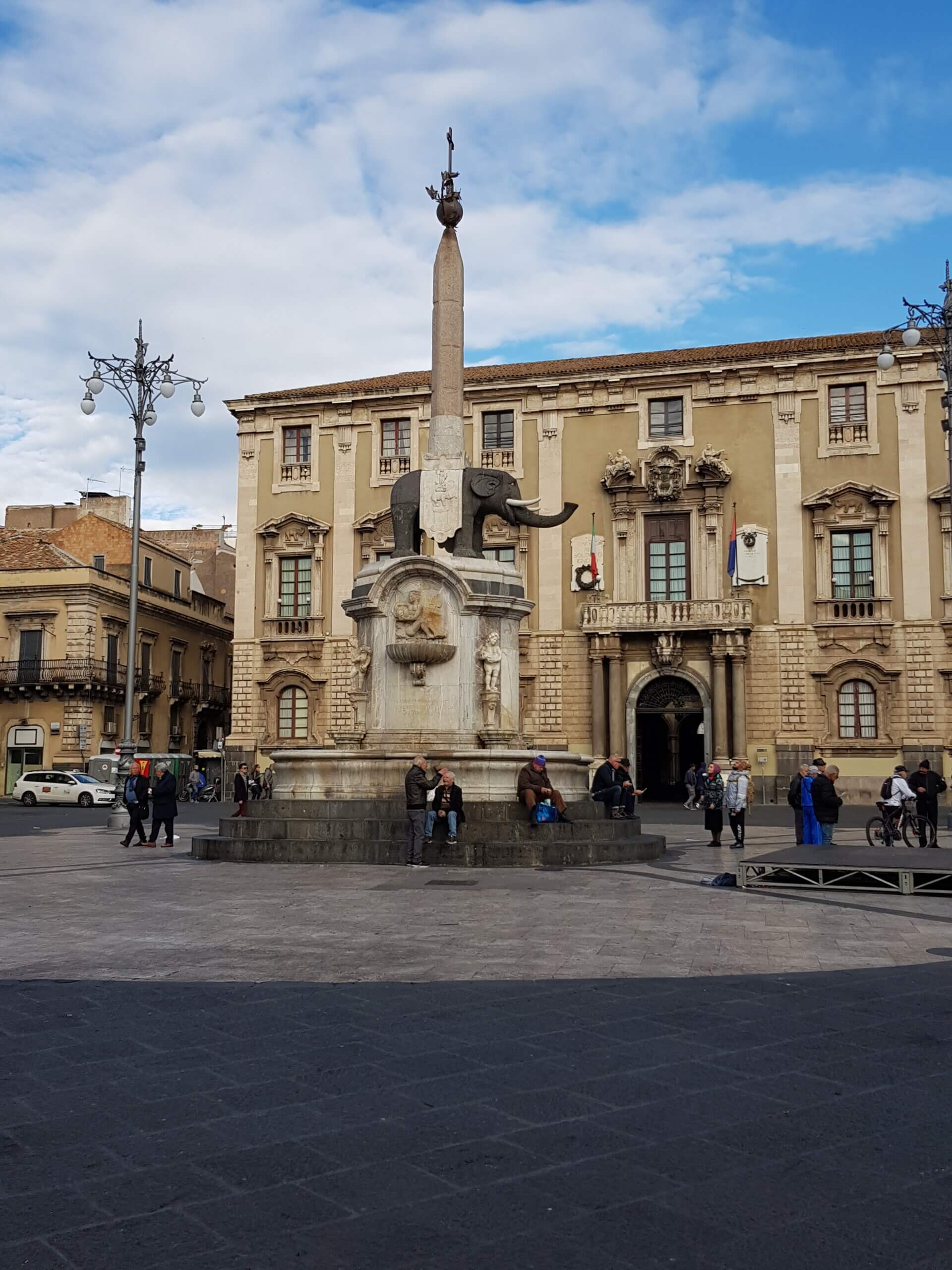
On the northern side stands Palazzo degli Elefanti, the town hall, whose rebuilding began in 1696. Vaccarini helped shape its appearance, including the formal emphasis of the central balcony and its supporting columns. Elephant motifs recur on the building, so the animal’s civic duties extend beyond posing in the fountain. Across the square, Palazzo dei Chierici, the former seminary, repeats the contrast of dark plaster and pale stone with particular clarity.
Beside the former seminary, the Amenano Fountain introduces another character whose presence is mostly concealed. The river flows beneath the city, becoming visible here below Tito Angelini’s marble fountain of 1867. A young river figure holds a cornucopia, water spreads into the basin and spills over its edge in a thin sheet. The local expression acqua a linzolu refers to that sheet-like fall of water.
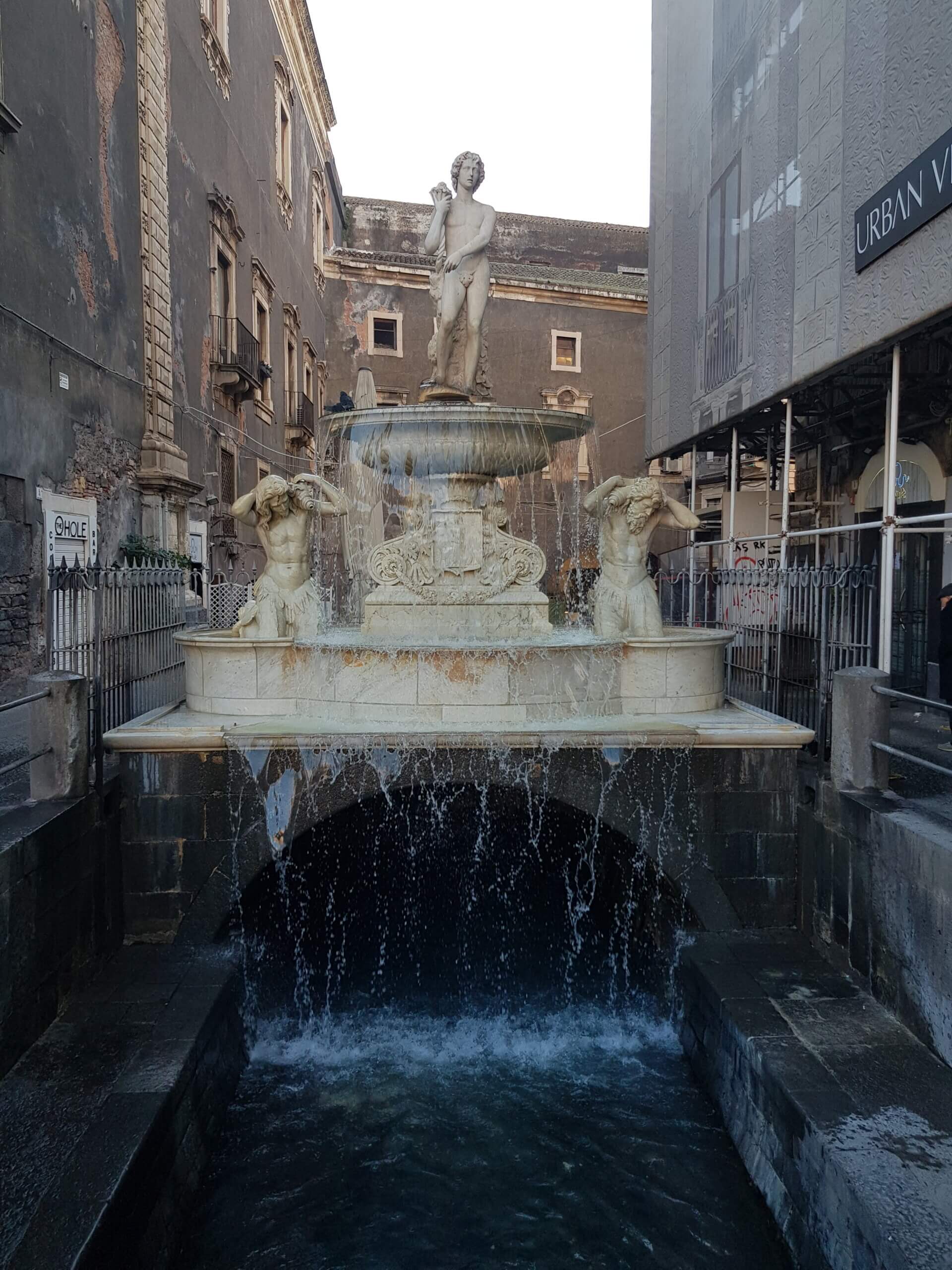
Steps beside the fountain lead down towards the old fish market. I left that for my second morning in Catania and turned my attention to the cathedral, which has a history sufficiently turbulent to account for several churches. The first Norman building was commissioned in the late eleventh century by Roger I, the count who established Norman power in this part of Sicily, on the site of Roman baths.
The earthquake of 1169 caused catastrophic destruction while worshippers were gathered for the period of Saint Agatha’s feast. Fire brought further damage in 1194, and the earthquake of 1693 again reduced much of the cathedral to ruins. Parts of its Norman structure survived, particularly around the apses, while the subsequent rebuilding gave it the Baroque appearance associated with Vaccarini. Ancient stone and columns reused in the building add another link to the Roman city beneath the streets.
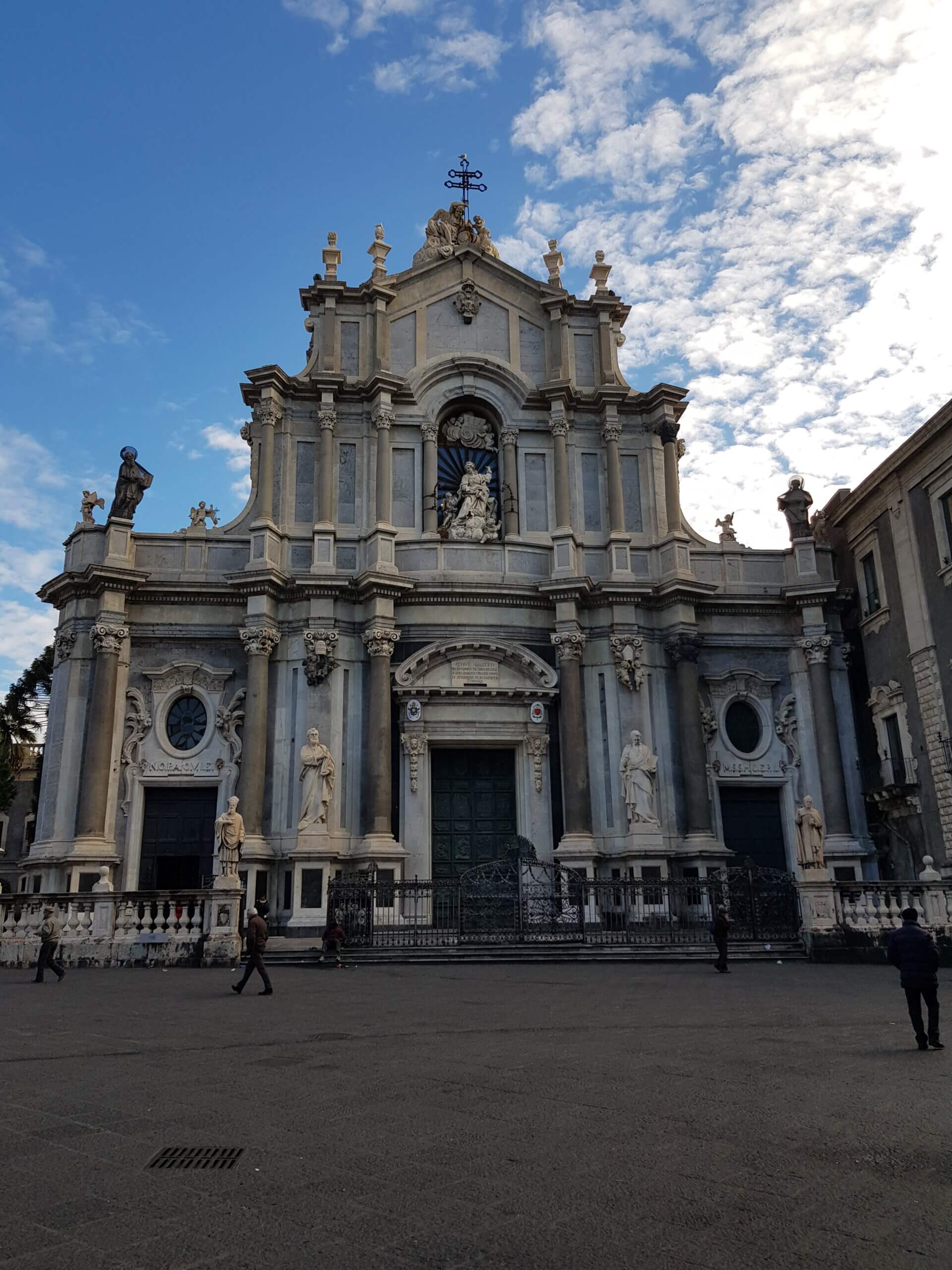
The façade brings together pale stone, grey surfaces, columns and saints in a composition that can hold its own across the broad square. Inside are works of art, the tombs of members of the Aragonese royal family and Bellini’s tomb. By this stage of the walk, the composer had acquired the familiarity of someone whose name keeps coming up in conversation. His burial here places him within the same building that preserves the city’s devotion to its patron saint.
Umbrellas, arcades and Bellini’s birthplace
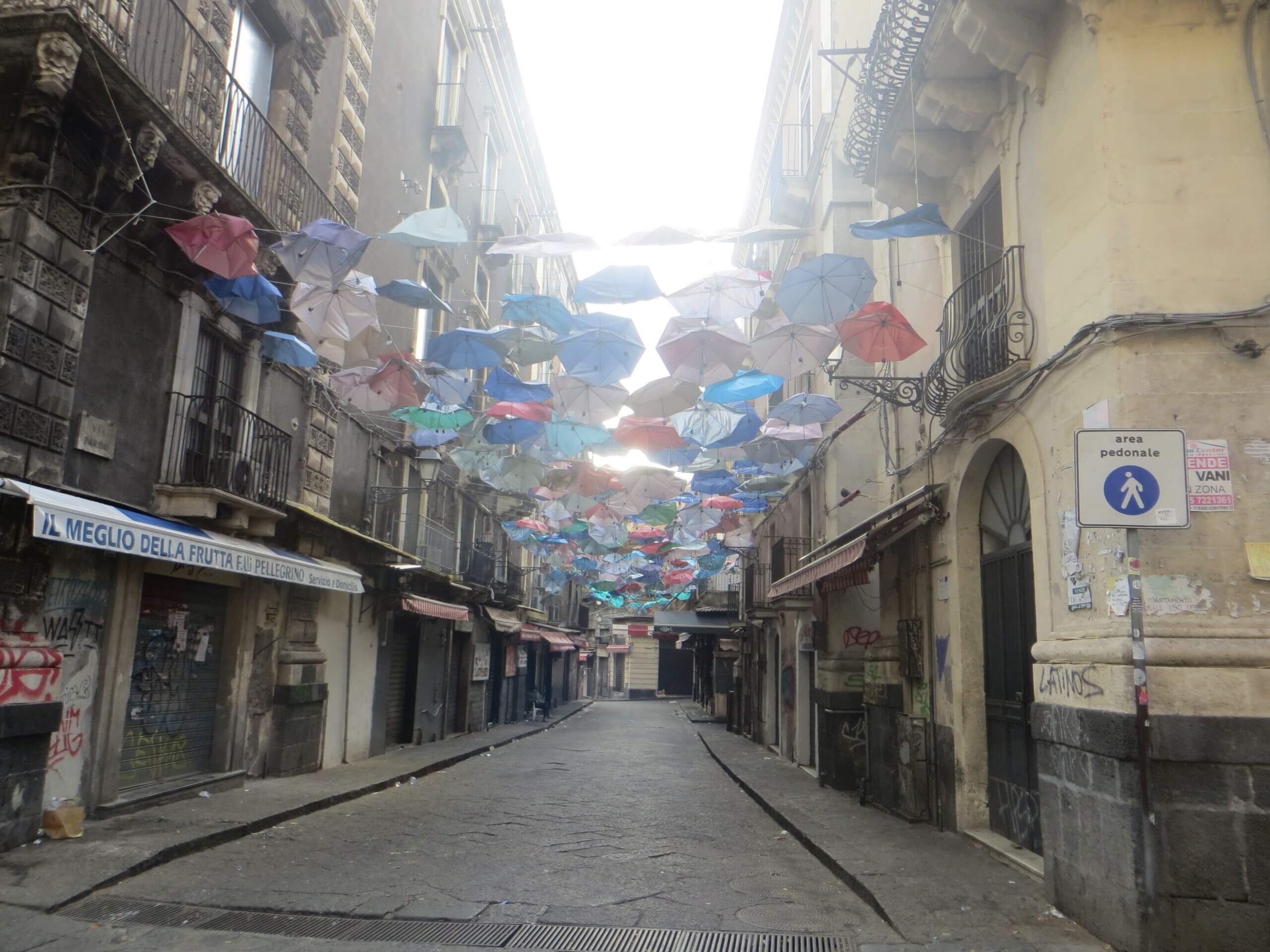
Leaving Piazza del Duomo along Via Giuseppe Garibaldi, I was drawn into Via Pardo by the umbrellas suspended overhead. The idea of filling a street with coloured umbrellas spread widely after the installations in Águeda, Portugal, became popular from 2012 onwards. It is easy to understand the appeal: shade, colour and changing patterns of light, all at the cost of looking upwards more often than usual.
The umbrellas in Via Pardo could have used some attention by the time I saw them. Even so, the colour was welcome among the surrounding stone, and their slightly tired condition did not prevent me from stopping. Catania was becoming a city of things that rewarded looking a little longer, including things that could plainly do with a replacement budget.
Back on Via Garibaldi, I continued to Piazza Giuseppe Mazzini. After the earthquake, this space was designed as a market square, with matching arcades at its four corners. Eight columns in each loggia support the arches, their pale shafts rising from dark lava-stone bases. Ancient columns reused from Roman remains give the eighteenth-century setting a much older foundation, and the terraces above belong to the surrounding palaces.
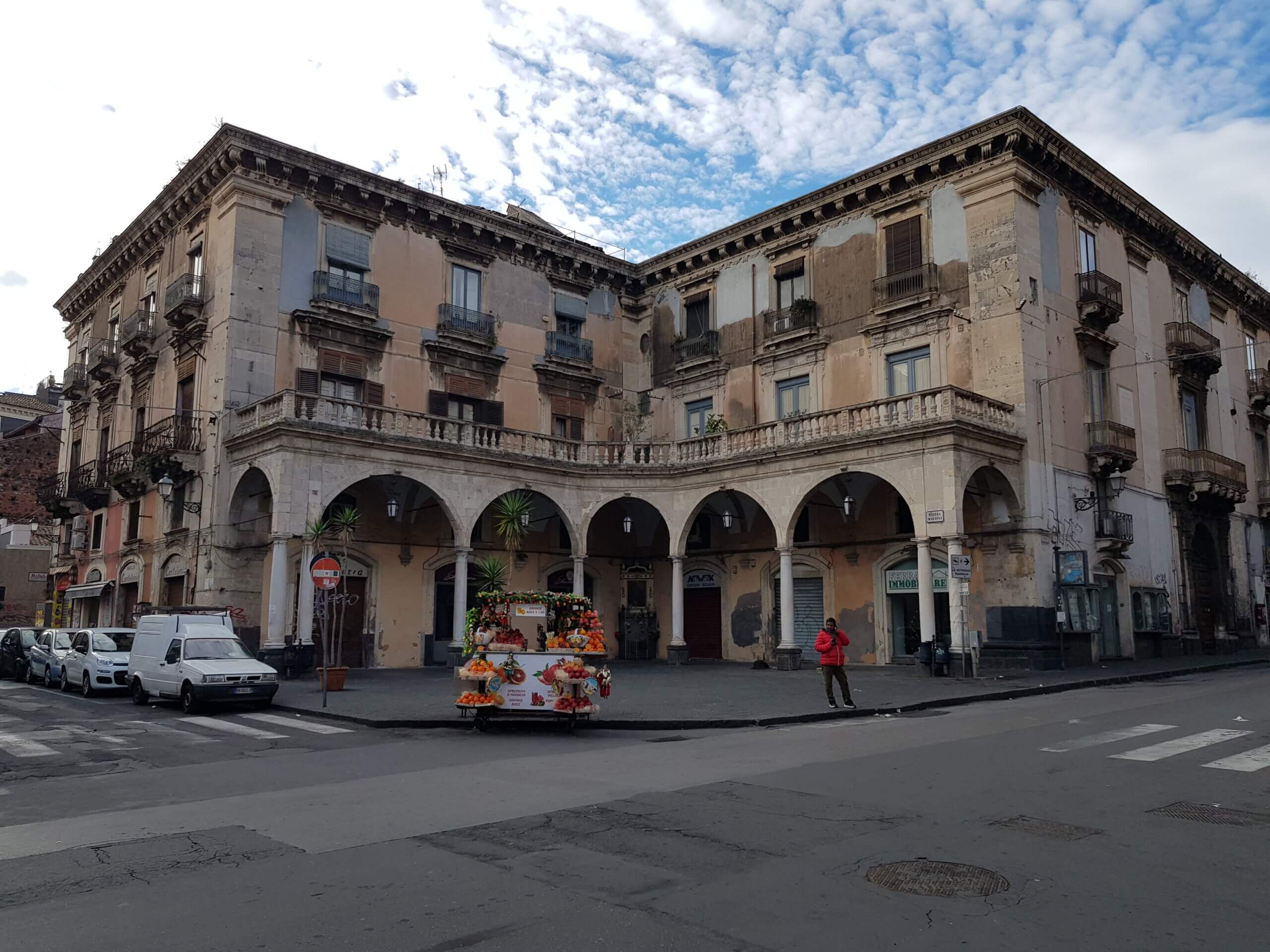
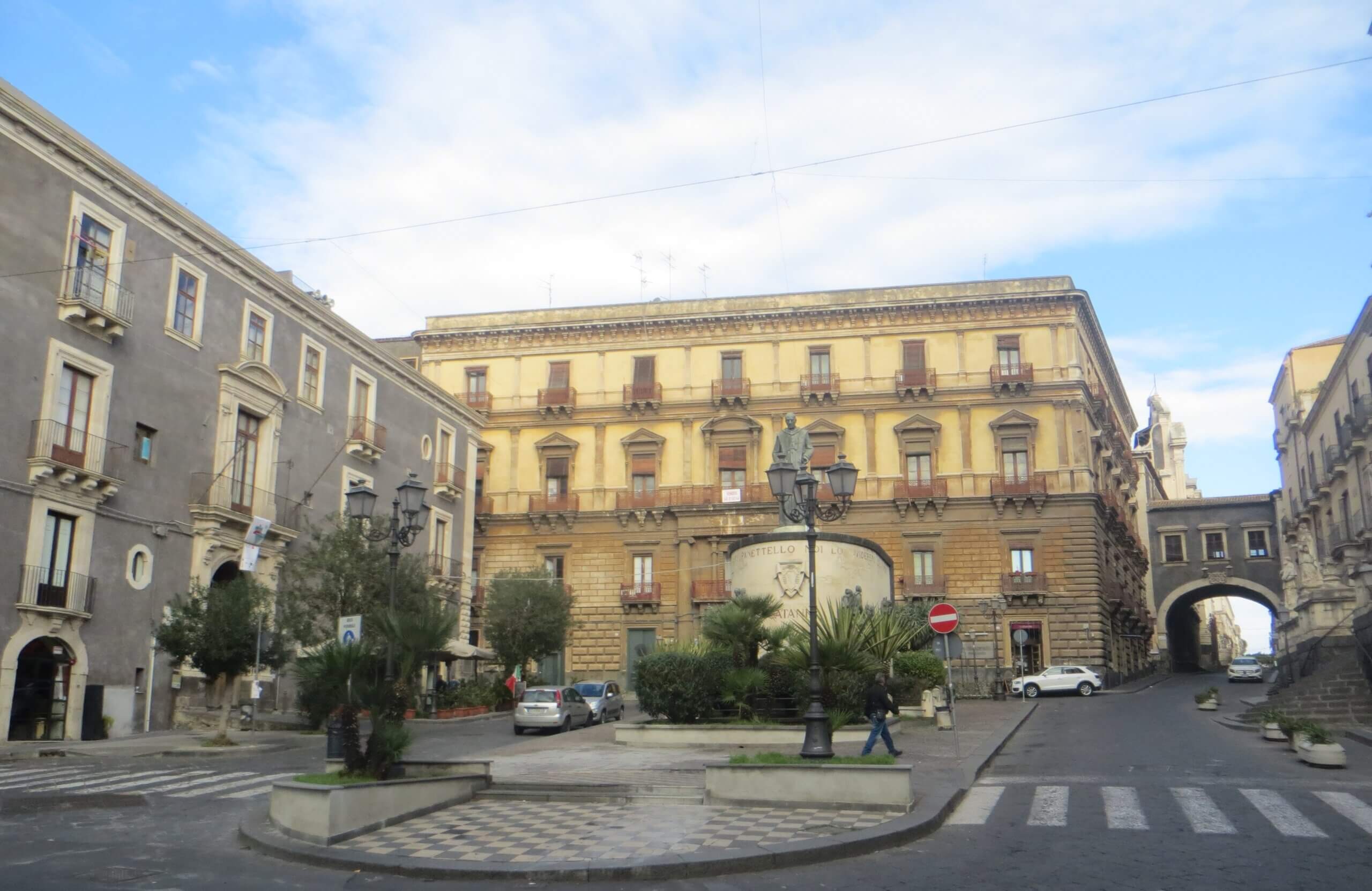
Only a few stalls occupied the square during my visit. The architecture suggested a more expansive public life than the scene in front of me, but the repeated arcades were enough to justify the detour. Turning right into Via Santa Maria della Lettera then brought me to Piazza San Francesco d’Assisi, where Cardinal Giuseppe Benedetto Dusmet stands in a monument erected in 1932, between the church and the palaces around him.
San Francesco d’Assisi all’Immacolata has its own royal and volcanic connections. Its medieval foundation is associated with Queen Eleanor of Anjou in 1329, and local tradition links her patronage to deliverance from an eruption. The present church developed after the destruction of 1693. Lava-stone steps and an iron enclosure lead towards a façade of paired columns, statues and two towers, its pale surfaces becoming more animated wherever the light catches the projecting stonework.
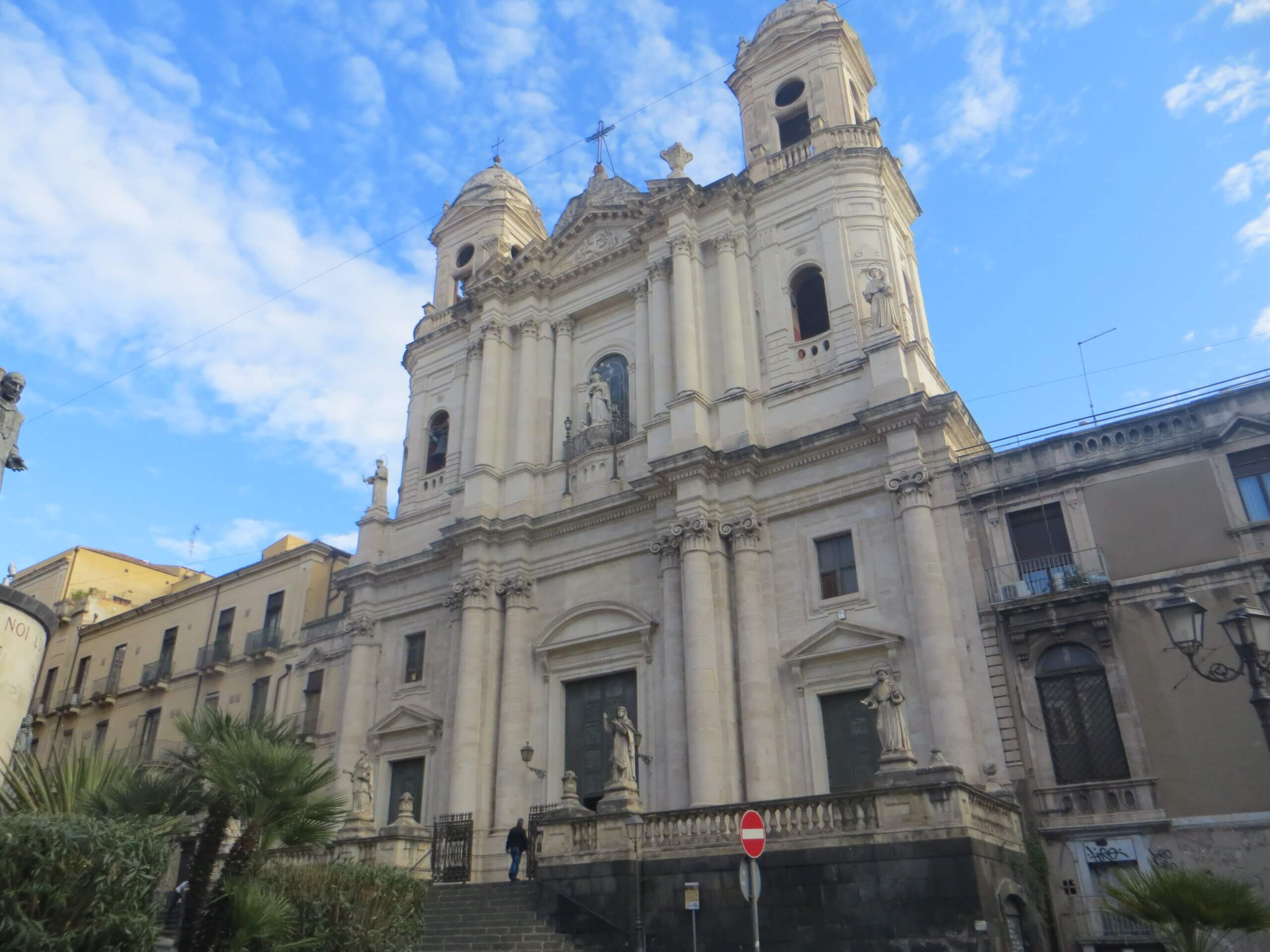
The church’s interior contains three aisles and a substantial collection of Sicilian sacred art. Across the square, however, was a building with a more personal claim on my interest: Palazzo Gravina Cruyllas, where Bellini was born. His birthplace became a museum devoted to his life and work, gathering documents, manuscripts and possessions around the rooms associated with his earliest years. Unfortunately, the museum was closed when I arrived.
The palace also housed the Emilio Greco museum at the time, and that was closed to me too. Greco, another Catania-born artist, achieved an international reputation through sculpture and graphic work; his Pinocchio and Fairy group in Collodi provides a particularly recognisable connection. The museum’s collection comprised around 150 graphic works, many exploring the female figure. Two very different artistic careers shared one address.
There is an update for anyone following the route now. The Bellini Museum’s newer multimedia installation uses rooms formerly occupied by the Greco museum, so the present arrangement should be checked through the museum rather than inferred from my visit. Bellini’s birthplace and collections remain the reason to put the palace on your route.
Nearby, later buildings concealed something I missed altogether: the Roman theatre. Palazzo Platania blocks the view of its eastern exterior from Piazza San Francesco, and I walked past without recognising what lay behind the façades. I had managed to overlook a theatre that once held thousands of spectators. That is not an achievement I am especially proud of.
The complex incorporates evidence of a Greek predecessor, with Roman construction beginning in the first century AD and major enlargement in the second. It could accommodate several thousand people, while the adjacent Odeon provided a smaller setting for music, poetry and rehearsals. Both fell out of use in late antiquity and were progressively covered by later buildings, some of which have been retained to show that longer history of occupation. Archaeological clearance gradually brought the ancient structures back into view; the water that sometimes occupies the theatre adds a further complication to its setting.
If you want to correct my omission, make the detour from this part of the walk and look deliberately for the theatre entrance on Via Vittorio Emanuele II. The amphitheatre in Piazza Stesicoro and this theatre are separate monuments. Seeing one is not a substitute for finding the other, as I discovered rather too late.
Via Crociferi: behind the Baroque façades
From Piazza San Francesco d’Assisi I continued into Via Crociferi, one of the stretches of Catania that most impressed me. The street gathers churches, religious houses and palaces into a relatively short distance, making the architecture easier to take in as a whole. Its name is associated with the Camillian religious order, known as the Crociferi, whose church of San Camillo stands farther along the street.
The arch of San Benedetto provides a particularly memorable entrance. Built in 1704, it connects the larger and smaller parts of the Benedictine convent across the street. Legend claims that it went up in a single night, an achievement that would make an uncomfortable comparison with quite a few modern building projects. The actual structure is substantial enough to turn the passage beneath it into one of the defining views of the walk.
Another story gives the area a nocturnal visitor: a headless horse. The explanation attached to the legend is that aristocrats spread frightening tales to discourage the curious from wandering into streets they preferred to use for discreet romantic meetings. That is a rather practical application of the supernatural. In a city where I had begun by imagining Venus and Mars misbehaving, it seemed only fair to allow the local nobility its own arrangements.
Behind the façades, the Benedictine convent has a much quieter history. Founded in the fourteenth century, destroyed in the earthquake and rebuilt during the eighteenth, it is still associated with an enclosed community of nuns. Prayer, work and seclusion shaped a world that existed beside the public life of the street while carefully controlling contact with it. The grilles and screened openings are part of that history, as significant to the meaning of the buildings as their decorative stonework.
Giovanni Verga explored the constraints of convent life in Storia di una capinera, later adapted for the screen by Franco Zeffirelli. The convent’s historic parlour was among the film’s settings, giving the architecture another life through literature and cinema. The smaller part of the complex has also housed the MACS contemporary art museum. There is a great deal concealed behind a street that can be walked in a few minutes.
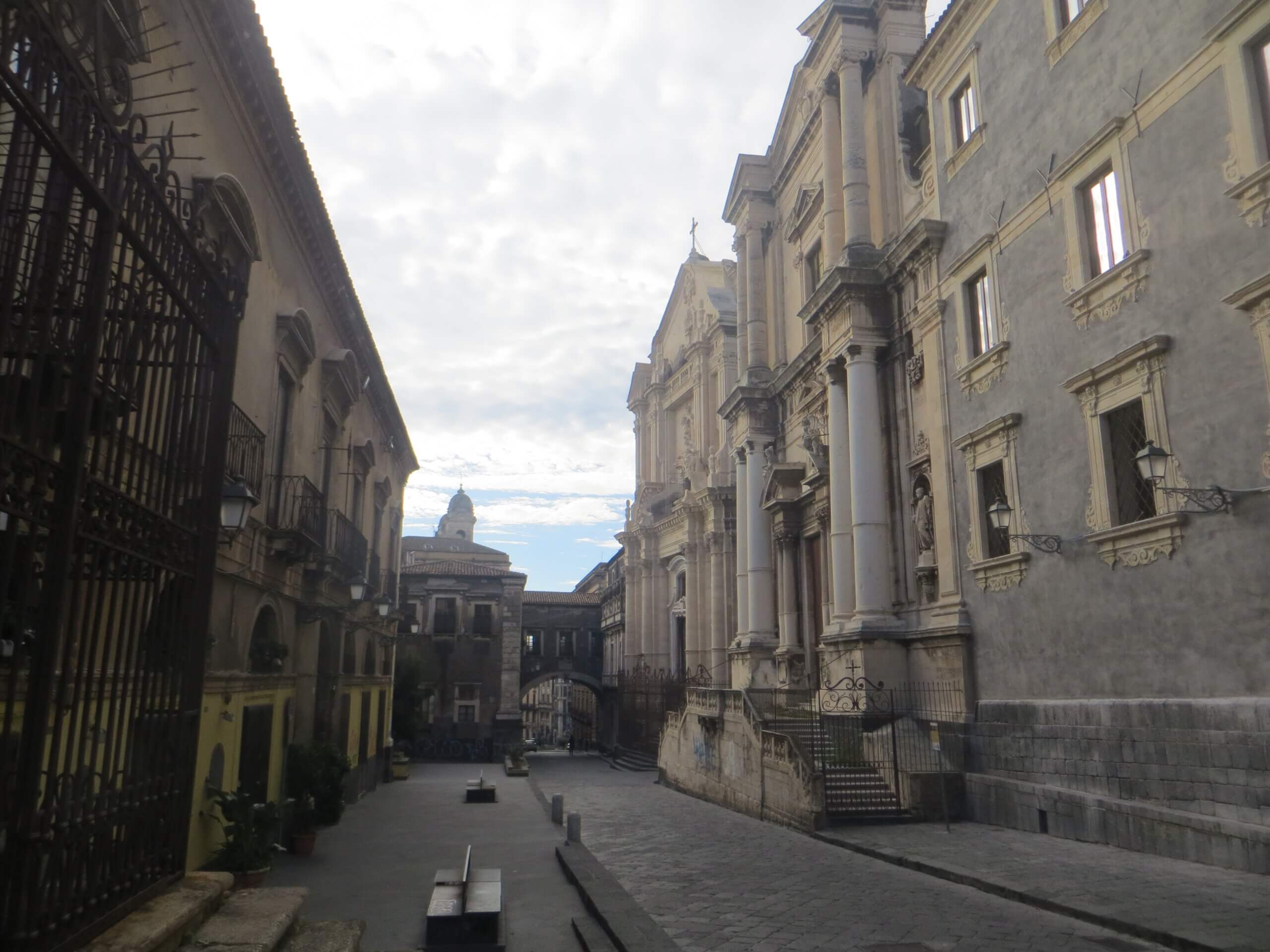
The church of San Benedetto is one of the principal reasons to explore beyond the street. Its decorated entrance and famous staircase lead towards an interior of frescoes, marble and an altar enriched with coloured stone, including jasper. Paintings of the saint’s life cover the surfaces above the worshipper, while grilles preserve the distinction between the public church and the enclosed religious community.
Beside it stands San Francesco Borgia, with a more measured front of columns arranged in two levels. Its eighteenth-century church and adjoining former Jesuit college belong to another important religious presence in Catania. Paintings, sculpture and the dome’s decoration continue the Jesuit story inside; on the street, the college’s portal, steps and dark stone provide much of the visual interest.
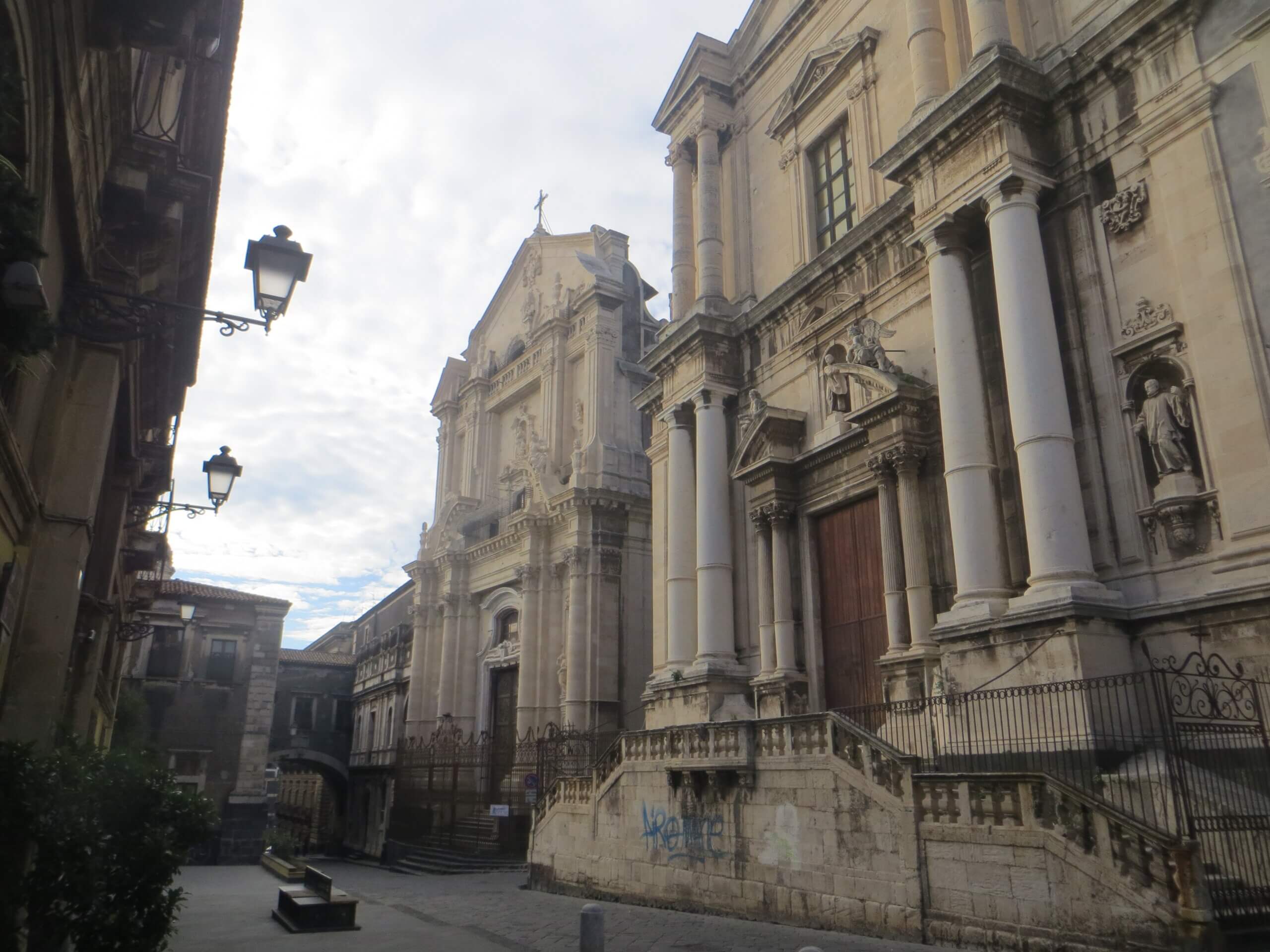
The Jesuits’ expulsion from Sicily in 1767 brought a decisive change. Their college subsequently accommodated vocational education, a hospice, judicial functions and an art institute. At the time of my visit, it was awaiting restoration.
Across the street, San Giuliano adds a rounded façade, an imposing iron enclosure and sculpted female figures reclining above the entrance. Its eighteenth-century reconstruction is associated with Giuseppe Palazzotto and Vincenzo Caffarelli, while Vaccarini’s name belongs to the design of the principal altar. Inside, the elongated octagonal plan and polychrome marble give the church a character of its own. It belonged to another Benedictine convent, whose nuns could watch the passing celebrations through screened openings.
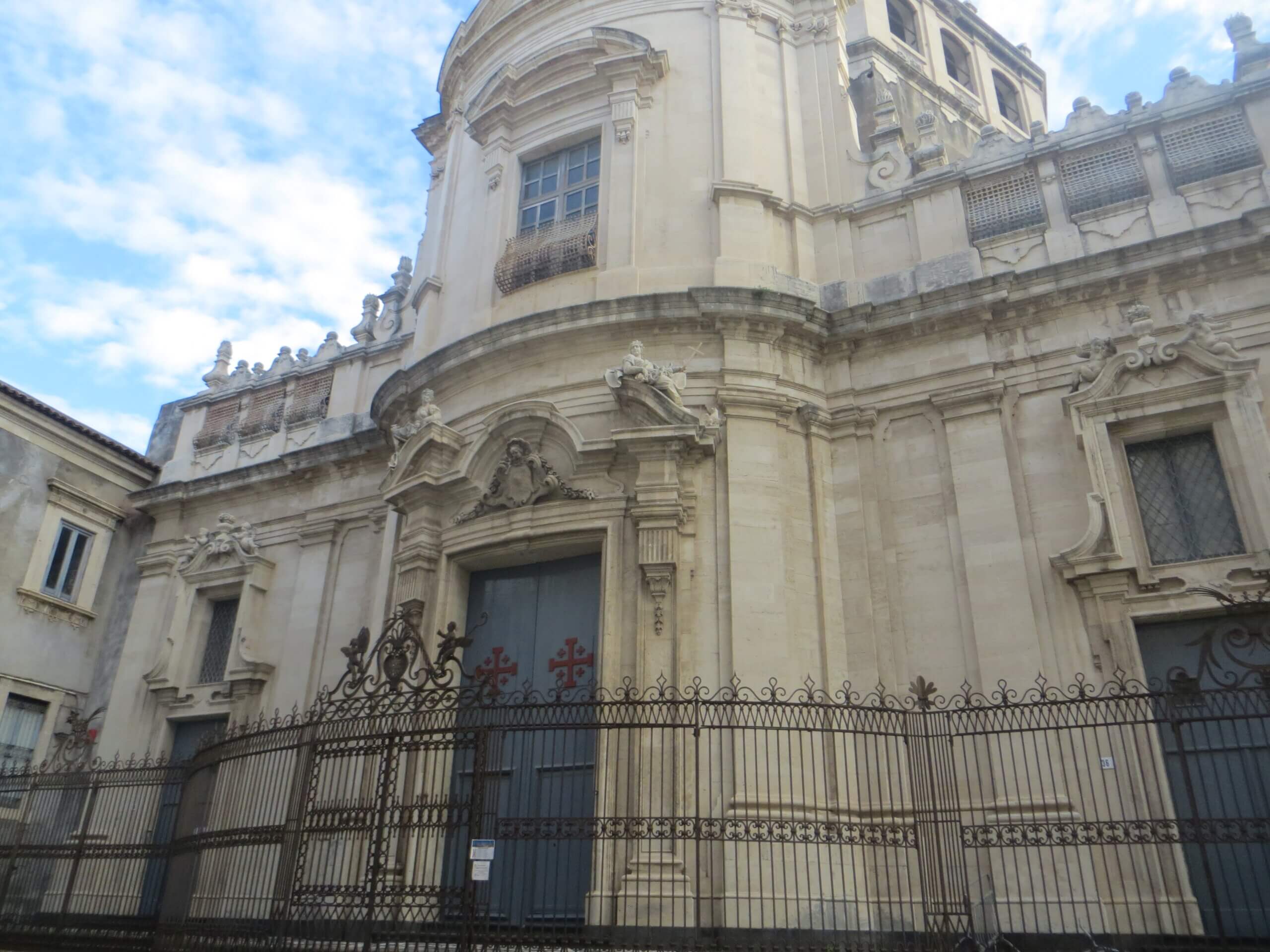
Unfortunately, this church was closed too. My guide described a view over the city and towards Etna from above, which made the locked entrance feel rather like being handed the menu after the kitchen had shut.
The repeated references to Saint Agatha begin to make more sense once you consider her place in the life of the city. The principal February celebrations take place from the third to the fifth, drawing immense crowds into processions that connect the cathedral, places associated with her martyrdom and streets throughout Catania. The candelore, elaborate gilded structures representing historic trades and communities, are among their most distinctive features. Devotion, local identity and public spectacle occupy the same streets I was exploring in the quieter circumstances of January.
There is food associated with the celebrations too, including sweets whose names and shapes refer to the saint and the traditions surrounding her. I was not there for the festival, but its presence could be read in the churches, the routes and the carefully positioned viewing grilles. The architecture preserves clues to how Catania gathers, watches and moves together at one of its most important times of year.
At the northern end of the street, an entrance led into the courtyard of Villa Cerami. The eighteenth-century residence belonged to the Rosso di Cerami family and later became the home of the university’s law faculty. The courtyard had a grand staircase and a fountain with a sculpture by Emilio Greco, whose museum I had been unable to visit earlier. At least I had now seen something of his work.
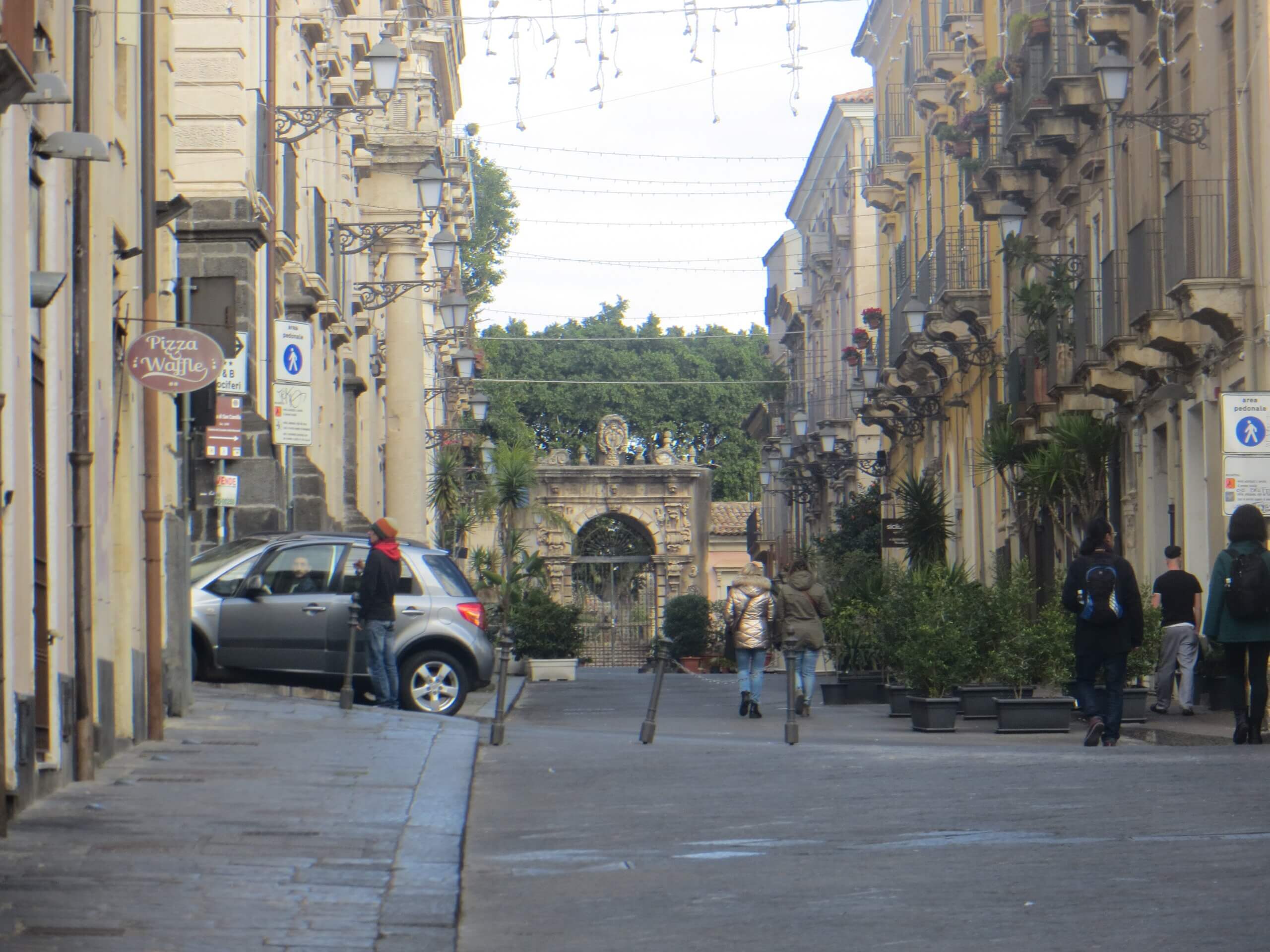
At Villa Cerami I turned back along Via Crociferi towards Via Vittorio Emanuele II. My train to Syracuse was due to leave at 10.45, and I still had to cross the eastern part of the centre to reach the station.
Just one more building
At Via Vittorio Emanuele II, I turned east. This street carries you back past the cathedral area and on towards the station, but it does little to help anyone who is trying to stop sightseeing. One church gives way to another palace, and even the buildings passed on the way to transport have histories capable of delaying departure.
Near the cathedral stands the Badia di Sant’Agata, the church of another former Benedictine convent. Vaccarini’s design plays particularly well with curves: the façade draws inward at the entrance and pushes outward to either side, while ironwork and paired columns enrich the approach. Much of Catania’s Baroque seemed to depend on what happened when a wall refused to remain flat. The church’s eighteenth-century construction was financed by the nuns, and the dome remains one of the recognisable features of the city skyline. The elevated view is another reason to investigate access if you have time; I continued at street level.
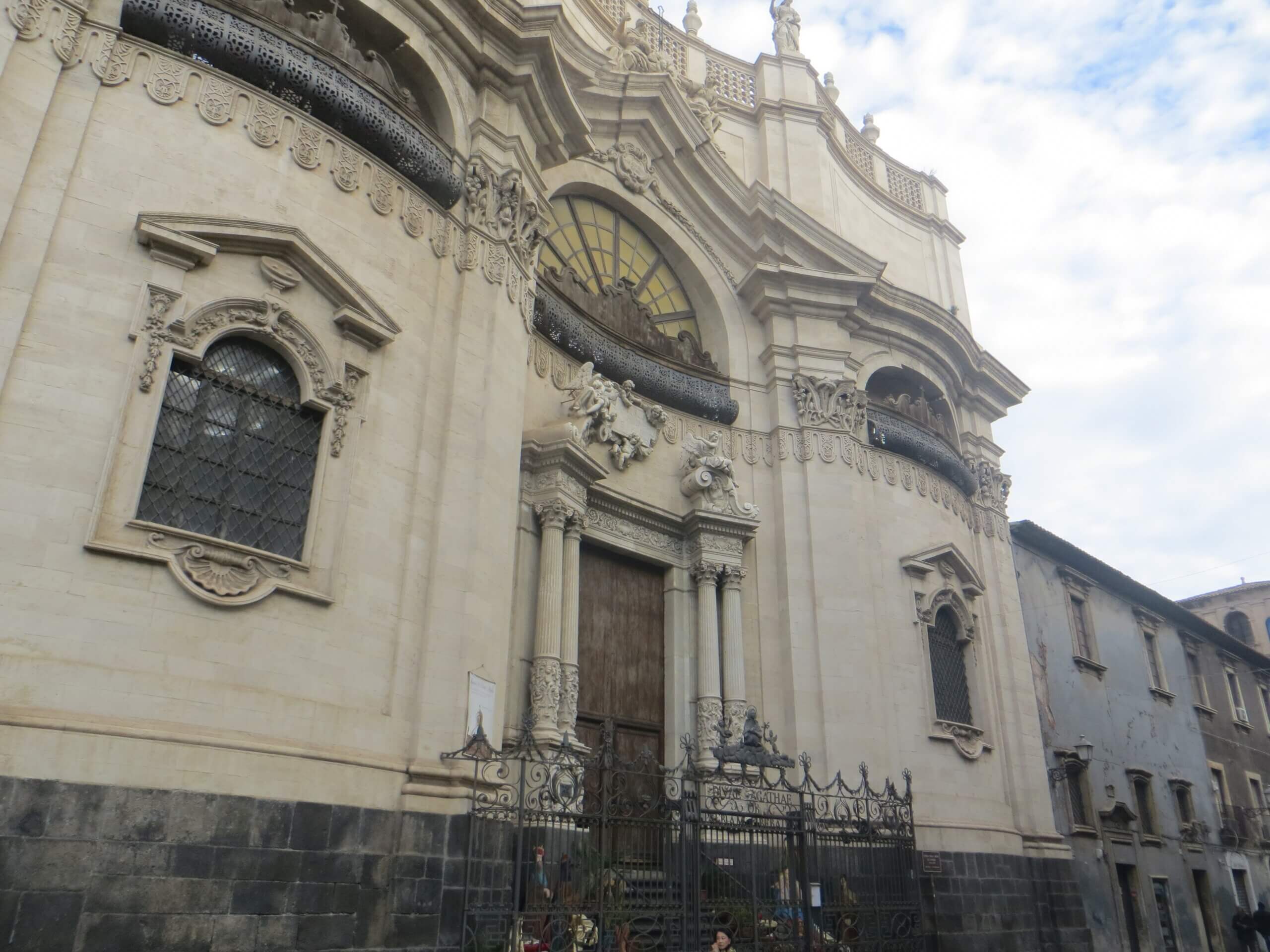
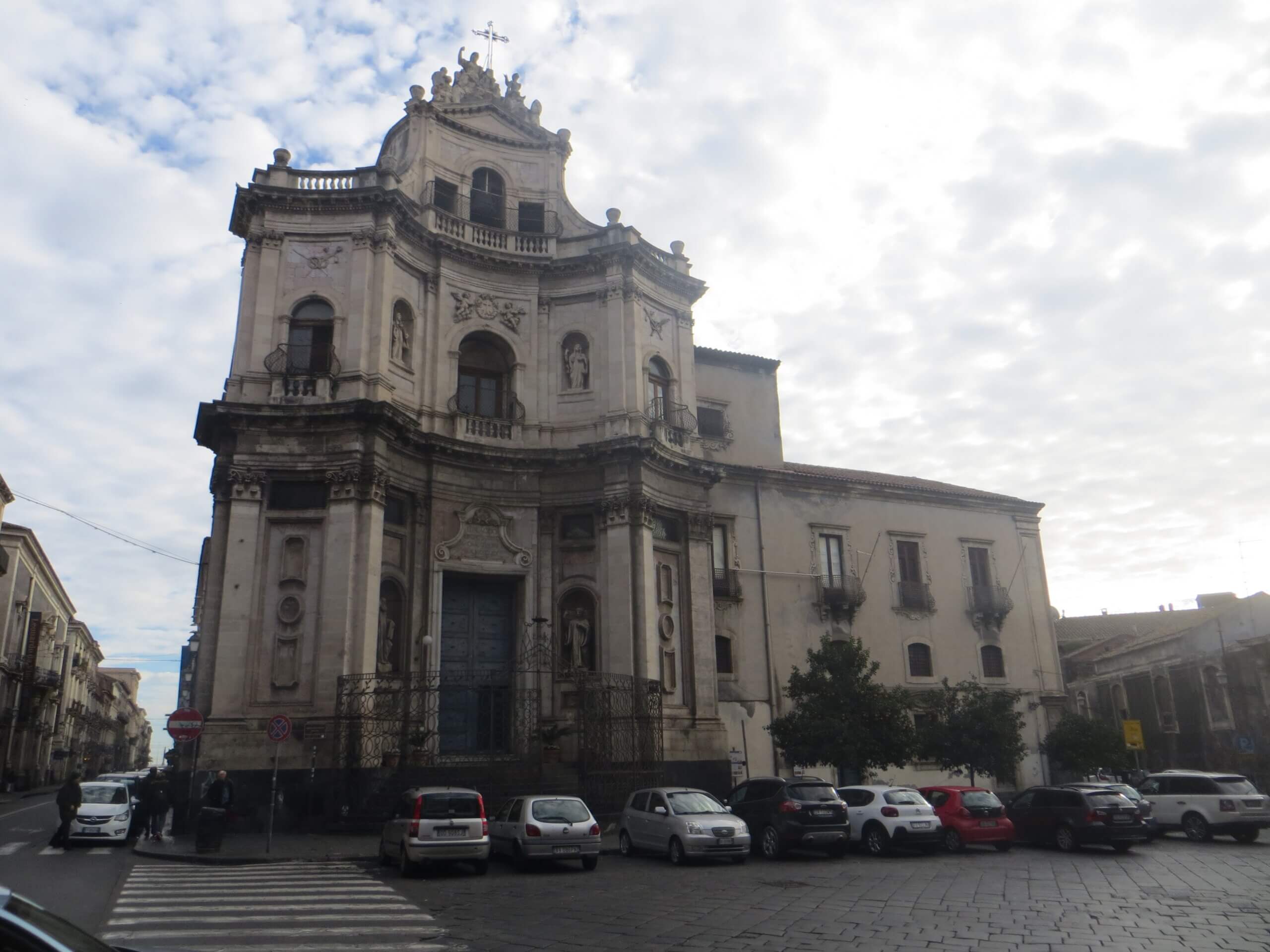
The tourist information office was beside the church during my visit. Beyond it, I passed the state archive and reached Piazza San Placido, where the church of the same name presents a concave front of pale stone. Stefano Ittar was responsible for its reconstruction after the earthquake, creating a composition of statues, windows behind grilles, an elaborate iron enclosure and three bells at the top.
Traditions connect the site with a sanctuary of Bacchus and claim that Saint Agatha was born here. The decoration continues inside the eighteenth-century church, with marble and gilded stucco, while statues of Saint Placidus and Saint Benedict watch over the entrance. Even on a hurried walk, the shape of the façade makes it recognisable among the churches already encountered.
The adjoining Palazzo Platamone adds a surviving fragment of a much older Catania. The family’s medieval residence was given to a religious community, and a loggia with a balcony remains within the later complex. The buildings have since taken on a cultural role as the Palazzo della Cultura, hosting exhibitions, performances and other events.
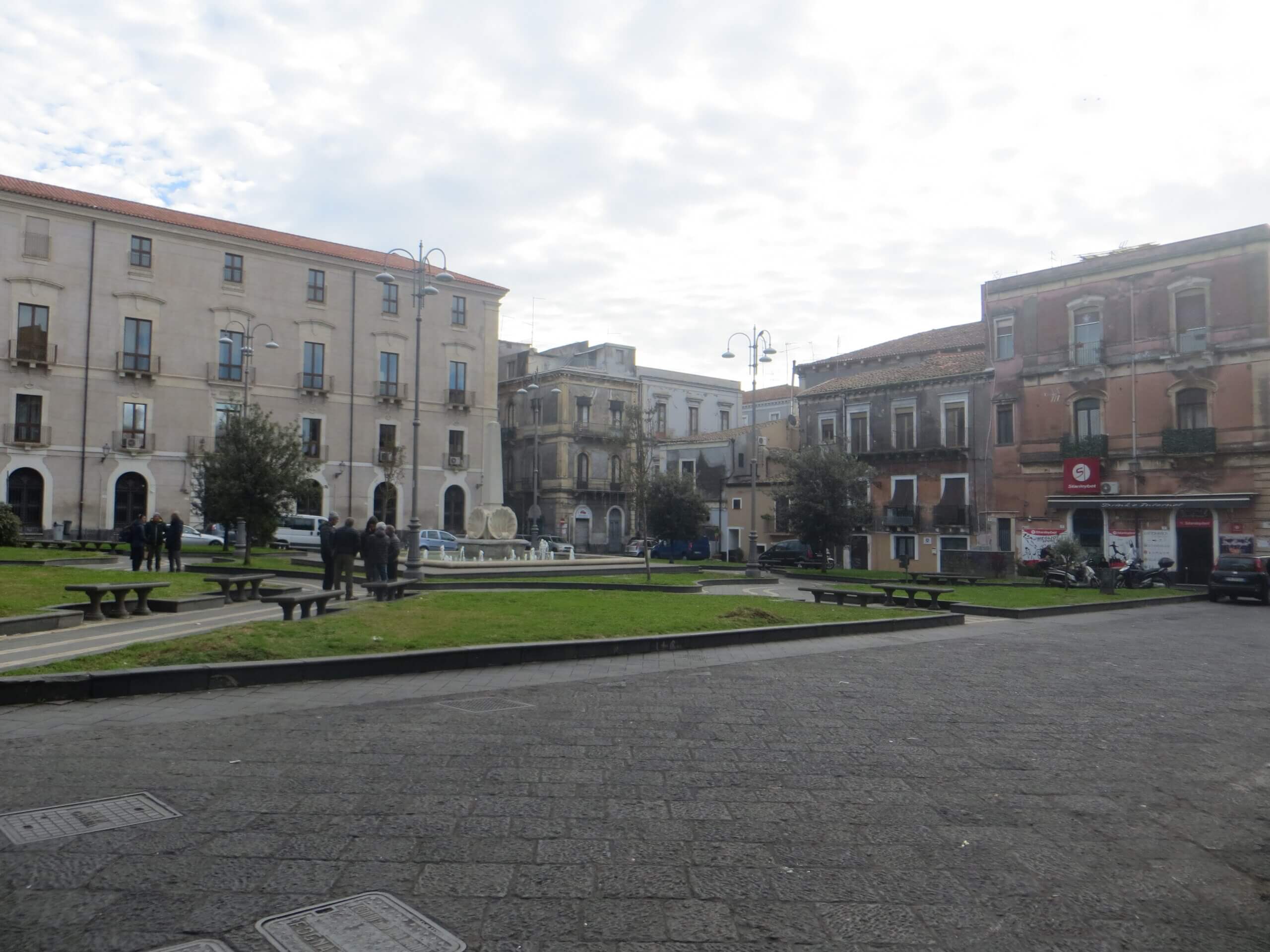
Farther east, Piazza Cutelli offered a more open pause around the Fontana delle Conchiglie. Its obelisk-like centre and shell decorations belong to a mid-twentieth-century fountain, a small change of period after so much Baroque stonework. Nearby, the former Teatro Nazionale found a new purpose as the Mosque of Mercy. Within a short walk, the city’s changing religious and social life had acquired a very different architectural example.
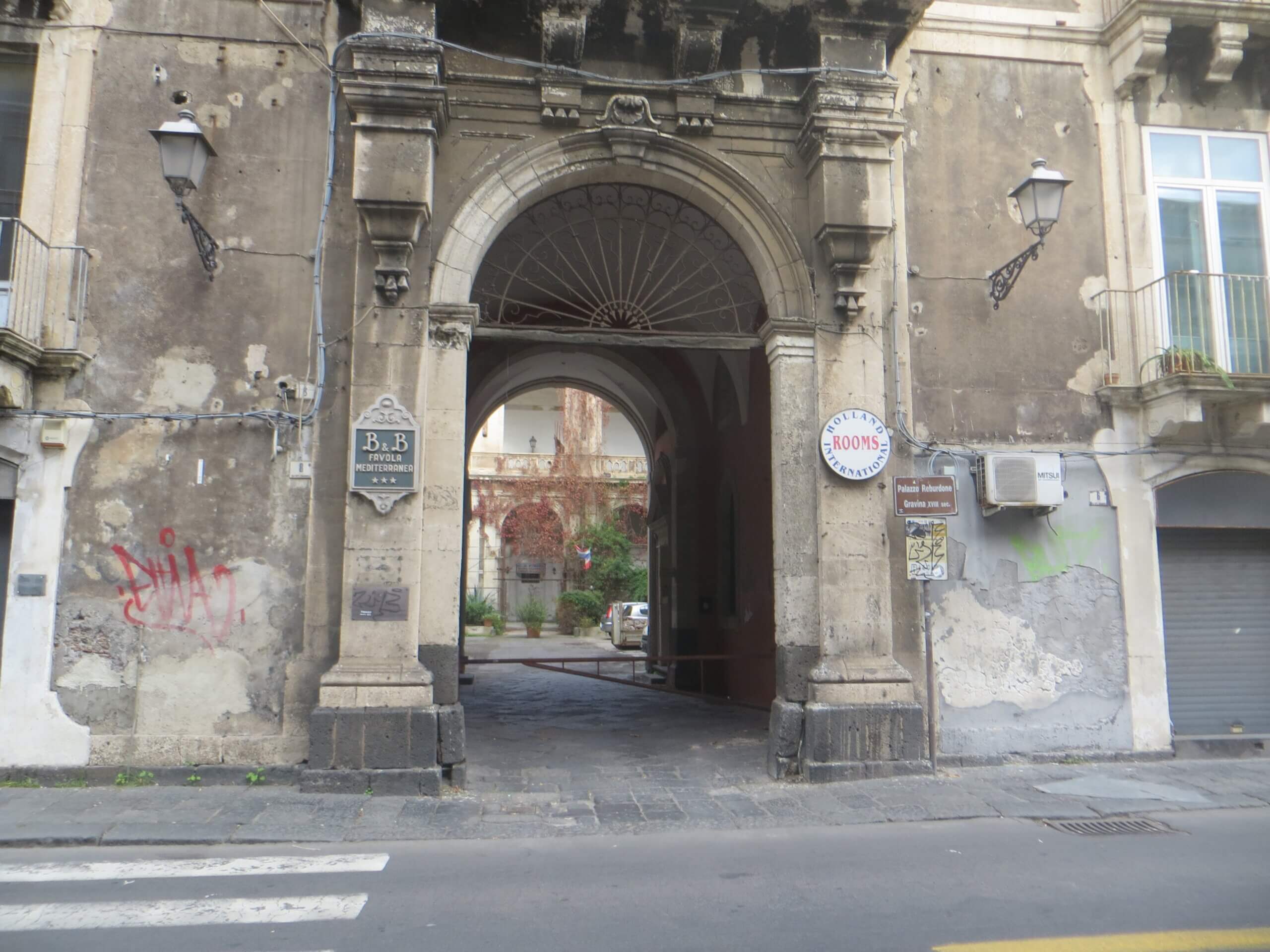
The university appears here again in Palazzo Pedagaggi and Palazzo Reburdone, two residences associated with the Guttadauro family. Reburdone, begun in the later eighteenth century, was intended to express the family’s rising wealth and status, and to accommodate the households of two sons. The family arrangement proved less durable than the palace. Following a dispute, the younger brother, the Baron of Pedagaggi, commissioned a separate residence nearby rather than occupy his intended share.
There is something satisfyingly human about encountering a family disagreement on this scale. Most people would have to settle for refusing an invitation; here, the result was another palace. Both buildings later acquired university functions associated with political and social sciences.
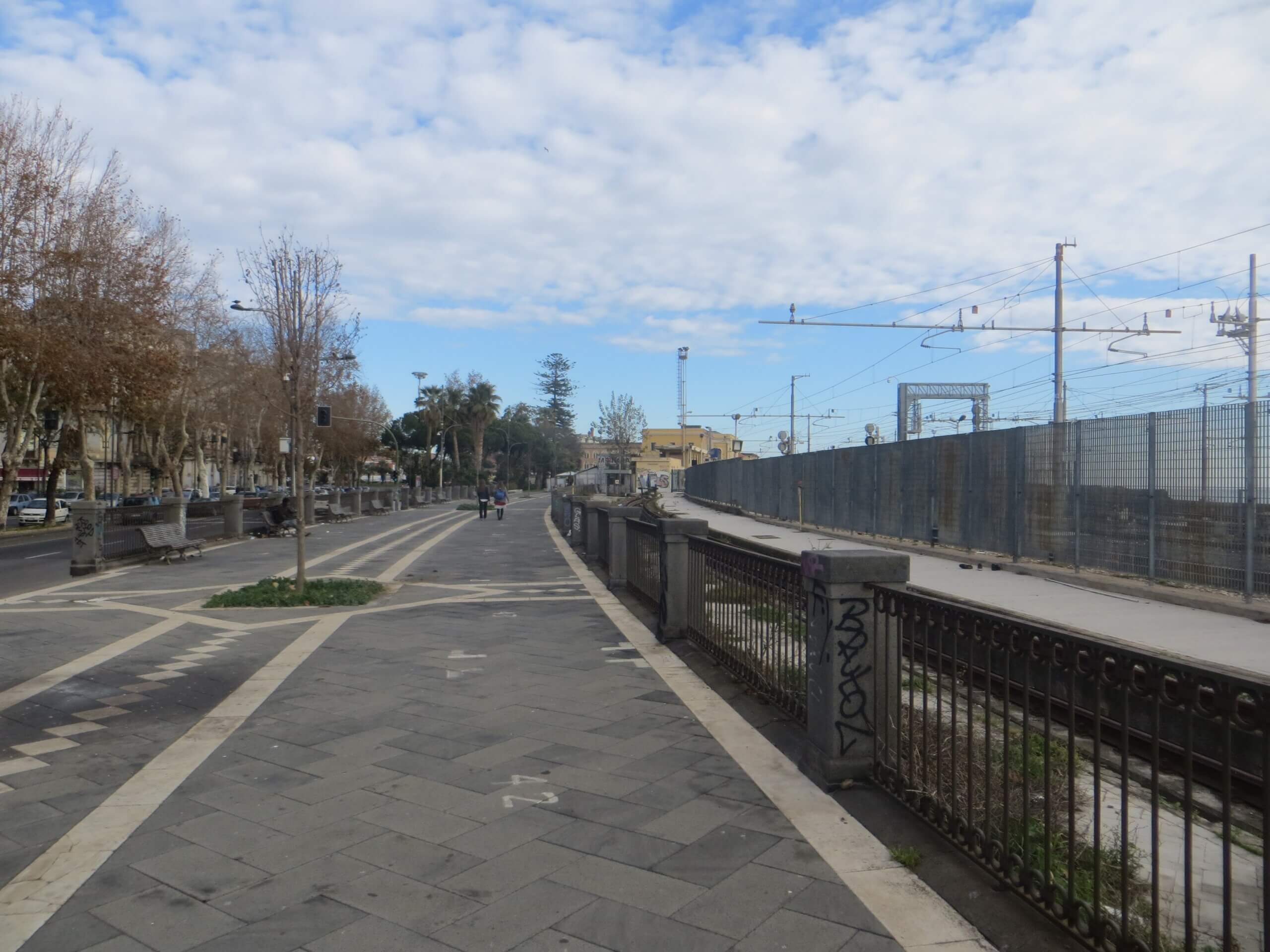
At Piazza dei Martiri I finally left the sequence of churches and palaces for the approach along Passeggiata alla Marina. The railway guided the last part of the walk to Catania Centrale, where I caught the train to Syracuse. That visit belongs to a separate story; Catania would resume when I returned later in the afternoon.
An evening with Norma
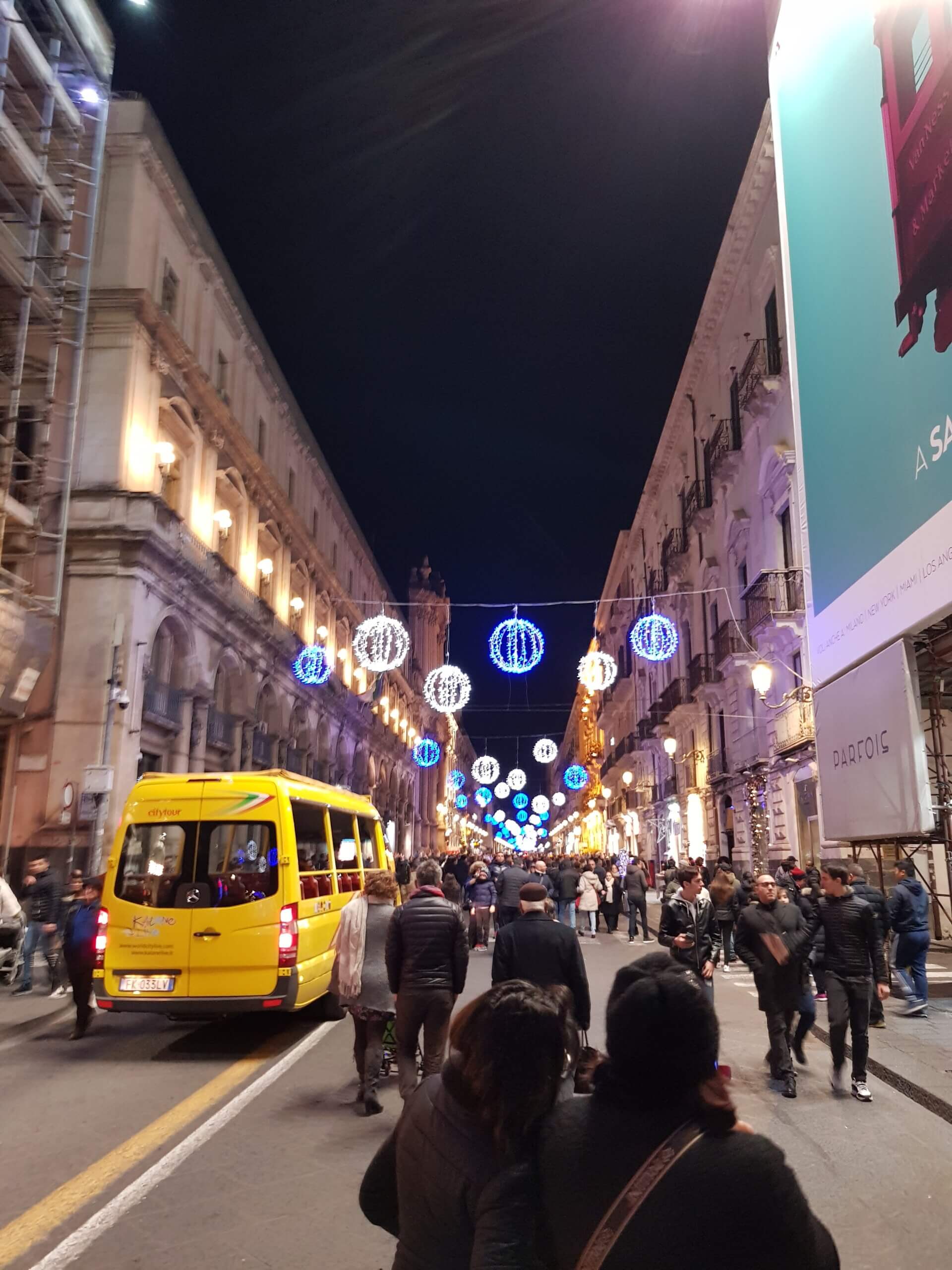
I was back around five, with an hour to reach the pickup point for the hotel’s six o’clock minibus. Via Antonino di Sangiuliano provided the most direct route, and this time I gave practical considerations their due. Compared with the streets of the morning, it did little to tempt me into further exploration, although Via Etnea after dark provided a final change of scene before the ride back.
By about 6.30 I was in the hotel and ready to exchange sightseeing for hot water. I had expected more from the wellness centre: the space was cramped, and it was difficult to achieve quite the level of relaxation I had imagined. Even so, after walking in both Catania and Syracuse, I was happy to spend an hour between the jacuzzi and saunas. My legs were evidently less demanding than I was.
Dinner brought another plate of pasta alla Norma. Aubergine and tomato were doing most of the work that mattered to me, with the classic combination of basil and salted ricotta completing a dish whose reputation seemed entirely justified. I had eaten it before and saw no reason to complicate the decision by ordering something else. Bellini’s city could celebrate its composer in marble all day; I was very happy with this particular form of tribute.
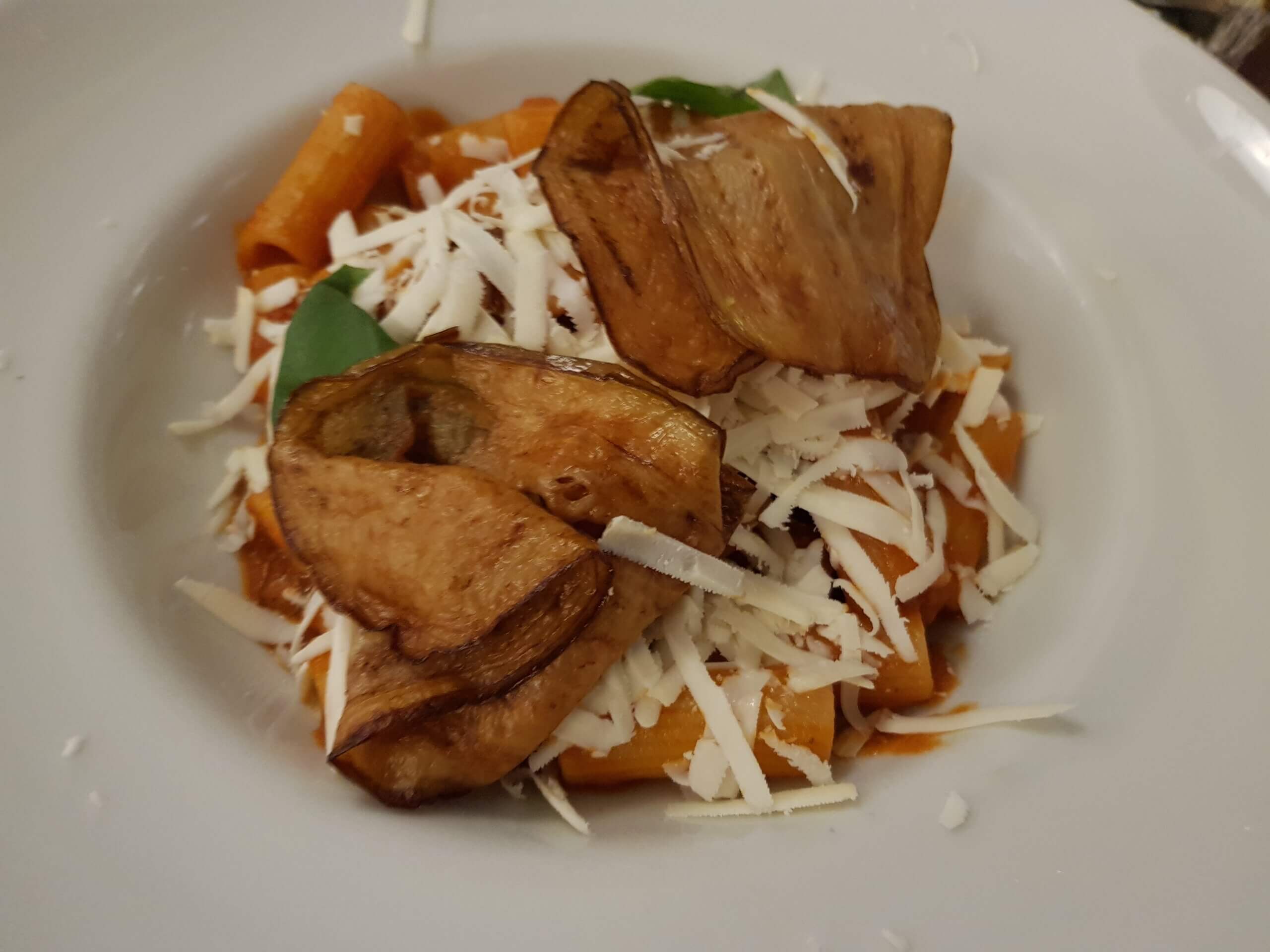
According to a local story, the name comes from the Catanese playwright Nino Martoglio, who praised the dish as “a real Norma”, comparing it with Bellini’s opera.
Etna and Taormina were on the following day’s programme, and I went to bed soon afterwards, with another early departure already arranged. My second morning in Catania would come after that excursion.
An opera house before the train
I was at breakfast shortly before seven. The buffet was still being set out, but the important Sicilian contributions had already arrived: cannoli and brioche with granita, which, with coffee, were enough to get me moving. My train was due in about forty-five minutes, and Cannizzaro station was roughly twenty minutes away on foot. Breakfast therefore required a degree of purpose.
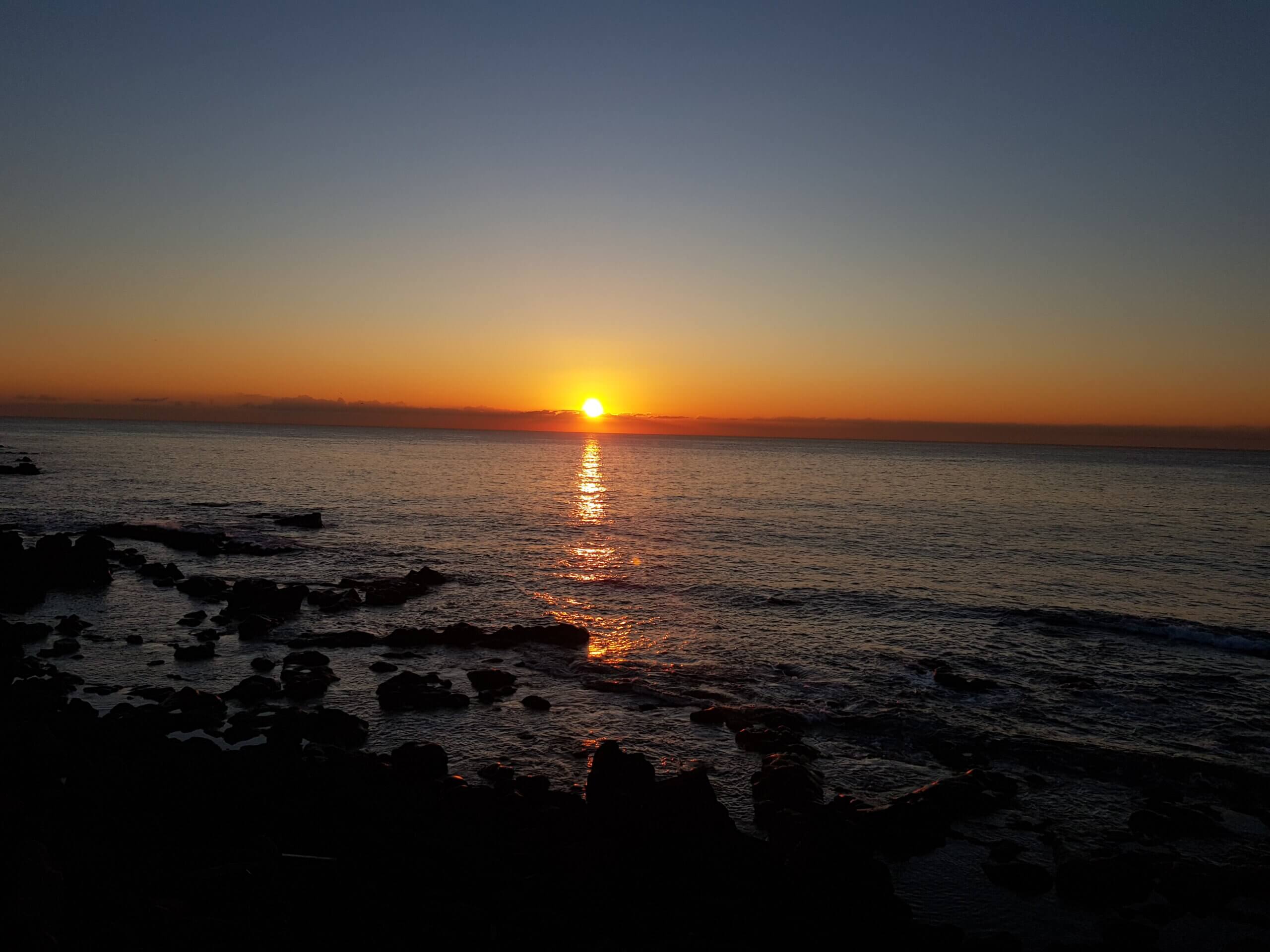
Outside, the light was only beginning to change, and I caught a lovely sunrise near the hotel. I would have liked to stay with it a little longer, but the railway had not been consulted about the photographic possibilities. I reached Cannizzaro in time, the train ran to schedule, and by eight I was back at Catania Centrale.
The day’s main attraction, for me, was the Circumetnea, the narrow-gauge railway running around the lower slopes of Etna. At the time, its Catania departure was from Borgo, near the upper part of Via Etnea, and I had about ninety minutes to get there. I decided that this was enough for two unfinished pieces of the city: the opera house and the fish market. Looking back at the map, I can see that I was maintaining a generous view of what ninety minutes ought to contain.
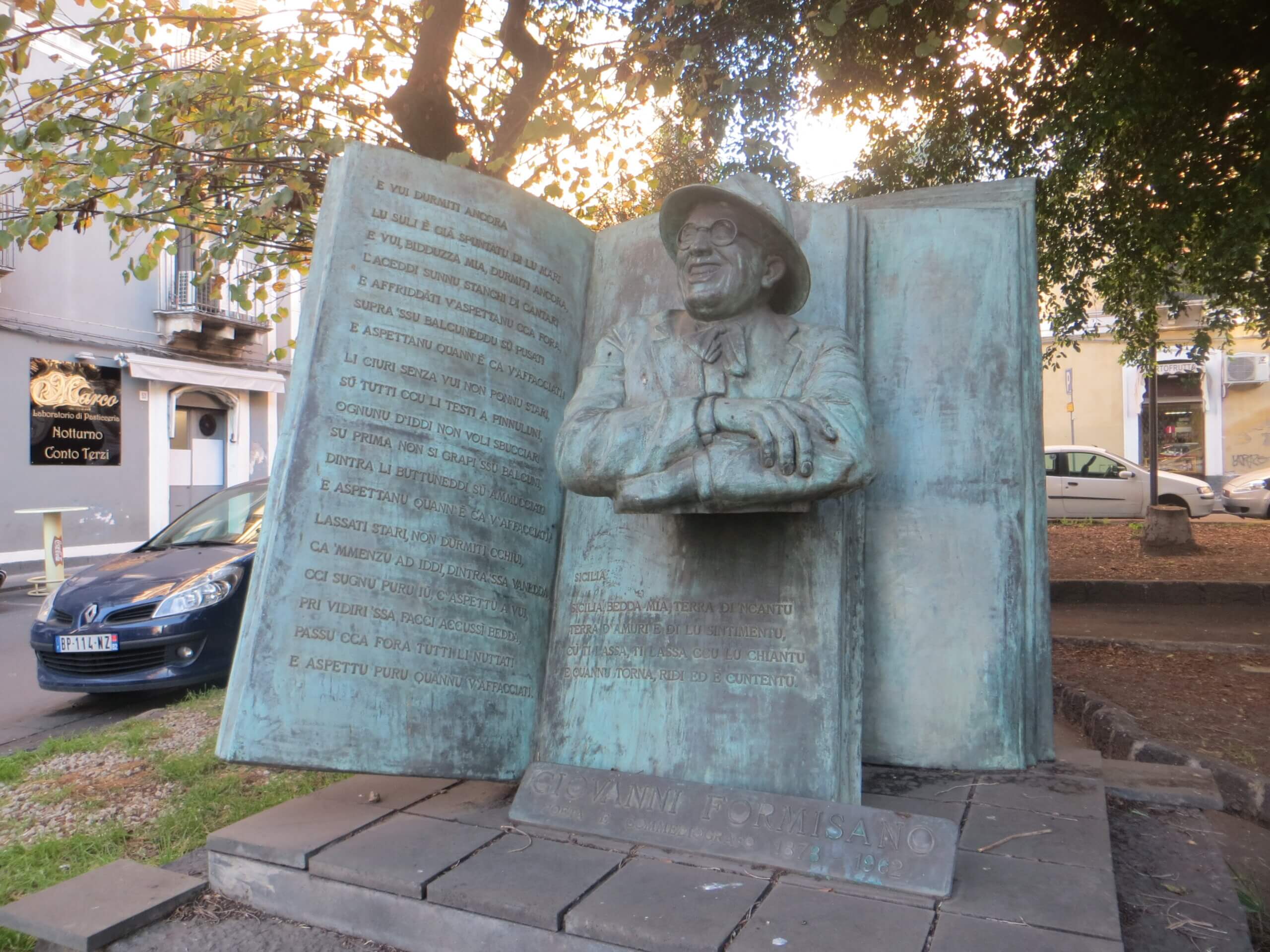
I followed the familiar Via Antonino di Sangiuliano and turned towards the theatre along Via Michele Rapisardi. On the way, at the junction with Via Monsignor Ventimiglia, I came across the statue of the poet Giovanni Formisano. It was one of those smaller encounters that make a walk feel less mechanical, even when the route is dictated by a departure time.
Teatro Massimo Bellini occupies the square named after the composer. Its façade belongs to the nineteenth century but takes its cues from the older buildings around it, so the theatre feels settled into the city rather than imposed on it. After so many references to Bellini during my first morning in Catania, reaching the opera house felt like arriving at the place where all that commemoration might finally become music.
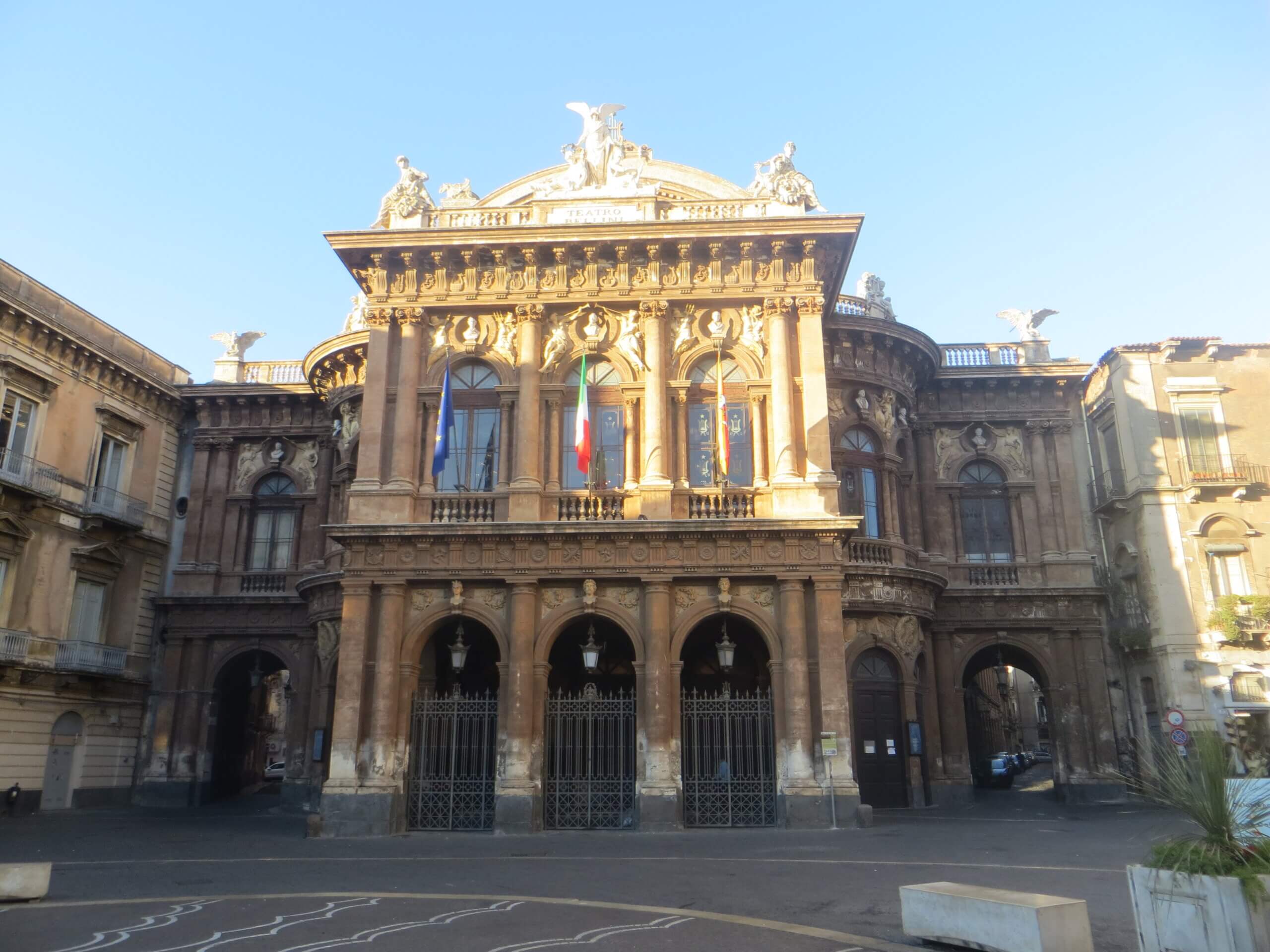
Construction took shape in the later nineteenth century, with the building completed in 1887 and formally inaugurated on 31 May 1890. The opening opera was, appropriately, Norma. The name Massimo indicates the theatre’s status as the city’s principal theatre; it is not a second person being commemorated alongside Bellini.
I did not manage to see the auditorium. The descriptions of its decoration and acoustics made me want to return for an actual performance, which would have been much more satisfying than admiring the exterior and moving on.
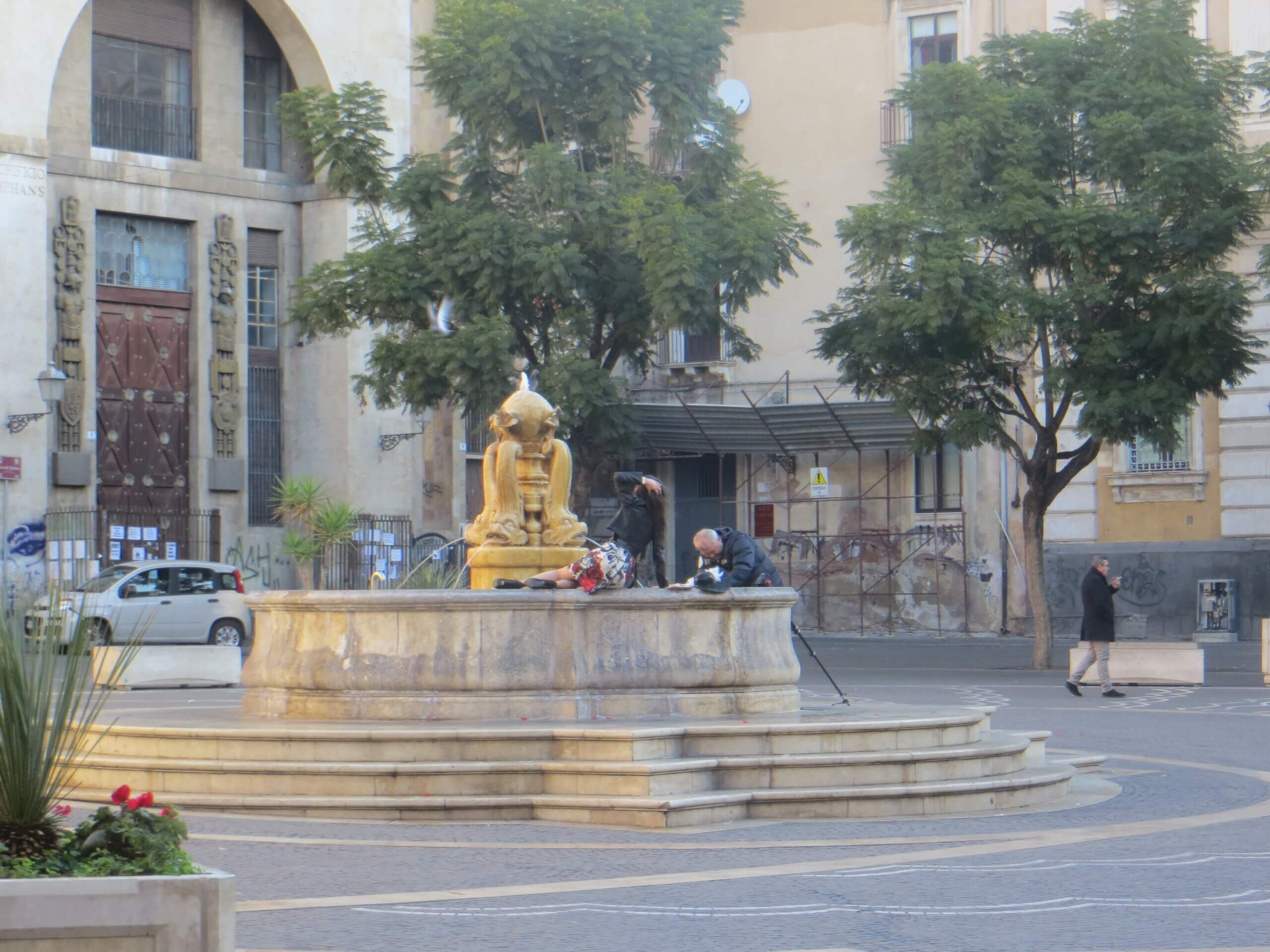
The surrounding piazza deserves attention in its own right. At its centre, the Fontana dei Delfini contributes a smaller eighteenth-century element, associated with Vaccarini and moved here from the convent of the Badia di Sant’Agata. Dolphins decorate the pale stone fountain.
La Pescheria, without ordering the fish
From the theatre, I walked along Via Leonardi and Via Vittorio Emanuele II to Piazza del Duomo. The Amenano Fountain was now a familiar landmark, and the steps beside it led me down to the place I had saved for this morning. After the controlled proportions of the opera house, La Pescheria introduced a much less orderly use of public space.
I do not like eating fish. That did absolutely nothing to diminish my enjoyment of Catania’s old fish market, known locally as the Piscarìa. The variety alone was enough to hold me: fish and shellfish in shapes and colours I could appreciate perfectly well without wanting any of them for lunch. There was more to look at than I could take in at a glance, and the activity around the stalls kept changing the scene.
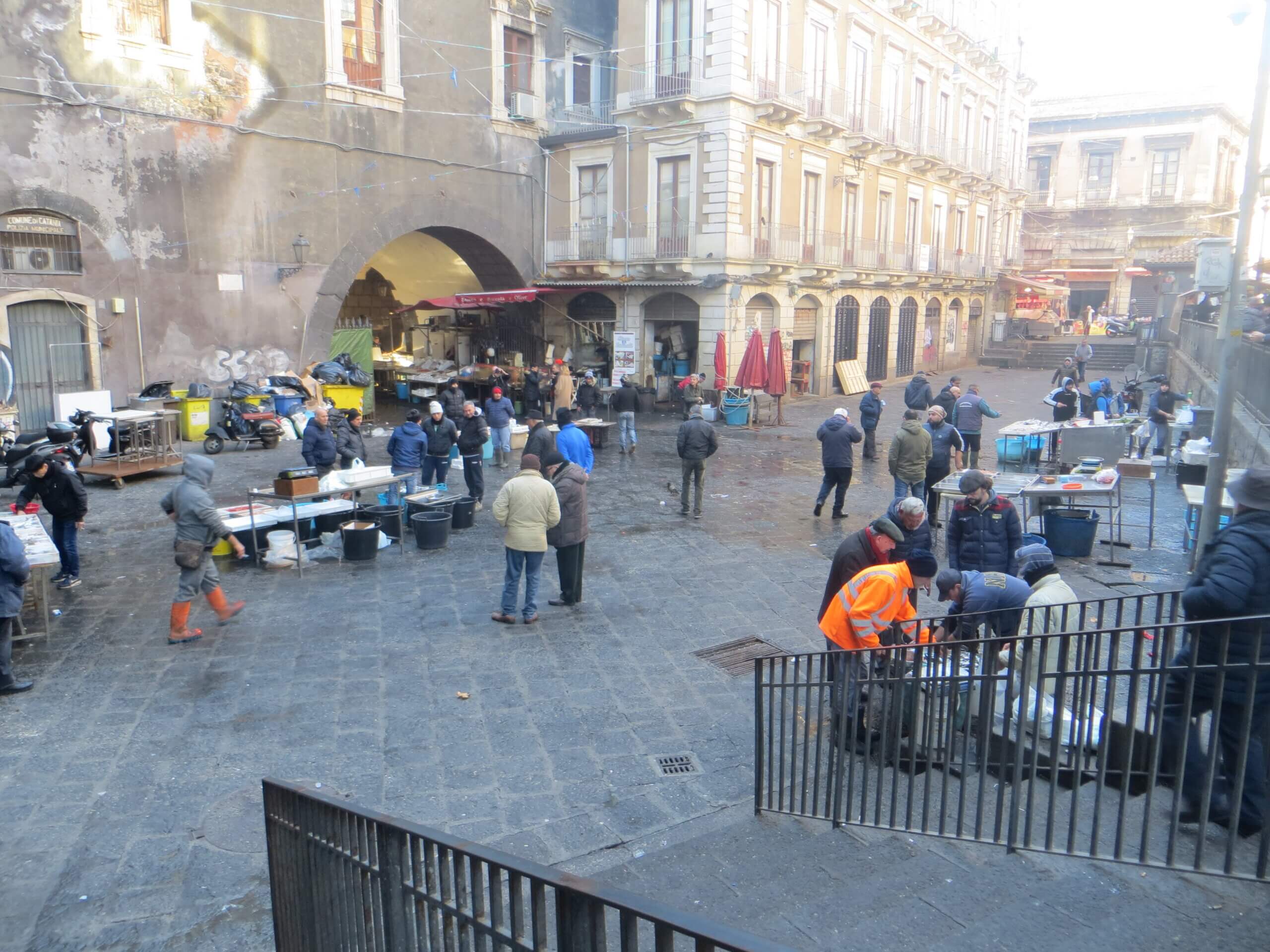
Customers negotiated over their purchases while traders advertised them at full volume. Conversations overlapped as people moved between the stalls. To me, it looked wonderfully chaotic. To the people doing their shopping, it was evidently a perfectly manageable way of buying lunch. I enjoyed watching that exchange as much as the displays themselves. Here was the everyday Catania I had sensed behind the façades, suddenly occupying the foreground.
The smell was unmistakably fish, but I did not find it unpleasant. The more immediate concern was underfoot, where attention to the displays could easily be rewarded with a step into fish entrails. Looking up had been good advice among the palaces; here, a periodic inspection of the pavement was the better approach. My enthusiasm for the market did not extend to taking part of it back on my shoes.
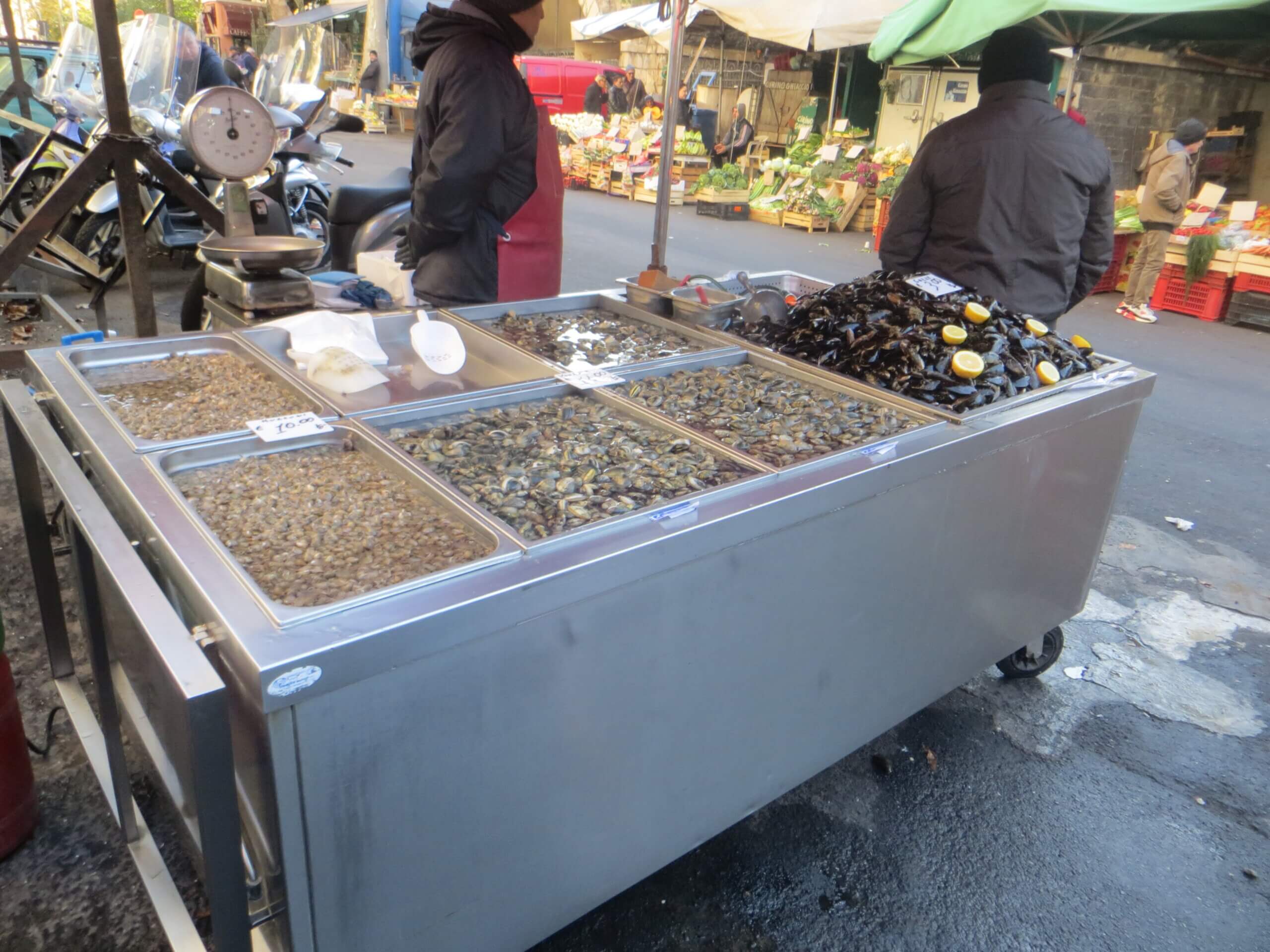
There were fruit and vegetable stalls too, along with fish-based street food. I was content to watch, absorbed by a place where shopping still involved voices, faces and a good deal of negotiation.
It gave me that slightly nostalgic feeling of being somewhere the business of choosing lunch could occupy the whole morning. I liked the apparent ease of it, the time devoted to ordinary exchanges, the pleasure people seemed to take in participating. For a while, even my own departure time became a less interesting subject. Of everything I saw in Catania, this was one of the places I most wanted to spend longer in.
Back up Via Etnea
Eventually I climbed back to Piazza del Duomo and began the walk north along Via Etnea towards Borgo. The square, the university, Bellini’s monument and the garden I had already promised to revisit were becoming familiar. It was a pleasant change to walk through a part of the city I could already recognise, even if I was once again keeping an eye on the time.
Farther up Via Etnea, I found one last temptation. The university’s botanical garden, founded in 1858, still preserves its nineteenth-century layout, divided between the Hortus Universalis, with plants from around the world, and the Hortus Siculus, devoted to Sicily’s native flora. The tropical greenhouse, extensive succulent collection and varied palms offered a very different kind of looking from the morning’s churches and market stalls.
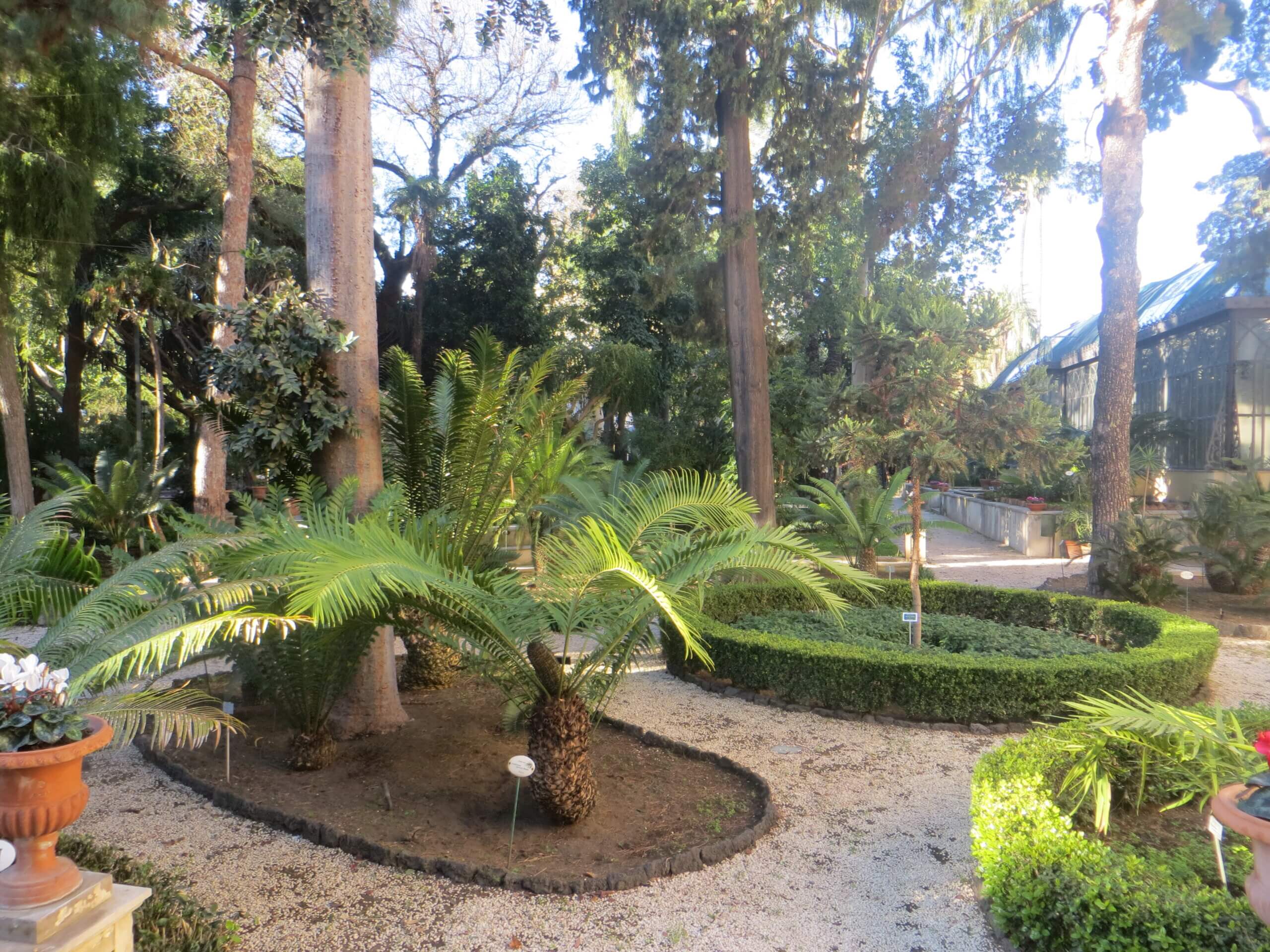
I could spare it only a few quick looks. The railway was waiting, and the next part of the journey would take me through the landscapes on Etna’s slopes, towards the source of so much of the dark material I had spent my two mornings in Catania admiring.
The Catania I was leaving had become much more distinct than the grey city of my first impression. I could now place its palaces along particular streets, recognise the connections between its churches and follow Bellini from a monument to his birthplace, his tomb and the theatre. So far, my most complete encounter with Norma had involved aubergine. I was very pleased with that part of the visit, but I still wanted the music.
Catania on foot – following this walk yourself
My route was divided by trips elsewhere in Sicily, and the times above describe that particular visit. I would allow at least a full day in Catania, with separate days for Syracuse and the Etna area. Several museum visits and church interiors could comfortably extend the city programme into a second day.
| Part of the walk | Route | Where to allow extra time |
|---|---|---|
| Via Etnea and the main squares | Villa Bellini, Piazza Stesicoro, Minoriti, Quattro Canti, Collegiata, Piazza Università, Piazza del Duomo | The park, amphitheatre and cathedral. |
| The western loop | Via Garibaldi, Via Pardo, Piazza Mazzini, Piazza San Francesco d’Assisi, Via Crociferi, Villa Cerami | Bellini’s museum, the Roman Theatre detour and the religious sites along Via Crociferi. Return south along Crociferi afterwards. |
| Towards the station | Via Vittorio Emanuele II, Badia di Sant’Agata, San Placido, Piazza Cutelli, Palazzo Reburdone, Piazza dei Martiri, Catania Centrale | This is the continuation I used to catch my Syracuse train. Leave it out if you are keeping the day within the central sightseeing area. |
| My second morning | Catania Centrale, Via Antonino di Sangiuliano, Teatro Massimo Bellini, Piazza del Duomo, La Pescheria, Via Etnea, botanical garden, Borgo area | Give the market a morning slot. The uphill return towards the botanical garden and Borgo is optional if you want a shorter walk. |
If you combine the two mornings into one day, move La Pescheria towards the beginning and fit the opera house into the nearby eastern part of the route. Check access for the Bellini Museum, Teatro Massimo Bellini, San Benedetto and the Roman Theatre when planning your day. Several palaces still serve as offices or residences, so an interesting exterior does not automatically mean there is an interior open to visitors.
One part of my journey can no longer be copied directly. Narrow-gauge services between Catania Borgo and Paternò ended in June 2024, so walking to Borgo will not reproduce my departure around Etna. For that excursion, use the current Circumetnea railway timetable and connecting services rather than my historical itinerary; the closure of the original section changed the starting arrangements.
The city walk itself remains a useful introduction, especially with enough time to follow an open door when you find one.